Treadmill vs. Outdoor Road Running: Biomechanical Differences Between the Two Training Environments and Selection Strategies for Taiwanese Runners
Introduction
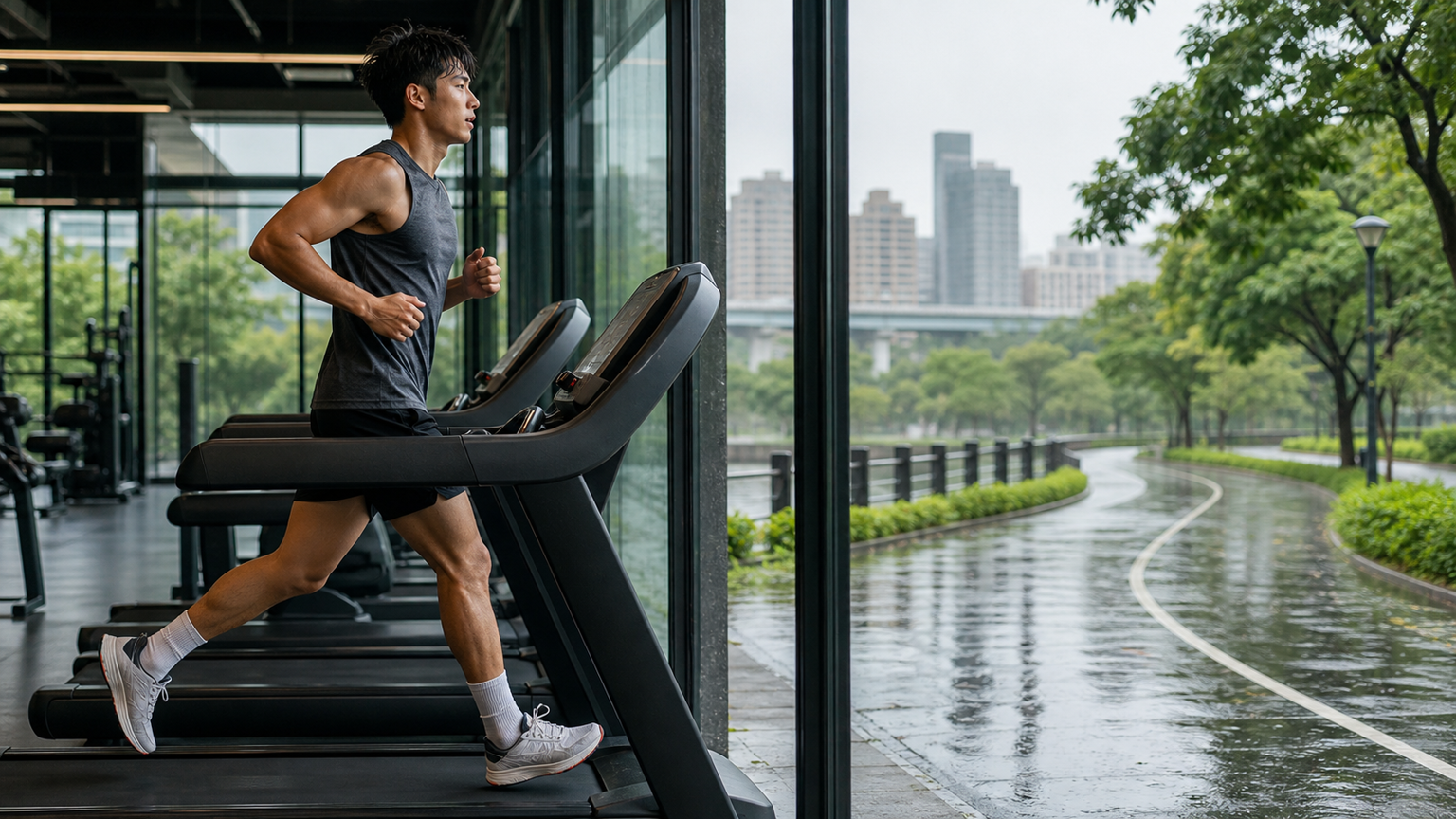
Taiwan’s climate characteristics—summer heat, persistent drizzle during the plum rain season, and occasional air quality alerts—have given treadmill training a considerable market here. Many runners hold gym memberships, yet remain skeptical about “whether treadmill training is actually effective.” On the other hand, some runners insist that “real running can only be done outdoors,” viewing the treadmill as the lazy option. The truth lies in between: both training environments have their advantages, and the key is how to use them well.
Core Biomechanical Differences
The most fundamental difference between treadmill and outdoor running lies in the direction of ground movement:
- Outdoor running: The runner actively propels forward, with the rearward push from the legs directly translating into forward speed
- Treadmill: The belt moves backward, and the runner only needs to lift and land the feet to “avoid being carried away,” resulting in relatively lower rearward push demands
This difference leads to the following biomechanical changes:
| Item | Treadmill | Outdoor Running |
|---|---|---|
| Gluteus maximus activation | Lower | Higher |
| Cadence | Similar | Similar |
| Stride length | Slightly shorter | Slightly longer |
| Achilles tendon load | Slightly lower | Slightly higher |
| Balance challenge | Low (fixed-width belt) | High (uneven surfaces, turns) |
| Heat stress | Low (indoor air conditioning) | High (Taiwan summer) |
Research shows that to make the physiological stimulus of treadmill running closer to outdoor running, a 1–2% incline is recommended to compensate for the lack of air resistance.
The Value of Treadmills Under Taiwan’s Unique Climate
Several typical scenarios in Taiwan are particularly well-suited for treadmill training:
Summer heat period (June–September)
- Midday temperatures in Taiwan often exceed 35°C, and high-intensity outdoor training carries a risk of heatstroke
- Treadmills combined with air conditioning make high-intensity interval training (Tempo, VO2max) safer
- Note: Treadmills omit heat stress training, so climate adaptation before winter marathons still requires supplemental outdoor training
Plum rain season (May–June)
- Prolonged overcast and rainy weather makes outdoor surfaces slippery, increasing injury risk
- Treadmills provide a stable training environment, keeping monthly mileage accumulation uninterrupted
Red alert air quality days
- Winter air pollution is more severe in central and southern Taiwan; when PM2.5 exceeds safe levels, treadmill training is the best alternative
Best Application Scenarios for Treadmill Training
- Speed training: Precisely set pace for lactate threshold runs (Tempo Run) without worrying about red lights or sidewalks
- Hill training: Set a 4–8% incline to simulate climbing, strengthening the quadriceps and glutes
- Recovery runs: Set low intensity and a fixed pace, allowing runners to focus on breathing and form
- Post-injury rehabilitation: The treadmill’s even, flat surface is more forgiving for runners in the recovery phase
Main Limitations of Treadmills
- Insufficient neuromuscular adaptation: The lack of irregular stimuli from outdoor surfaces means inadequate training for the stabilizing muscles around the ankle joint, and long-term use may lead to proprioception decline
- Psychological adaptation differences: Some runners report during outdoor races that “their legs are used to a constant speed and are not accustomed to pace changes”
- Uphill/downhill training limitations: Most treadmills can only simulate uphill running; the eccentric training of the quadriceps from downhill running cannot be performed on a treadmill
Basic Considerations When Buying a Treadmill
If considering a home treadmill:
- Belt width: At least 50 cm, so your stride is not restricted
- Maximum speed: At least 16 km/h, to handle interval training demands
- Incline range: A range of -3% (downhill) to 12% (steep uphill) is ideal
- Cushioning system: Good cushioning design reduces joint impact, making longer sessions more comfortable
- Price range: Home treadmills on the Taiwanese market typically cost NT$15,000–50,000, while commercial gym-grade models are higher
Practical Recommendations
The best strategy is to “let the two environments complement each other”:
- High-intensity interval training (summer): Treadmill (air-conditioned environment, precise pace control)
- Base aerobic long runs: Outdoors (contact with real surfaces, strengthening neuromuscular adaptation)
- Technical training: Outdoors (practicing downhill running form and gait adjustments on uneven terrain)
- Bad weather days: Treadmill substitute, ensuring monthly mileage is not interrupted
Conclusion
The treadmill is not an inferior substitute for outdoor running, but a complementary tool for different training goals. By leveraging the advantages of both environments, Taiwanese runners can maintain training quality through the sweltering summer and face the challenges of the autumn and winter race season with a more complete training foundation.
Related Reading
- Muscle Strength Differences Between Treadmill and Outdoor Running: The Actual Impact of Incline Settings and Wind Resistance
- Treadmill vs. Outdoor Running: A Scientific Comparison and Optimal Training Combination Strategies
- Road vs. Trail vs. Treadmill: Training Differences and Recommendations Across Three Running Environments
- The Science of Treadmills: Speed Calibration for Treadmill Training and a Guide to Transitioning Outdoors
元宇宙運動 ! RouvyAR 虛擬實境約騎! 台灣路段開箱 帶你日月潭環潭一圈 | 團騎競賽參加教學 | 常見小問題整理 三人共享一年不用一千 | 公路車 | 訓練台 | CTYeh
5 年前
單車 一日北高 ( 雙城 ) 肥宅雙人瘋狂行 紀錄片 REACTO
10 年前
風櫃嘴! 現實與虛擬騎乘 會有誤差嗎? 背著iPad邊騎一趟風櫃嘴實際測試一次 | 公路車 | CT Yeh
3 年前
Rouvy 元宇宙運動世界! 用VR 騎遍全台灣單車路線 武嶺 中社路 風櫃嘴
5 年前
#公路車 #Fitting 靠人工智慧APP 幫你調整單車
6 年前
實景訓練台) 彰化經典百K 高強度喵團 90分鐘 跟著一起練功 2019 Indoor workout Changhua Classic 100 Taiwan
7 年前
單車 梅山36灣 坡度介紹 路段介紹 空拍 (相關遊記影片,請參考說明或我的頻道喔,歡迎訂閱)
6 年前
Zwift 元宇宙單車世界 如何與全世界同步騎車運動
6 年前