The Lifespan of Carbon Fiber Components: When Should You Retire Your Carbon Frame?
Introduction: Is Carbon Fiber Forever?
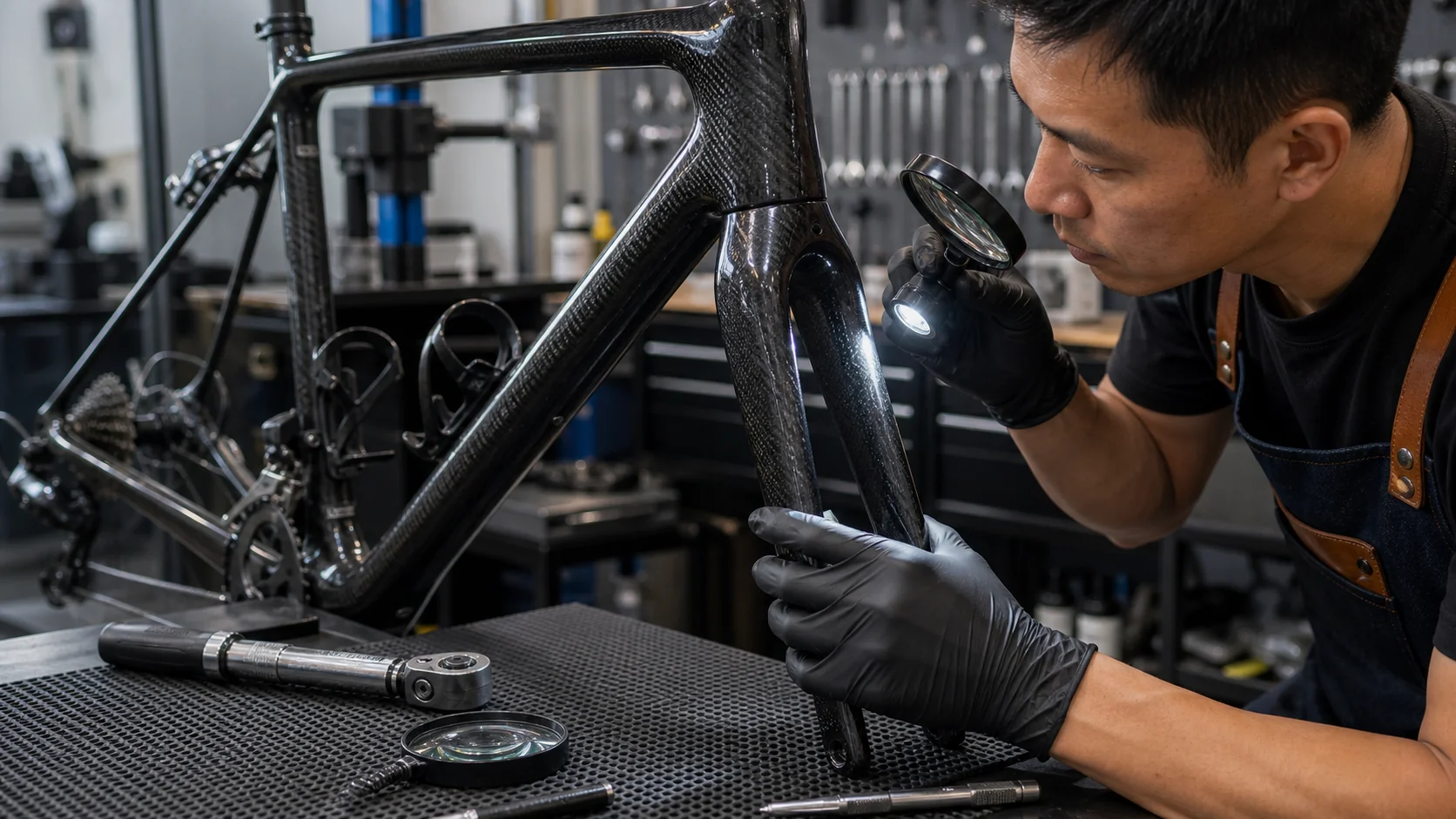
When you spent a small fortune on a carbon fiber frame, the shop clerk probably told you “carbon fiber doesn’t rust, doesn’t fatigue, and in theory can last a lifetime.” But five years later, your frame has picked up a few scars, been crashed twice, and once got roughly handled by an airport baggage belt. Now you’re wondering — is this frame still safe?
Carbon fiber really is an excellent material, but it isn’t indestructible. Let’s talk about the lifespan of carbon fiber components, and when it’s time to seriously consider retiring one.
Material Properties of Carbon Fiber
What Is Carbon Fiber?
Carbon fiber reinforced polymer (CFRP) is a composite made of carbon fiber tows and epoxy resin:
- Carbon fiber: provides strength and stiffness
- Epoxy resin: bonds the fibers together, providing shape and impact resistance
- Layup design: layers of carbon fiber at different angles stacked to provide multi-directional strength
How Carbon Fiber Ages Differently Than Metal
| Property | Carbon Fiber | Aluminum Alloy | Steel |
|---|---|---|---|
| Corrosion | None | Oxidizes | Rusts |
| Metal fatigue | None (not a metal) | Yes | Theoretically has a fatigue limit |
| UV degradation | Epoxy resin does degrade | No | No |
| Impact damage | May fracture internally | Dents and deforms | Dents and deforms |
| Visibility of damage | Low (may be hidden) | High (visible) | High (visible) |
Carbon Fiber’s Failure Mode
The biggest difference between carbon fiber and metal is this: metal deforms before it breaks; carbon fiber can break outright.
This means:
- When a metal part fails, you can usually see it (bending, cracking)
- A carbon fiber part can look fine on the outside while already damaged inside
- Carbon fiber failure is sudden and catastrophic
Factors That Affect Carbon Fiber Lifespan
1. Impact Damage
This is carbon fiber’s biggest enemy. Impacts can cause:
- Surface damage: visible scratches and cracks
- Matrix cracking: cracks within the epoxy resin
- Delamination: bonding failure between carbon fiber layers
- Fiber breakage: broken carbon fiber tows
Common sources of impact:
- Crashes
- Bike falling over
- Transport collisions
- Falling rocks or debris
- The frame being crushed (e.g., another bike falling on it while parked)
2. Ultraviolet Light
Prolonged sun exposure gradually degrades epoxy resin:
- The surface yellows or discolors
- The resin becomes brittle
- The protective clear coat peels
Note for Taiwan riders: UV exposure in Taiwan is intense — don’t leave your bike outdoors for extended periods. Indoor storage is your best option.
3. Over-tightening
Carbon fiber components are extremely sensitive to concentrated clamping force:
- Stem bolts over-tightened → carbon handlebar or steerer cracks
- Seatpost clamp over-tightened → carbon seatpost cracks
- Bottle cage bolts over-tightened → frame surface crushed
Essential tool: a torque wrench. Carbon fiber components should never be tightened by feel.
4. Chemical Exposure
Certain substances can damage epoxy resin:
- Strong acidic or alkaline cleaners
- Some organic solvents
- Prolonged sweat exposure (especially on the top of the steerer/stem area)
- Electrolyte leakage (from a leaking battery)
5. Sustained Stress
Although carbon fiber doesn’t suffer from metal fatigue, sustained high stress can gradually weaken the structure:
- Frequent hard out-of-the-saddle sprints
- Touring with loads exceeding the frame’s weight limit
- Long-term use on indoor trainers (especially traditional clamp-style trainers)
How to Inspect Carbon Fiber for Damage
Visual Inspection
Perform a full visual inspection regularly (monthly or every 1,000 km):
-
Key areas to check:
- Head tube to down tube junction
- Around the bottom bracket shell
- Near the rear dropouts
- Seatpost clamp area
- Top tube near the head tube
-
Signs to look for:
- Cracks (even hairline ones)
- Discoloration or whitening (blanching)
- Surface bubbling or bulging
- Shadows beneath the paint
- Areas that feel soft to the touch
Tap Test
Lightly tap the frame surface with a coin or your knuckle:
- Healthy carbon fiber: a crisp, high-pitched “tap tap” sound
- Damaged carbon fiber: a dull, hollow “thud thud” sound
Compare the sound across different areas of the frame — if one area sounds noticeably different, there may be internal damage.
Note: The tap test can only catch fairly significant damage; small internal cracks may not be detectable this way.
Professional Inspection
If you suspect there’s a problem with your frame, seek a professional inspection:
| Inspection Method | Principle | Cost | Accuracy |
|---|---|---|---|
| Ultrasonic testing | Sound wave reflection detects internal flaws | NT$3,000-5,000 | ★★★★ |
| X-ray inspection | Radiographic imaging of internal structure | NT$5,000-10,000 | ★★★★★ |
| Visual + tap test | Experience-based judgment | NT$500-1,000 | ★★★ |
Few companies in Taiwan offer carbon fiber inspection services — ask your local bike shop whether they have a partner inspection facility.
Lifespan Guidelines for Different Carbon Components
Carbon Fiber Frame
| Condition | Recommendation |
|---|---|
| Normal use, no damage | Can last 10-15+ years |
| Minor surface scratches | Keep riding, monitor for changes |
| Cracks or whitening present | Stop riding, get it professionally inspected |
| History of a severe crash | Get it inspected even if it looks fine |
| Years on a traditional trainer | Pay special attention to the rear stays and BB area |
Carbon Fiber Fork
The fork is one of the most safety-critical components:
- Replace it if there’s any suspected damage
- Replace after a crash even if it looks undamaged
- Recommended service life is no more than 10 years
Carbon Fiber Handlebar
- Replace after a crash
- Must be replaced if cracked or showing whitening
- The stem clamping area is the key inspection point
Carbon Fiber Seatpost
- The seatpost clamp area is the key focus
- Watch closely for signs of over-tightening
- If there’s slippage, check whether it’s already crushed
Carbon Fiber Wheels
- Carbon rim brake surfaces have a limited service life
- Disc-brake carbon rims theoretically last longer
- Inspect carefully after hitting a pothole
Carbon Fiber Repair: Is It Worth It?
Carbon fiber frames can be repaired, and several specialist workshops offer carbon repair services:
Repair Process
- Damage assessment and quote
- Removal of the damaged carbon material
- Re-laying carbon fiber layers
- Pressure curing
- Sanding and repainting
- Testing and quality inspection
Cost Reference
| Damage Level | Repair Cost | Worth It? |
|---|---|---|
| Minor surface damage | NT$3,000-5,000 | Worth it |
| Moderate structural damage | NT$8,000-15,000 | Depends on frame value |
| Severe damage | NT$15,000-30,000 | May not be worth it versus buying new |
Carbon Frame Care Tips for Taiwan
- Store indoors: Taiwan’s sun is intense, and UV exposure is a slow killer for carbon fiber
- Use frame protection film: 3M protection film can prevent small rocks and chain slap from damaging the frame
- A torque wrench is essential: whether your carbon components live or die depends on your torque control
- Use carbon assembly paste: reduces the clamping torque needed
- Avoid leaning the bike against sharp objects: carbon fiber is vulnerable to concentrated point pressure
- Choose your trainer wisely: use a direct-drive trainer and avoid traditional rear-wheel clamp-style trainers
When Should You Retire It?
Seriously consider retiring your carbon frame if any of the following apply:
- Visible cracks confirmed as a structural issue by professional inspection
- A history of a severe crash with safety that can’t be confirmed
- Unexplained noise from the BB area after ruling out all other causes
- The frame is over 15 years old with heavy accumulated mileage
- Repair cost exceeds 50% of the frame’s value
Conclusion
Carbon fiber is a remarkable material, but it isn’t indestructible. With regular inspection, proper use, and appropriate protection, your carbon frame can stay with you for a very long time.
But when there’s doubt about safety, don’t hesitate — no frame is worth gambling your physical health over. It’s better to spend money on a new bike than to ride one that might snap on a high-speed descent.
Your life is worth more than your bike. Always remember that.
Related Reading
功率實測 Lun Hyper 2023 碳幅條輪組 D45 碟煞 | 公路車 | CT Yeh
3 年前
碟煞公路車 優缺點?換車一年半實際經驗分享 / 公路車 / CT Yeh
2 年前
換車囉! TIME ADH 2023 全內線碟煞公路車 開箱實錄!/ Dyneema 碳纖維真的太猛了 / 曜越單車 / CT Yeh
3 年前
再一組! 全碳幅條 碟煞/無內胎輪組 開箱! 到底好騎嗎? UNAAS X40 | 公路車 | CT Yeh
4 年前
鉅齒紋輪組!? ControlTech MEG-T50 EVO 碳纖維幅條輪組/ 功率對比實驗 / 公路車 / CT Yeh
2 年前
2025 自行車錶排行榜 兩萬車友大數據 / Garmin Bryton 排名會大洗牌嗎? / 全新的碼表前身分析 /公路車 / CT Yeh
1 年前
雷達尾燈 雷不雷? 邁金L508 智慧雷達尾燈 情境考驗實測 | 同場加映 2千元等級的專業車錶 C406 Pro | 公路車 | CT Yeh
3 年前
Nepest NOVA 碳條輪組:輕量、空力、舒適一次滿足!/ 公路車 / CT Yeh
7 個月前