Cold Water Baths and Recovery: When Post-Race Ice Baths Are Appropriate and the Risks of Overuse
Introduction
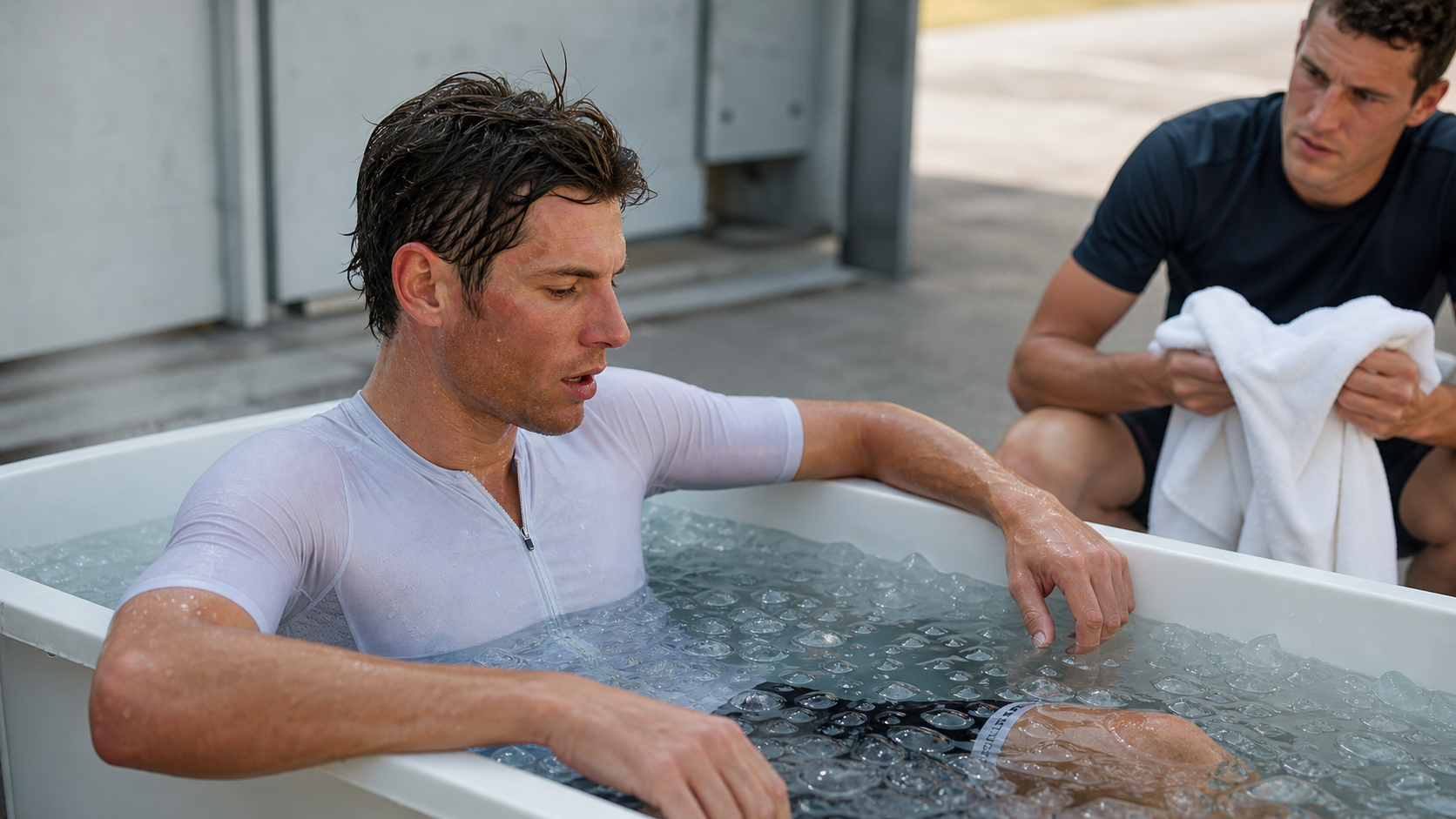
For cyclists who have watched the Tour de France or the Taiwan Cycling Festival, the image of riders soaking in ice-filled bathtubs after races is deeply etched into their minds—“If professional riders do it, it must work!” However, sports science research over the past decade on Cold Water Immersion (CWI) has revealed a more complex truth: Ice baths are a double-edged sword. Used at the right time, they are a powerful recovery tool; used at the wrong time, they may hinder your long-term progress.
The Physiological Mechanisms of Ice Baths
Vasoconstriction and Swelling Reduction
When cold water contacts the skin, peripheral blood vessels rapidly constrict (Vasoconstriction), reducing tissue leakage and local swelling. After leaving the cold water, blood vessels rebound and dilate (Rebound Vasodilation), flushing out metabolic waste, creating a “pump effect.”
Lowering Core and Muscle Temperature
After high-intensity riding, muscle temperature can reach as high as 39–40°C, and sustained heat can prolong the inflammatory response. Ice baths rapidly lower muscle temperature, theoretically slowing the spread of inflammatory mediators.
Analgesic Effects on the Nervous System
Cold stimulation activates temperature receptors in the skin, inhibiting pain signal transmission, making athletes feel that muscle soreness is reduced. This part is an improvement in subjective perception, not necessarily accelerated tissue repair—this point is crucial.
Situations Where Ice Baths Are Appropriate
| Situation | Ice Bath Benefit | Recommendation |
|---|---|---|
| Multi-day races or consecutive competitions (e.g., Taiwan Cycling Festival) | Rapid swelling reduction, maintaining next-day performance | Suitable, prioritize |
| Need to compete again within 24 hours after an important race | Accelerates perceived recovery, maintains competitive level | Suitable |
| After a single high-intensity training session | Short-term perceived improvement, long-term adaptation may be impaired | Use with caution |
| After base aerobic training | Limited benefit, suppresses adaptation signals | Not recommended |
The Risk of Overusing Ice Baths: Hindering Training Adaptation
This is the most important research finding in recent years. Since 2013, multiple studies (including Roberts et al., Journal of Physiology) have shown:
Ice baths suppress the signaling molecules of training adaptation.
Specifically:
- After high-intensity training, the mTOR pathway (protein synthesis signal) and PGC-1α (mitochondrial biogenesis signal) in muscles are activated—these are the key to training-induced supercompensation
- Ice baths “switch off” these signals through rapid cooling and inflammation suppression
- If you take an ice bath after every training session, you are essentially telling your body “no need to adapt that seriously” each time
Studies have found that subjects who took ice baths after every training session for 4–12 weeks showed significantly smaller gains in muscle strength and aerobic capacity compared to the control group.
Proper Ice Bath Protocol
If you decide to use ice baths, here are the best practices currently supported by research:
- Water temperature: 10–15°C (too cold, < 10°C, may trigger shivering and increase muscle tension)
- Duration: 10–15 minutes, not recommended to exceed 20 minutes
- Immersion depth: Below the waist (targeting the leg muscles primarily used in cycling)
- Frequency: Only during race periods or consecutive race stretches; routine use during regular training periods is not recommended
- Afterward: Allow the body to rewarm naturally after leaving the cold water; avoid immediately showering with hot water (it accelerates vasodilation and carries a risk of dizziness)
Alternative Hydrotherapy: The Contrast Bath Option
Another option is the contrast bath (alternating cold and hot), with some studies showing benefits comparable to pure ice baths, but with a more comfortable experience:
- Cold water (10–15°C): 1 minute
- Hot water (38–40°C): 1 minute
- Repeat for 4–5 cycles
- End with cold water
Practical Recommendations
- Distinguish between training and race periods: During training periods, replace ice baths with warm showers and foot soaks; use ice baths only during consecutive race periods
- Local Taiwan alternative: In summer, a near-room-temperature cold shower (25–28°C) also provides mild vasoconstriction benefits without the need to specially prepare ice
- Psychological benefits count too: If you genuinely feel especially relaxed after an ice bath, the “placebo effect” still has positive significance in recovery; the key is not to use it daily during the training adaptation phase
- Acute injury phase: For sprains or impact injuries, local ice application (rather than whole-body ice baths) remains the standard treatment, as the mechanism is different
Conclusion
Ice baths are not a magical tool where more is better, but a weapon that must be wielded at the right time. Use them during race periods for rapid recovery and maintaining consecutive-race performance; use them sparingly during training periods to let the body naturally activate adaptation signals. Understanding this distinction will bring your ice bath strategy closer to the mindset of professional riders, rather than merely mimicking surface-level behavior.
Related Reading
- Cold Therapy and Ice Baths: The Double-Edged Sword of Inflammation Suppression—Trade-offs and Timing Between Recovery and Adaptation
- Contrast Therapy: Applications of Cold and Hot Baths in Sports Recovery
- Do Post-Run Ice Baths Actually Work? Latest Scientific Research Explained
- Cold and Hot Therapy After Swimming: Comparing the Recovery Benefits of Ice Baths and Hot Baths
碟煞公路車 銑面器 !? 原來銑完差這麼多! 降低蹭碟機率! | TIME 公路車 保養小記錄 | CT Yeh
3 年前
CT暗黑廚房) 車友必備 宇宙無敵鮮蚵湯 幫助訓練恢復 天然食補 好市多 超肥鮮蚵 破PR
7 年前
滑雪新手們慘摔學習全紀錄(請開字幕),滑雪好好玩 | Snowboard + Ski | 岩原 スキー場 | 滑雪APP使用 | GoPro Max
6 年前
西進武嶺 免費訓練分析服務 Intervals | 練不夠還是練過頭?你哪一種類型選手?AI模型告訴你! | 備戰神器 | 公路車 訓練 | CT Yeh
4 年前
4K 東眼山 x 水蜜桃冰沙 百人單車約騎! 操完再吃冰 多爽快
7 年前
洗單車神器 吹水機! 實際洗車用用看 暴力洗鍊條大法 | 公路車 | CT Yeh
4 年前
下次拍照前要查清楚啦🤣 #cycling
7 個月前
一日北高/長距離團騎 常見問題補充篇 / 組團或跟團的眉角 / 壯車友容易被瘦車友慢性拉爆 / 原來屁股痛可能是這個原因...? / 風場配速法 / 公路車 / CT Yeh
2 年前