The Application of Compression Garments in Cycling Recovery: A Study on Wearing Timing and Benefits
Introduction
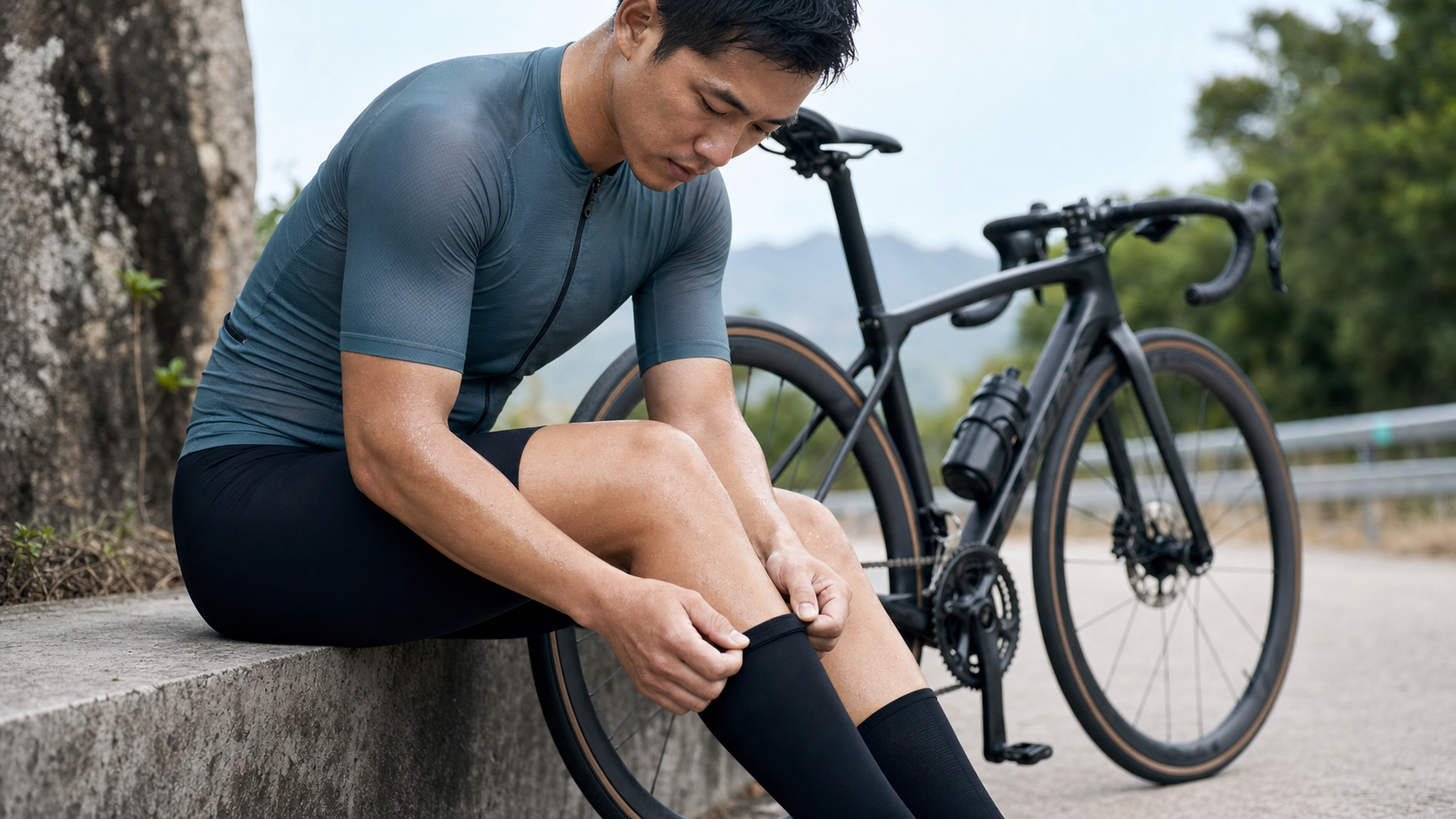
After a race or long ride in Taiwan, you’ve surely seen fellow cyclists changing into compression tights or calf sleeves. These products have seen explosive growth in the sports market in recent years, touting “accelerated recovery” and “reduced delayed onset muscle soreness (DOMS).” However, are these benefits genuine physiological improvements, or just marketing hype? This article breaks down the scientific evidence behind compression garments and how to use them correctly.
How Compression Garments Work
Compression garments are designed based on medical elastic stockings (used for preventing varicose veins and deep vein thrombosis), and were later adapted for sports recovery.
Venous Blood Return
During cycling, a large volume of blood pools in the lower limb muscles. Compression garments provide a graduated pressure gradient from the distal end (ankle) to the proximal end (thigh) (typically 15–30 mmHg), helping venous blood return to the heart and reducing the swelling sensation caused by fluid accumulation in the interstitial spaces.
Reduced Muscle Vibration
Pedaling impact and road vibration during cycling cause oscillation of muscle fibers, which accumulates into micro-damage. Compression garments provide a wrapping effect that theoretically reduces the amplitude of muscle vibration, minimizing additional mechanical damage.
Enhanced Proprioception
The compressive feel of the garments enhances proprioception in the skin and muscles, potentially improving movement coordination and exercise efficiency—especially important in the later stages of long-distance rides.
What Does the Research Say? The Actual Magnitude of Benefits
| Benefit | Level of Research Support | Notes |
|---|---|---|
| Reduced DOMS (delayed onset muscle soreness) | Moderate support | Moderate effect size, high individual variability |
| Accelerated lactate clearance | Weak evidence | Limited benefit compared to active recovery |
| Improved next-day performance | Partial support | More pronounced benefits in multi-day event scenarios |
| Power output during riding | Not significant | Not recommended to purchase for “performance enhancement” |
| Reduced subjective fatigue | Strong support | Psychological/perceptual benefits are consistent |
In short: The most well-established benefit of compression garments is improved subjective sensation (lighter legs, reduced soreness), rather than dramatic improvements in quantifiable physiological markers. But subjective sensation still matters greatly in recovery—if you feel recovered, the quality of your next day’s training naturally improves as well.
Best Practices for Wearing Timing
Wearing After Riding (Most Recommended)
- Timing: Immediately after completing a high-intensity ride or long distance, put on compression tights/calf sleeves
- Duration: Wear for 2–4 hours, or until bedtime (wearing compression garments overnight works for some people)
- Scenarios: After each stage of a multi-day race, or after long-distance challenges (e.g., island tours, century rides)
Long-Distance Travel or Flights (Recommended)
- When taking trains, high-speed rail, or flights home after a race, compression calf sleeves can effectively prevent the risk of venous thrombosis while maintaining leg circulation
- The benefits in this scenario have strong medical backing, extending beyond sports recovery
Wearing During Riding (Neutral)
- Some cyclists habitually wear compression calf sleeves while riding; comfort is the primary consideration
- Research shows the impact on power output is nearly negligible
- Not recommended for “performance enhancement,” but if it feels comfortable, there’s no harm in wearing them
How to Choose Compression Garments
Quality varies enormously across the market. Here are the key purchasing points:
- Pressure rating (mmHg): 15–20 mmHg is recommended for recovery; medical-grade 20–30 mmHg requires assessment of suitability
- Graduated compression design: Confirm the product description mentions pressure decreasing from the ankle upward
- Fabric breathability: Taiwan’s summer heat and humidity require moisture-wicking materials; otherwise, stuffiness will cause discomfort
- Accurate sizing: Sizing should be based on ankle and calf circumference—too loose is ineffective, too tight impairs circulation
- Reference brands: 2XU, Compressport, CEP, Skins (all available in Taiwan)
Common Myths Clarified
- “Wearing them all night while sleeping works better”: Some studies show positive results for overnight wear, but ensure the pressure rating isn’t too high, which could affect nighttime circulation
- “Wearing compression tights while riding can push higher power”: Current research does not support this claim; power gains come from training, not equipment
- “The more expensive, the more effective”: Price differences mainly reflect fabric durability and comfort, not stronger recovery benefits
Practical Recommendations
- Wear for 2–4 hours after long-distance activities: The most scientifically supported usage
- Combine with leg elevation recovery: While wearing compression tights, elevate your legs against a wall for 15–20 minutes to double the venous return effect
- Don’t replace active recovery with compression garments: Compression garments are a supplementary tool; Zone 1 easy riding and adequate sleep are the mainstays of recovery
- Individual differences matter: If wearing them feels comfortable and you perform better the next day, keep using them; if you don’t notice a difference, there’s no need to force yourself to spend the money
Conclusion
Compression garments are a recovery aid with a reasonable scientific basis, but the magnitude of their benefits is “icing on the cake” rather than “a lifeline in times of need.” The biggest beneficiaries are multi-day race athletes, long-distance challengers, and cyclists who need to recover quickly after flights. For everyday training, compression garments are an optional add-on, not a necessity. Prioritize your budget for sleep quality, nutritional recovery, and training planning before considering compression garments—that’s the most cost-effective recovery strategy.
Related Reading
- Recovery Benefits of Compression Tights: An Evidence Review
- Do Compression Garments Really Work? A Comprehensive Sports Science Analysis of Compression Gear
- 70.3 Compression Garments and Calf Sleeves: Scientific and Practical Perspectives
- Compression Garment Benefits for Runners: A Scientific Evaluation of Recovery Compression Gear
3D 列印車褲墊 / 舒適改善? / 無痕 x 分區壓縮 / ATK & Decider系列 / JE22黑科技 / #公路車 #CTYEH
11 個月前
鉅齒紋輪組!? ControlTech MEG-T50 EVO 碳纖維幅條輪組/ 功率對比實驗 / 公路車 / CT Yeh
2 年前
#公路車 #Fitting 靠人工智慧APP 幫你調整單車
6 年前
摔車後補裝備: 好市多新款單車安全帽& Specialized Romin 北高整路屁股都不痛的坐墊 | 一千元居然有MIPS | CT Yeh | 公路車
4 年前
靠單車減肥35公斤 心得分享與整理
7 年前
單車胎壓觀察到的有趣現象,SRAM Quarq TyreWiz 2.0 無內胎胎壓計 / 裝了有哪些幫助? / Tubeless / 公路車 / CT Yeh
1 年前
碟煞公路車 銑面器 !? 原來銑完差這麼多! 降低蹭碟機率! | TIME 公路車 保養小記錄 | CT Yeh
3 年前
洗單車神器 吹水機! 實際洗車用用看 暴力洗鍊條大法 | 公路車 | CT Yeh
4 年前