Introduction
In recent years, massage guns (Percussion Massage Guns) have become an essential recovery tool in the Taiwanese market. From Theragun and Hypervolt to various budget domestic brands, prices range from a few hundred to over ten thousand NT$. But do you really know how massage guns affect muscles, and what situations call for different vibration frequencies and depths?
This article explains the mechanisms of massage guns from the perspectives of kinesiology and neurophysiology, and provides practical usage recommendations for cycling.
The Core Mechanism of Massage Guns: Vibration Therapy
Massage guns are a form of Localized Vibration Therapy. Unlike traditional massage, the defining feature of a massage gun is rapid, repetitive impact rather than sustained, slow pressure.
Neuromuscular Inhibition
Rapid vibration stimulates the Ia-type sensory nerve endings in the muscle spindle. Sustained vibration stimulation triggers adaptive inhibition of the Stretch Reflex, lowering muscle tension—this is the physiological reason why massage guns relax tight muscles faster than static stretching.
Enhanced Local Blood Flow
Vibration promotes vasodilation in the skin and subcutaneous tissues, increasing local microcirculation, which aids in the removal of metabolic waste and nutrient delivery.
Improved Fascial Permeability
The impact force can break down excessively aggregated hyaluronic acid molecular polymers in the fascia, improving fascial glide and reducing restricted movement.
The Effects of Vibration Frequency (Hz/rpm)
| Vibration Frequency | Sensation | Recommended Use |
|---|---|---|
| Low frequency (< 30 Hz / ~1800 rpm) | Gentle, relaxing sensation | Post-race recovery, pre-sleep relaxation, early stage after injury |
| Medium frequency (30–50 Hz / 1800–3000 rpm) | Deep massage sensation, slight tingling | Recovery after daily training, relaxing sore muscles |
| High frequency (> 50 Hz / > 3000 rpm) | Intense vibration, less numbing sensation | Pre-training activation, deep fascial release |
Key concept: Higher frequency does not mean better results; choose based on your goal. Use low frequency for acute post-race recovery, medium frequency for deep relaxation of stiff muscles, and high frequency to awaken muscles before training.
The Effects of Stroke Depth (Amplitude/Stroke Length)
Stroke depth refers to the back-and-forth travel distance of the massage gun head with each strike, typically categorized as:
- Shallow stroke (6–10 mm): Suitable for sensitive areas, near bones, and gentle recovery
- Medium stroke (10–14 mm): Suitable for daily recovery of large muscle groups (quadriceps, glutes, hamstrings)
- Deep stroke (14–16 mm and above): Suitable for deep massage of thick, chronically tight muscles, but not suitable near bones or injured areas
For cyclists, the quadriceps, glutes, and calves are the primary targets, and a medium stroke (around 12 mm) is usually the most practical choice.
Massage Gun Application for Cycling Muscle Groups
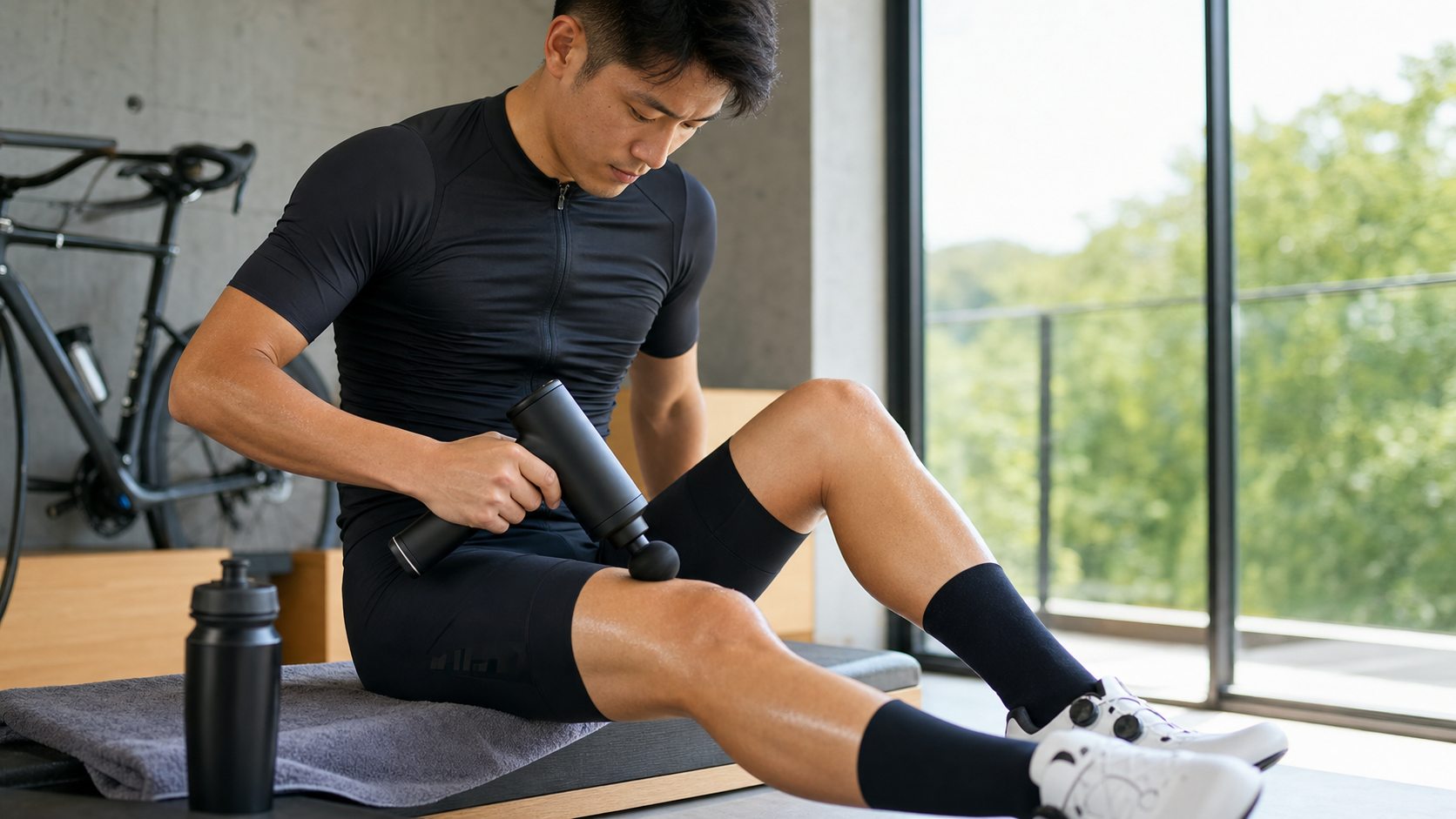
Quadriceps (Front of Thigh)
- Head type: Ball or flat head
- Frequency: Medium (2000–2400 rpm)
- Time: 60–90 seconds per side, move slowly, do not stay on the same spot for more than 15 seconds
- Caution: Avoid striking directly on the tendon attachment point above the kneecap
Calves (Gastrocnemius)
- Head type: Ball head
- Frequency: Low to medium
- Time: 45 seconds per side
- Caution: Absolutely avoid the Achilles tendon and the inner calf (the area where the posterior tibial artery runs)
Glutes (Gluteus Maximus/Medius)
- Head type: Ball or flat head
- Frequency: Medium to high
- Time: 60–90 seconds per side
- Benefit: Particularly effective for deep gluteal tightness after long rides
Lower Back (Erector Spinae)
- Head type: Fork head (to avoid the spinous processes)
- Frequency: Low to medium
- Time: 60 seconds, rolling along both sides of the spine
- Caution: Strictly forbidden to strike directly on the spinal bones
Precautions When Using a Massage Gun
The following areas and conditions are prohibited for massage gun use:
- Acute injuries (sprains or strains within 24 hours)
- Areas with severe varicose veins
- Bony prominences (kneecap, tibial crest, ankle bone protrusions)
- Nerve-dense areas (groin, sides of the neck)
- Areas with skin damage or inflammation
Massage Gun vs. Foam Roller: How to Choose
| Comparison Item | Massage Gun | Foam Roller |
|---|---|---|
| Precision | High (can target specific muscles) | Low (broad-area rolling) |
| Convenience | High (can use on your own back) | Medium (back requires assistance from others) |
| Depth | High (stronger impact force) | Low to medium |
| Price | Higher (good quality 2,000–8,000 NT$) | Low (300–1,500 NT$) |
| Suitable Scenarios | Deep tightness in specific muscle groups, travel portability | Broad relaxation of large muscle groups |
The two are complementary, not an either/or choice.
Practical Recommendations
- Do not exceed 2 minutes per area: Prolonged vibration may cause local nerve sensitization
- Use within 30 minutes after training for maximum benefit: Muscles are still warm, yielding better results
- Key purchasing criteria: Battery life > 2 hours, noise < 60 dB (considering apartment living in Taiwan), stroke ≥ 12 mm
- Do not use it as a “warm-up” and jump straight into high intensity: Muscles relaxed by a massage gun do not equal a complete warm-up; dynamic warm-up is still required
- Pair with stretching: Performing static stretching on the same area after using a massage gun yields significantly better range-of-motion improvements than using either method alone
Conclusion
The massage gun is a scientifically supported recovery tool, but “the longer and harder you use it, the better” is a common misconception. Correct frequency selection, appropriate stroke depth, and avoiding dangerous areas are what allow a massage gun to deliver maximum benefit. For cyclists, integrating it into a 15-minute post-ride recovery routine, alongside a foam roller and stretching, is an effective strategy for improving training quality.
Related Reading
- The Complete Guide to Massage Guns: Deep Muscle Relaxation for Cyclists
- The Real Benefits of Massage for Sports Recovery: Which Claims Are Supported, Which Are Exaggerated, and the Correct Use of Foam Rollers and Massage Guns
- Post-Run Muscle Massage: When to Use Foam Rollers, Massage Guns, and Manual Massage
- The Scientific Examination of Massage and Foam Rolling: Mechanisms, Effect Sizes, and the Overlooked Placebo Component
[教學] Premiere 影片 手震 修正 教學 防抖 單眼 影像 GoPro 穩定 Video Stabilization
8 年前
如何把 GoPro 影片 翻轉 批次 轉正?
6 年前
洗單車神器 吹水機! 實際洗車用用看 暴力洗鍊條大法 | 公路車 | CT Yeh
4 年前
全台首發!邁金P715踏板功率計!市場價格撼動者再出招 / 功率對比實測 / FAVERO ASSIOMA 可參考! / 公路車 / CT Yeh
1 年前
Insta 360 One 超級防手震技術實測
7 年前
西進武嶺 免費訓練分析服務 Intervals | 練不夠還是練過頭?你哪一種類型選手?AI模型告訴你! | 備戰神器 | 公路車 訓練 | CT Yeh
4 年前
#公路車 #Fitting 靠人工智慧APP 幫你調整單車
6 年前
入門車錶王者 iGPSPORT BSC100S 一千元的售價! 超大螢幕、連續兩趟北高的續航、藝術般的APP! Bryton Garmin 兩王地位撼動? | 公路車 | CT Yeh
3 年前