Introduction
Hand paddles are among the most frequently used training aids in swimming. By increasing the surface area of the hand, hand paddles allow swimmers to feel greater water resistance with each stroke, strengthening upper-body muscle groups and improving stroke technique. However, improper use—especially choosing a size that is too large—can place excessive stress on the shoulder joint and lead to injury. This article provides an in-depth analysis of how different hand paddle sizes correspond to different training goals, helping swimmers make safe and effective equipment choices.
The Training Principles Behind Hand Paddles
The core principle of hand paddles is to increase the surface area of the hand during the stroke, thereby boosting the propulsion generated with each pull. Training with hand paddles can achieve the following effects:
- Strengthen the primary pulling muscles, including the latissimus dorsi and triceps
- Help swimmers better feel the entry angle and timing of the “catch”
- Increase distance per stroke (DPS), improving stroke efficiency
- Practice maintaining correct stroke technique under high resistance
However, one critical point must be noted: the added resistance of hand paddles is a double-edged sword. If technique is not yet refined or the paddle size is too large, the rotator cuff muscles can be subjected to abnormal torque, making this one of the most common causes of shoulder injuries in swimmers.
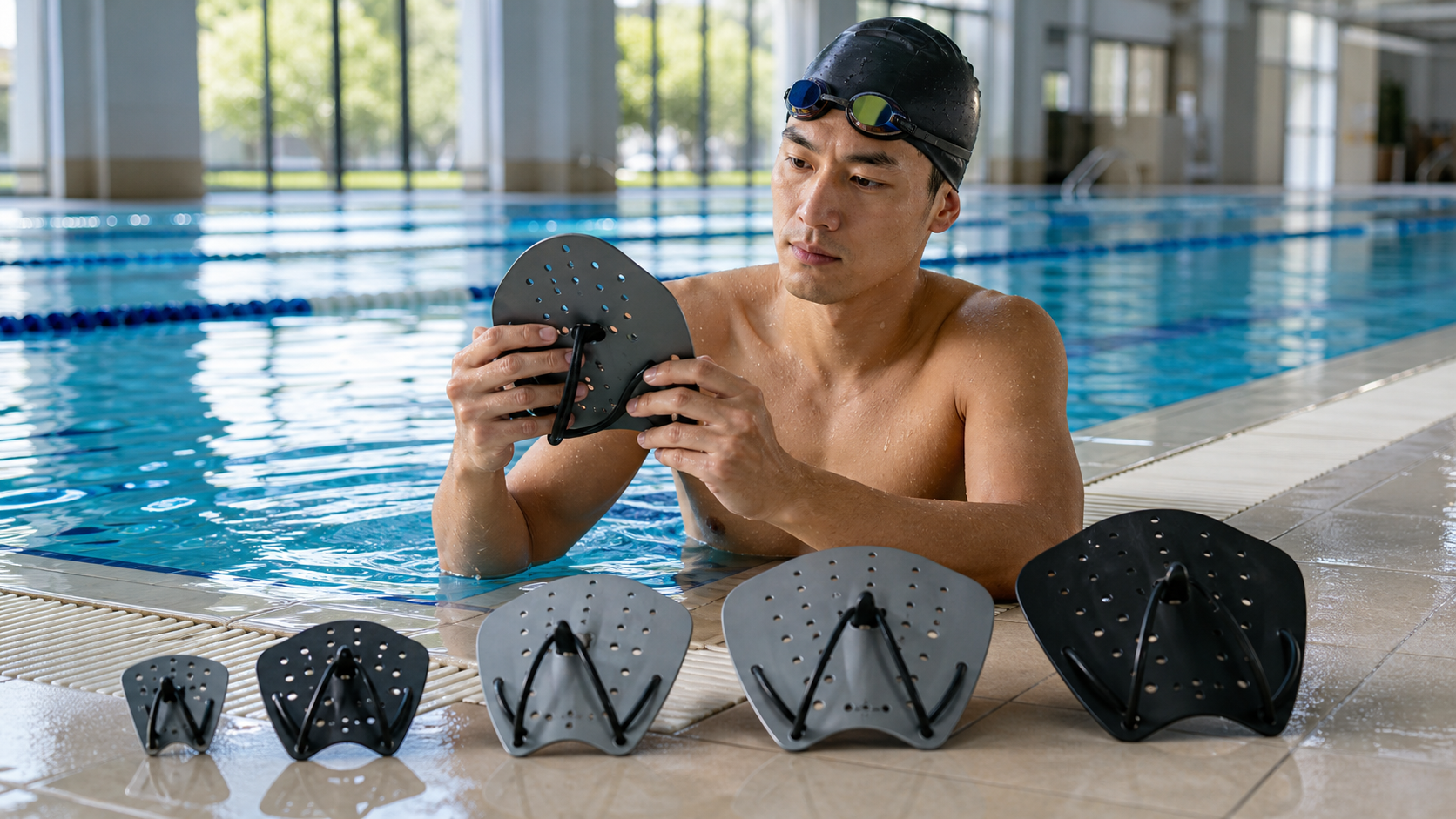
Hand Paddle Size Classification and Target Users
| Size Classification | Surface Area Relative to Hand | Target Users | Primary Training Goal |
|---|---|---|---|
| Small (S) | Roughly equal to palm size | Beginners, technique improvement | Feeling the entry angle, minimal risk |
| Medium (M) | 20–30% larger than the palm | Intermediate swimmers | Pulling strength and efficiency |
| Large (L) | 40–60% larger than the palm | Advanced swimmers | Strength training, explosive power |
| Extra Large (XL) | 70%+ larger than the palm | Elite swimmers | Maximum resistance training, very high injury risk |
General recommendation:
Using your own palm size as the baseline, first-time users should choose a model that is “no larger than the palm,” then gradually progress to larger sizes as technique improves.
Comparison of Different Design Types
Beyond size, the shape and design of hand paddles also affect training outcomes:
Traditional flat paddle:
- The most common design, flat rectangular or oval shape
- Suitable for training overall pulling strength
- Lower margin for error—resistance becomes greater when technique is incorrect
Finger paddle:
- Covers only the fingers, with a small surface area
- Best for strengthening the initial “hand entry” contact phase
- Very beginner-friendly, with extremely low injury risk
Curved paddle:
- The paddle surface curves slightly toward the palm
- Mimics the natural curvature of the hand in the water
- More shoulder-friendly, suitable for swimmers with shoulder issues
Finis Agility Paddle (no finger holes):
- Held to the palm solely by water pressure, with no elastic straps
- The paddle automatically falls off when stroke technique is incorrect, forcing technique improvement
- Ideal for swimmers who want to use paddles to refine their stroke
Usage Recommendations Within a Training Plan
For a swimmer with a weekly training volume of roughly 10–15 km, a reasonable proportion of hand paddle use would be:
- Weekly distance with hand paddles should not exceed 30–40% of total training volume
- When using hand paddles, pair them with a pull buoy to prevent leg movement from interfering with upper-body training
- Perform a full shoulder warm-up before each session (arm circles, resistance band activation)
- After use, watch for any shoulder pain or discomfort—if present, stop immediately
Suggested weekly hand paddle training combinations:
- Technique day: Use small finger paddles, focus on entry angle, swim 500–1000 m at low intensity
- Strength day: Use medium/large flat paddles with a pull buoy, perform short-distance sprint sets
- Aerobic day: No hand paddles, allowing the shoulders to fully recover
Maintenance and Lifespan
Hand paddles are typically made of rigid plastic and require relatively simple maintenance:
- Rinse with fresh water after use to prevent chlorine residue buildup
- Avoid prolonged compression that could cause deformation during storage
- The elastic bands (wrist straps and finger loops) degrade over time and can be purchased separately as replacements
- If the paddle surface develops cracks, replace it to avoid sharp edges that could cause cuts
Practical Recommendations
- If you are new to hand paddles: Start with finger paddles or a size matching your palm
- If you have a history of shoulder injury: Use curved paddles and perform shoulder stretches after training
- If you want to improve technique: Try the finger-hole-free “Agility” style paddle
- For children and adolescents: Choose junior-specific sizes—even a small adult paddle may be too large for a child’s hand
Conclusion
Hand paddles are a highly effective swimming training tool, but the intuition that “bigger is better” does not apply here at all. Choosing the right size combined with correct usage is what allows paddle training to enhance performance while protecting the shoulder joint. Swimmers are advised to introduce paddle training gradually under the guidance of a qualified coach, progressively building pulling strength and efficiency.
Related Reading
- The Complete Guide to the Training Effects and Proper Use of Swimming Hand Paddles
- Hand Paddle Buying Guide: A Full Breakdown of the Training Differences Between Large, Medium, and Finger Paddles
- Hand Paddles, Pull Buoys, and Fins: The Correct Use of Swimming Training Aids and the Shoulder Injury Red Line
- How to Properly Use Resistance Training Aids (Hand Paddles / Resistance Pants)
西進武嶺 免費訓練分析服務 Intervals | 練不夠還是練過頭?你哪一種類型選手?AI模型告訴你! | 備戰神器 | 公路車 訓練 | CT Yeh
4 年前
[教學] Premiere 影片 手震 修正 教學 防抖 單眼 影像 GoPro 穩定 Video Stabilization
8 年前
訓練台體驗) 2019台北自行車展 三大家 訓練台體驗 Tacx Neo Flux 2 Xepdo Apx Wahoo Kickr
7 年前
如何把 GoPro 影片 翻轉 批次 轉正?
6 年前
3D 列印車褲墊 / 舒適改善? / 無痕 x 分區壓縮 / ATK & Decider系列 / JE22黑科技 / #公路車 #CTYEH
11 個月前
鉅齒紋輪組!? ControlTech MEG-T50 EVO 碳纖維幅條輪組/ 功率對比實驗 / 公路車 / CT Yeh
2 年前
3C心得) 電腦用 43吋 4K 螢幕 適合嗎 ! BDM4350UC 長期使用心得 剪接影片 修圖 Premiere Davinci Lightroom
7 年前
#公路車 #Fitting 靠人工智慧APP 幫你調整單車
6 年前