Introduction
The fundamental reason swimming is difficult to master lies in the physical properties of “water” as a medium. Water is approximately 800 times denser than air, and its viscosity coefficient is far higher than that of air, meaning the resistance a swimmer encounters while moving through water is far more complex than when running or cycling. According to the fundamental laws of fluid dynamics, drag is proportional to the square of velocity—double your speed, and drag increases fourfold. Therefore, improving posture and reducing frontal surface area has become one of the most effective aspects of swimming training.
Three Main Types of Drag
Drag in swimming can be categorized into three main types. Understanding their causes is essential for targeted improvement:
1. Form Drag
Form drag is the most significant source of resistance, accounting for approximately 60–70% of total drag. It is determined by the body’s cross-sectional area and shape. When a swimmer’s hips sink, the head is held too high, or the knees bend at an excessive angle, the “frontal area” the body presents in the water increases, acting like a wall blocking the flow of water.
Key postural elements for reducing form drag:
- Maintain a horizontal body position, keeping the hips and shoulders on the same plane
- Engage the core muscles to prevent the lower back from sagging
- Keep the head neutral, with the eyes looking toward the bottom or slightly forward, avoiding excessive head lift
- Enter the water with the hand close to the extension line of the head, rather than too wide or too short
2. Skin Friction Drag
Skin friction drag arises from the contact between water flow and the skin’s surface, accounting for approximately 10–20% of total drag. Racing swimsuits (such as polyurethane full-body suits) are designed specifically to optimize this factor, reducing friction through smooth materials and compression effects. For amateur athletes, shaving body hair (a common practice before tapering) can also slightly reduce friction drag.
3. Wave Drag
When a swimmer moves along the water’s surface, the body creates waves on the surface, and these waves carry away kinetic energy. Wave drag is particularly pronounced when swimming near the surface, which is why underwater dolphin kicking in deeper water is often faster than surface swimming—underwater swimming completely avoids wave drag.
Biomechanics of the Streamlined Position
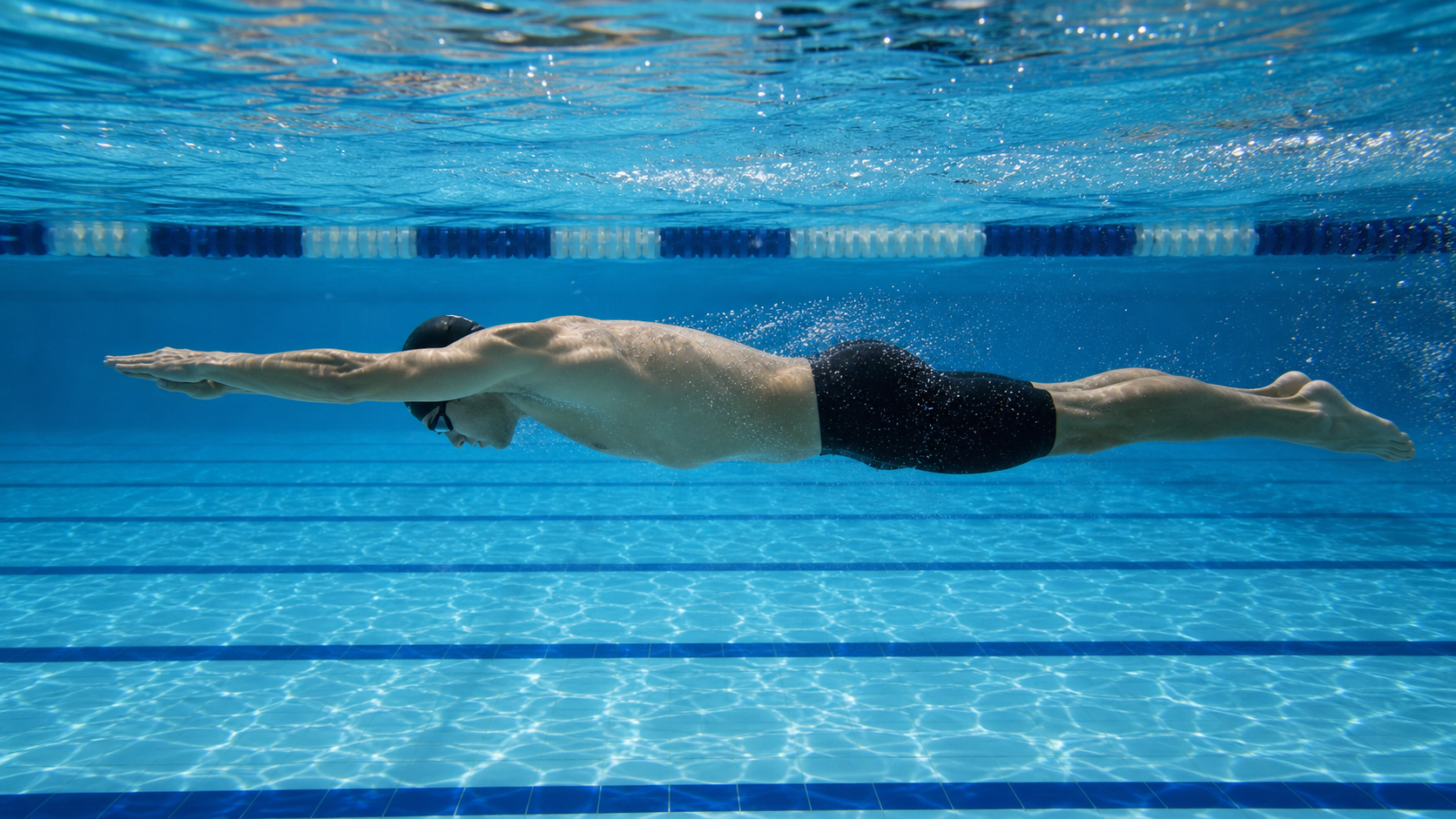
The so-called “streamline position” is one of the most important postural concepts in swimming science. During the glide after pushing off the wall or the underwater propulsion phase following a turn, the standard streamlined position minimizes body drag.
| Postural Element | Standard Action | Common Error | Drag Impact |
|---|---|---|---|
| Arms | Hands stacked, arms hugging the ears, fully extended | Arms separated or bent | Drag increases 15–25% |
| Head | Neutral, fully tucked between the arms | Head lifted | Hips sink, drag multiplies |
| Core | Engaged, lower back not sagging | Relaxed lower back | Form drag increases significantly |
| Ankles | Extended, toes pointed (plantar flexion) | Ankles flexed | Increases tail-end drag |
Research shows that a perfect streamlined position can reduce drag by approximately 30–40% compared to a relaxed, natural float, and the glide distance after pushing off the wall can be extended several-fold.
Stroke Technique and the “Cavitation” Phenomenon
Beyond static posture, the stroke motion itself also affects drag. The pull path of elite swimmers is not a straight line backward but rather an S-shape or curve, designed to allow the hand to continuously find “still water” to push against, rather than pulling through already-disturbed eddies.
When stroke speed is too fast or technique is flawed, a “cavitation effect” may occur in front of the palm—low-pressure bubbles form in the water, causing the hand to lose its grip on the water and propulsive force to plummet. This is why many coaches emphasize “water feel”—at its core, it is the fine-tuned regulation of pressure distribution through proprioception.
Practical Recommendations
Priority improvement checklist for amateur swimming trainees:
-
Fix the sinking hips first: This is the biggest culprit behind form drag. Practice using a light kick to support the hips, or incorporate kickboard-assisted leg drills into training to strengthen core stability.
-
Video analysis from the side view: This is the most effective way to diagnose posture. Have someone record you from the side with a phone at poolside, focusing on hip height and head position.
-
Perform a standard streamline on every push-off: Each wall push-off in streamline is free speed that requires no physical exertion. Build the habit so that the glide lasts at least 3–4 meters.
-
Feel the pressure on your palm: During the pull, deliberately sense the feeling of “pressing the water” with your palm, ensuring every stroke has a solid catch. If your palm feels like it’s “spinning,” reduce stroke rate and focus on technique.
-
Short-distance technique sets: Using 25-meter repeats, focus entirely on a single technical element (such as hip height). This builds neuromuscular patterns far more effectively than careless long-distance swimming.
Conclusion
Water drag is the biggest ceiling on swimming speed, and the most effective way to reduce drag is not training volume but postural improvement. Understanding your movements from a fluid dynamics perspective, combined with deliberate technical practice, allows you to significantly increase swimming speed without expending additional energy. For Taiwanese swimmers seeking improvement, the return on investment from technical training far exceeds that of simply adding training distance.
Related Reading
- The Science of Water Resistance in Swimming: Streamlined Technique and Energy Expenditure
- Improving Posture Against Water Resistance: The Relationship Between Streamlined Body Position and Head Placement
- The Science of Water Resistance in Swimming: The Ratio of Form Drag vs. Skin Friction Drag and Drag Reduction Strategies
- Swimming Drag Analysis: Wave Drag, Skin Friction Drag, and Form Drag
CT 喇低賽) 武嶺牽車 才是王道 西進牽車四小時內秘訣 攝手位置 如何判斷 防抽筋小秘訣
7 年前
3D 列印車褲墊 / 舒適改善? / 無痕 x 分區壓縮 / ATK & Decider系列 / JE22黑科技 / #公路車 #CTYEH
11 個月前
戰略) Zwift Race 如何咬在第一集團 如何評估自己要開多少推力 (請開1.5倍速看)
7 年前
一日北高/長距離團騎 常見問題補充篇 / 組團或跟團的眉角 / 壯車友容易被瘦車友慢性拉爆 / 原來屁股痛可能是這個原因...? / 風場配速法 / 公路車 / CT Yeh
2 年前
一日北高前的西濱集訓 | 跟著11小時軍團 | 300W踩不動的大逆風 | 輪車破風差幾瓦?
6 年前
靠單車減肥35公斤 心得分享與整理
7 年前
16/02/16 - 夜訪中社路 緩慢進步中
10 年前
CT 喇低賽) 單車 比賽總是沒照片? 攝影師的觀點大公開 姿勢就是力量! 請加速1.25倍收看
7 年前