The Buoyancy Principle of Swimming: How Body Fat Percentage and Lung Capacity Affect Your Ability to Float in Water
Introduction
“I always sink when I swim—I’m just not built for it.” This is a feeling many beginners share. However, from a sports science perspective, the root causes of “buoyancy differences” between individuals can be explained, and they are not entirely determined by genetics. Buoyancy follows Archimedes’ principle: the buoyant force acting on an object in a fluid equals the weight of the fluid it displaces. Therefore, the key factor affecting a swimmer’s buoyancy is whether their body’s “average density” is lower than that of water (1.0 g/cm³).
The Decisive Influence of Body Composition on Buoyancy
The human body is not a homogeneous solid but is made up of tissues with vastly different densities:
| Tissue Type | Density (g/cm³) | Effect on Buoyancy |
|---|---|---|
| Adipose tissue | ~0.9 | Lower than water, aids floating |
| Muscle tissue | ~1.06 | Slightly higher than water, causes the body to sink |
| Bone | ~1.5–2.0 | Much higher than water, significantly sinks |
| Lungs (inflated) | ~0.05–0.1 | Extremely low, strongly floats |
This table makes it clear: people with a higher body fat percentage float more easily, while those with greater muscle mass or higher bone density tend to sink more.
This also explains several common observations:
- Heavier-set trainees often learn to float on their backs faster than lean fitness enthusiasts
- Athletes of African descent, due to higher average bone density, are relatively less common in competitive swimming
- Women generally have a higher body fat percentage than men, so they typically float more easily when first learning to swim
The “Buoyancy Switch” Role of Lung Capacity
The lungs play a unique role in buoyancy calculations. When the lungs are filled with air, they act as an extremely low-density “air bladder” that significantly reduces the body’s average density; after exhaling, this advantage disappears, the body’s overall density rises, and buoyancy decreases.
A real-world example:
An adult male weighing 70 kg has a lung capacity of about 5 liters. When fully inflated, the lungs’ “buoyancy contribution” is roughly equivalent to 5 kg of additional buoyancy (5 liters of air displaces 5 kg of water while having almost no weight). After exhaling, this 5 kg of buoyant support disappears, and the body tends to sink more.
Implications for swimming technique:
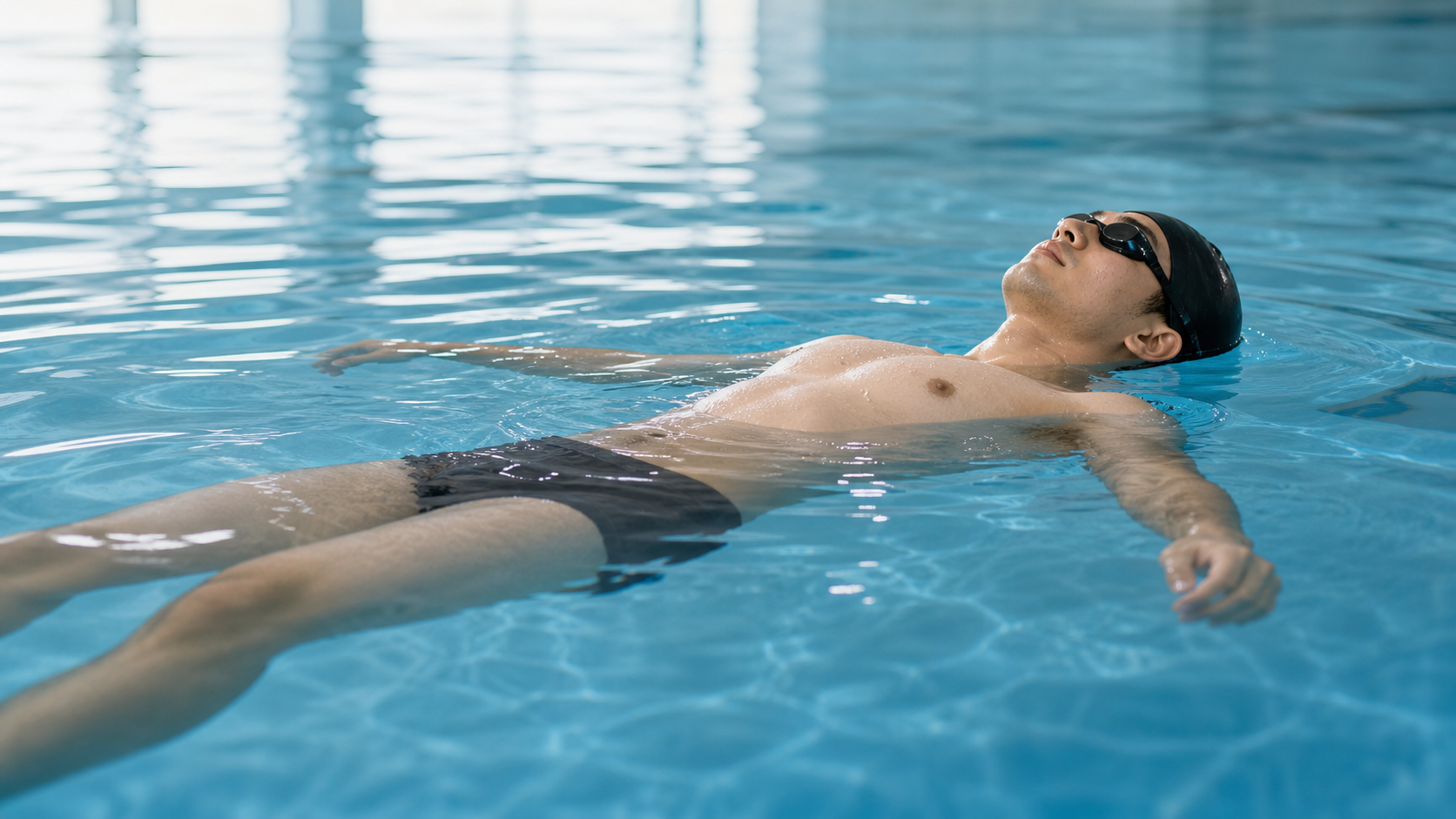
- Beginners practicing back float should keep their lungs as full as possible and avoid unconsciously exhaling when nervous
- In freestyle breathing, if you habitually “exhale completely before inhaling,” your body will sink more easily at the end of the exhalation, making it harder to maintain a horizontal position
- It is recommended to adopt a “slow, continuous exhalation” breathing pattern, retaining some air in the lungs
Buoyancy Differences Across Body Segments
Even if the body as a whole can float, the density of different body parts is not uniform, causing the “center of buoyancy” and the “center of gravity” to not coincide, which creates a rotational torque.
Typical problem: sinking legs
For most people, the lower body (thighs, calves, more bone) has a higher density than the upper body, while the chest cavity (including the lungs) has the lowest density. This creates a tendency for the body to be “head-light, legs-heavy,” causing the hips and legs to sink during swimming, which increases form drag.
Improvement strategies:
- Kick training: Strengthen the “active lift” of the legs, using muscular force to counteract the legs’ natural tendency to sink
- Head position adjustment: Tilt the head slightly downward to shift the center of buoyancy, which helps lift the hips
- Use of a kickboard: Let beginners first feel the sensation of their legs floating, building proprioception
The Relationship Between Water Temperature, Salinity, and Buoyancy
Buoyancy is not determined solely by the body—water density also changes:
- Saltwater vs. freshwater: Seawater has a density of about 1.025 g/cm³, roughly 2.5% higher than freshwater, so floating in the sea is easier than in a pool (freshwater). This is one reason open water swimming feels “easier” than pool swimming.
- Water temperature: The higher the temperature, the slightly lower the water density, and the slightly lower the buoyancy. However, this difference has little practical impact on how a swimmer feels.
Practical Recommendations
-
Don’t give up swimming because you sink: Sinking legs are a normal phenomenon for most people and can be fully overcome through technique training. Even elite swimmers need active kicking to maintain a horizontal position.
-
Practice inflated back floating: Take a deep breath, relax your entire body, and feel your body’s natural balance point in the water. This exercise helps build an intuitive sense of buoyancy.
-
Body fat management has its limits: There is no need to deliberately increase body fat for swimming, because good technique—especially core support and kicking—matters more than body fat percentage for swimming performance.
-
Choose appropriate training goals: If you have high bone density (e.g., long-term weightlifters), accept the reality that you will need to kick harder, and focus your training on stroke efficiency rather than trying to “float up.”
-
Take advantage of buoyancy in open water training: Practice at the seaside or in salt lakes (such as Taiwan’s eastern coast), using the higher water density to build confidence in back floating before transitioning to freshwater pools.
Conclusion
Buoyancy is not fate—it is physics. Understanding how body fat percentage, muscle mass, and lung capacity collectively determine whether you sink or float in water allows you to approach the frustrations of learning to swim in a more scientific way. For most people, the “sinking” problem can be greatly improved through posture adjustments and technique training, rather than being a simple limitation of physical condition.
Related Reading
- The Buoyancy Principle in Swimming: The Effects of Body Fat Percentage and Muscle Mass on Buoyancy
- Seawater vs. Freshwater: The Impact of Buoyancy Differences on Open Water Swimming
- Technical Differences Between Ocean Swimming and Lake Swimming: The Effects of Salinity, Buoyancy, and Freshwater Density
- Swimming Training for Overweight Individuals: Designing an Effective Fat-Loss Program Leveraging Buoyancy Advantages
一日北高/長距離團騎 常見問題補充篇 / 組團或跟團的眉角 / 壯車友容易被瘦車友慢性拉爆 / 原來屁股痛可能是這個原因...? / 風場配速法 / 公路車 / CT Yeh
2 年前
戰略) Zwift Race 如何咬在第一集團 如何評估自己要開多少推力 (請開1.5倍速看)
7 年前
靠單車減肥35公斤 心得分享與整理
7 年前
一日北高常見問題大集合 | 攻略 | 路線 | 訓練 | 補給 | 自行車 單車 | 一日雙城 | 雙塔 | TWB北高360 | 屁股痛
6 年前
#公路車 #Vo2Max #最大攝氧量 測驗 體驗 | 心肺測試
6 年前
西進武嶺 8000名單車友數據分析 PART1 | 從新手到高手數量/瓦數/推力比/FTP推力比/功率計使用率 大解析 | 公路車 | CTYeh
5 年前
Nepest NOVA 碳條輪組:輕量、空力、舒適一次滿足!/ 公路車 / CT Yeh
7 個月前
CT 喇低賽) 武嶺牽車 才是王道 西進牽車四小時內秘訣 攝手位置 如何判斷 防抽筋小秘訣
7 年前