Introduction
"How many times have you said, ‘I feel fine today, I should be able to train’? Subjective feelings can sometimes be deceiving. In the early stages of overtraining, athletes often don’t notice anything wrong, and only realize the problem when they hit a breaking point.
Heart Rate Variability (HRV) is currently one of the most objective, non-invasive indicators in sports science for assessing the recovery status of the autonomic nervous system. From WorldTour teams to amateur triathletes, more and more people are using HRV as the scientific basis for deciding “how hard today’s training should be.”
What is HRV?
A heart rate of 60 beats per minute doesn’t mean each beat is exactly 1000 milliseconds apart. The variation in time intervals between consecutive heartbeats (fluctuations in the R-R Interval) is what we call heart rate variability.
| HRV Status | Autonomic Nervous System Dominance | Body State |
|---|---|---|
| High HRV | Parasympathetic (vagus nerve) dominant | Good recovery, low stress, suitable for high-intensity training |
| Low HRV | Sympathetic dominant | Fatigue, high stress, body not yet recovered |
HRV levels reflect not just “whether muscles are sore,” but the overall recovery state of the entire nervous, immune, and hormonal systems, making it a more sensitive recovery indicator than resting heart rate.
How to Measure HRV
Proper Measurement Protocol
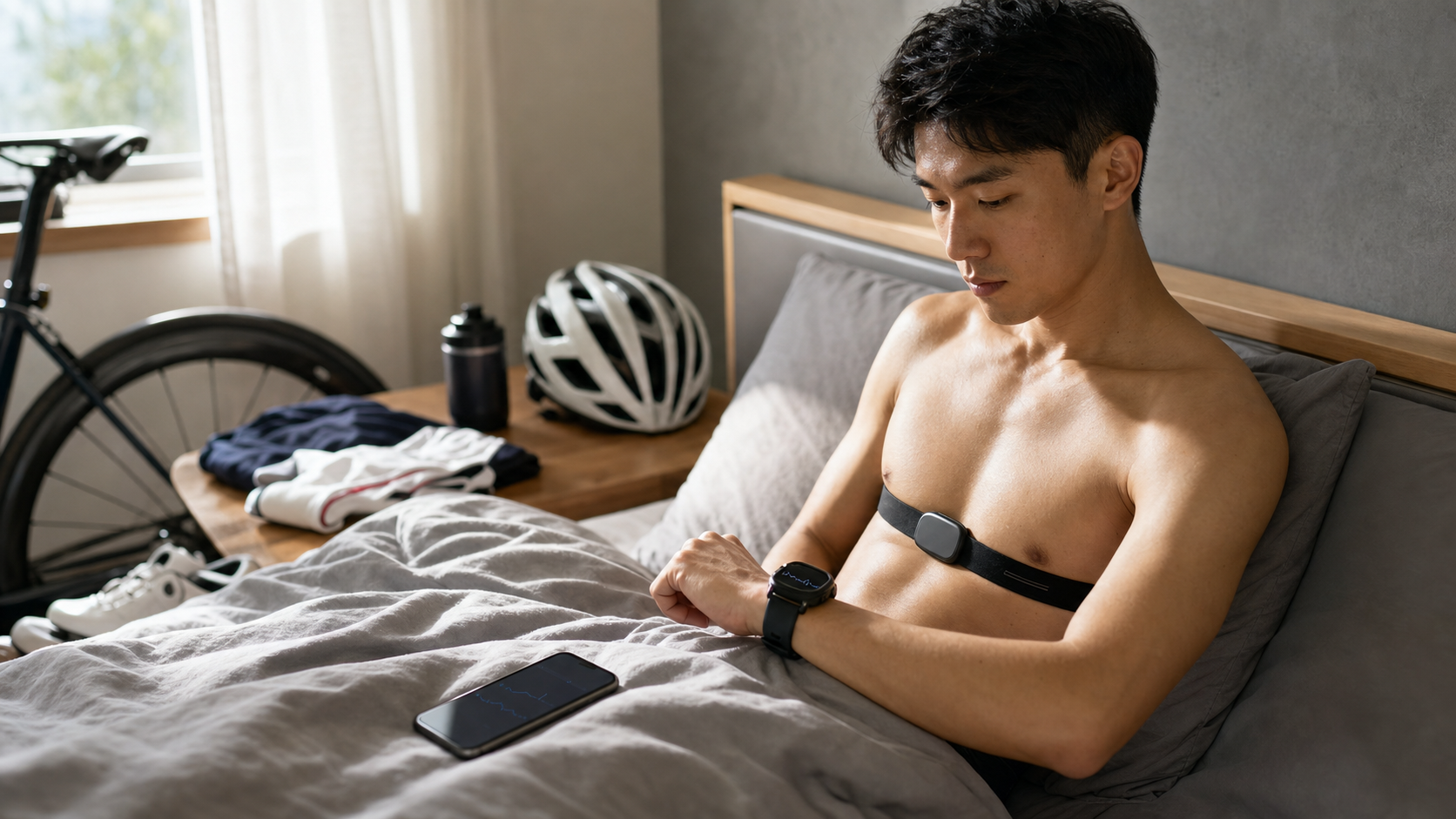
- Timing: Upon waking in the morning, before getting up, while still lying in bed (avoid any activity affecting the readings)
- Position: Supine, remain still
- Measurement Duration: 2–5 minutes (varies by device)
- Measurement Frequency: Measure at the same time daily; at least 7–14 consecutive days are needed to establish a personal baseline
Measurement Tool Options
| Tool Type | Representative Products | Accuracy | Availability in Taiwan |
|---|---|---|---|
| Heart rate chest strap + phone app | Polar H10 + Elite HRV App | Highest | Readily available |
| Optical heart rate smartwatch | Garmin, Apple Watch, Polar Vantage | Medium to high | Widespread |
| Dedicated HRV device | Oura Ring | High | Requires import |
| Phone camera only | Apps using the camera to sense fingertip pulse | Medium (prone to interference) | Free |
Recommendation: If your budget allows, the Polar H10 chest strap paired with the Elite HRV or HRV4Training app is currently the gold standard combination for amateur athletes, with accuracy approaching clinical grade.
How to Interpret HRV Values
Your Personal Baseline Matters More Than Absolute Values
HRV values vary enormously between individuals (ranging from 20 to 120 ms RMSSD, or even wider). What matters is not whether your value is above some threshold, but how today’s value compares to your own 7-day average.
Practical Interpretation Framework (Based on Percentage Deviation)
- More than +5% above the 7-day average: Nervous system is in good shape, suitable for high-intensity training
- Within ±5% of the 7-day average: Normal range, train as planned
- More than -5% below the 7-day average: Recommend reducing intensity, switch to Zone 1–2 or take complete rest
- Below baseline for 3+ consecutive days: Possible overtraining or early sign of illness; serious rest is needed
Trends Matter More Than Single-Day Readings
A single day of low HRV doesn’t necessarily require stopping training (alcohol before bed or insufficient sleep the previous night can both affect single-day readings). A downward trend over 3–5 consecutive days is the signal that warrants caution.
Integrating HRV into Your Training Plan
Here is an operational process for integrating HRV into a weekly training schedule:
- Establish a baseline (Weeks 1–2): Measure daily without adjusting training based on HRV; purely collect data
- Set personal action rules (from Week 3 onward): For example, “HRV below baseline by 8% → switch to an easy ride or rest”
- Combine with RPE (Rate of Perceived Exertion): If HRV is high but you subjectively feel tired, you can still lower intensity; if HRV is slightly low but you subjectively feel great, you can maintain planned intensity, but monitor closely
- One week before a race: A steadily rising HRV is a good sign that fitness is peaking; if HRV remains persistently low, you may need to extend the taper period
Limitations of HRV
- Not a universal indicator: HRV cannot distinguish the cause of fatigue (training fatigue, life stress, minor illness); it must be combined with other information for assessment
- Affected by multiple factors: Alcohol, caffeine (within 2 hours before measurement), insufficient sleep, and the menstrual cycle can all significantly affect HRV
- Requires consistent measurement conditions: Any inconsistency in measurement timing or posture increases the difficulty of interpretation
Practical Recommendations
- Set a daily morning HRV measurement alarm: Once the habit is formed, it only takes 3–5 minutes
- Record additional contextual information: Hours of sleep last night, stress level (1–5 scale), and yesterday’s training intensity help explain HRV fluctuations
- Don’t make decisions based on HRV alone: Combine it with how your body feels, your training plan, and your race schedule for an overall judgment
- Long-term trends are more meaningful than short-term fluctuations: When training adaptation is going well, baseline HRV should slowly rise
Conclusion
HRV monitoring turns “should I train or rest today” from a subjective guess into a data-driven decision. For serious cyclists in Taiwan, incorporating daily morning HRV measurement into your training plan is a highly efficient, low-cost strategy to enhance training intelligence and prevent overtraining. Your body is speaking; HRV helps you translate it into numbers.
Related Reading
- HRV Heart Rate Variability: Using Data to Decide Whether to Train or Rest Today
- Heart Rate Variability (HRV) and Training Recovery: How to Use Data to Avoid Overtraining
- HRV and Trail Running: Deciding Whether to Train
- HRV Monitoring in Practice: Using Morning Heart Rate Variability to Determine Today’s Training Intensity
西進武嶺 免費訓練分析服務 Intervals | 練不夠還是練過頭?你哪一種類型選手?AI模型告訴你! | 備戰神器 | 公路車 訓練 | CT Yeh
4 年前
#公路車 #Vo2Max #最大攝氧量 測驗 體驗 | 心肺測試
6 年前
2026 車錶排行榜!誰是最多車友正在使用?練家子最愛哪款?🏆 (2萬名車友數據) / 公路車 / CT Yeh
5 個月前
白沙屯媽祖進香在家走!UREVO 坡度自調走步機 / 可連接訓練遊戲APP MyWhoosh / 邊看直播邊走起來 / CT Yeh
11 個月前
JE22 百里任務體驗,心跳不能過150,三小時內有可能...? 沒有天時地利難度有多高? / 公路車 / CT Yeh
1 年前
RAMP FTP Test 直播 究竟能撐到幾瓦 訓練台 Gravat Zwift
6 年前
單車AI教練!全新 ChatGPT4o 幫你分析訓練成果!排武嶺課表,分析騎車姿勢! 太神了! / 公路車 / CT Yeh / feat. 緯緯
2 年前
[教學] Premiere 影片 手震 修正 教學 防抖 單眼 影像 GoPro 穩定 Video Stabilization
8 年前