Introduction
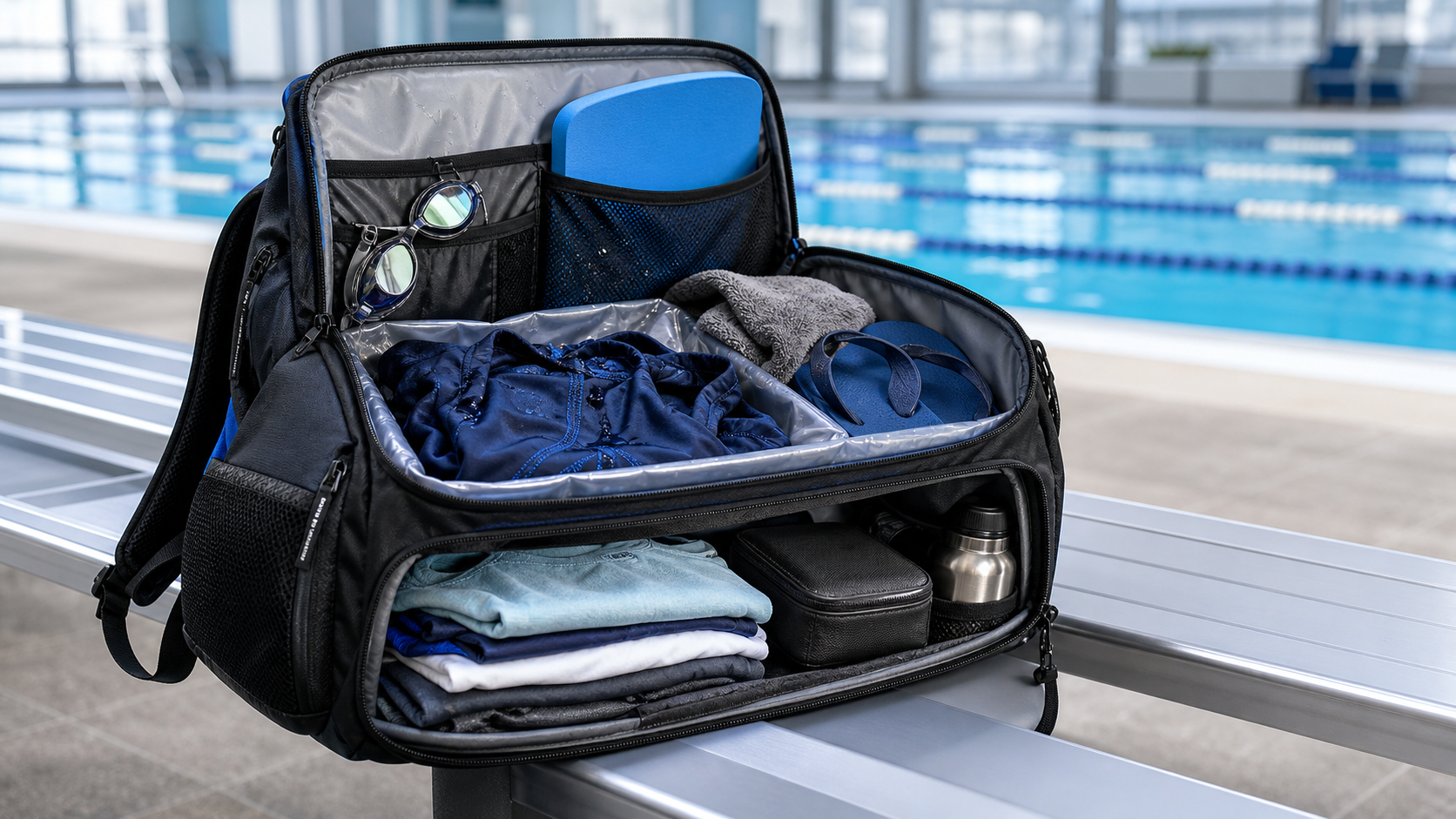
Stuffing a wet swimsuit and flip-flops directly into a regular backpack after swimming, leaving the entire bag damp—this is a daily annoyance for many swimmers. A well-designed swim bag needs more than just ample capacity; the key is a wet/dry compartment separation design that allows wet swimwear, towels, and kickboards to be stored independently while keeping spare clothes and electronics dry. This article systematically analyzes swim bag design elements, capacity requirements, and buying recommendations for different types of swimmers.
Core Design Elements of Swim Bags
1. Wet/Dry Compartment
This is the most important design feature of a professional swim bag. The separation methods mainly include the following:
- Detachable waterproof wet bag pouch: A separate waterproof bag included inside the bag that can be removed and used independently
- Waterproof divider design: A compartment made of waterproof material at the bottom or side of the bag for placing wet items directly
- Dedicated wet-zone zippered compartment: A dedicated waterproof compartment with its own opening that does not affect the main storage space
The best design is one that combines a removable waterproof wet bag with a fixed waterproof compartment, offering the greatest flexibility.
2. Ventilation Design
Swim bags store wet items for extended periods; without ventilation, mold and odors can easily develop. Good ventilation designs include:
- Mesh material on the outer layer to allow air circulation
- Drainage holes at the bottom to let residual water escape
- Antimicrobial lining material
3. Storage Design
Swim gear comes in many varieties, and good storage design ensures every piece of equipment has its place:
- Dedicated goggle pocket (usually with hard-shell protection)
- External elastic mesh or clips for large equipment such as kickboards and pull buoys
- Waterproof inner pocket for phone and keys
- Side pocket for a water bottle
Swim Bag Type Comparison
1. Barrel/Cylinder Bag:
Cylindrical design, the most common style among swim teams. The wide opening makes accessing gear very convenient, with capacities typically ranging from 30–50 liters. The downside is lower carrying comfort, usually with only a single shoulder strap.
2. Backpack Style:
The most popular style in recent years, combining the carrying system of a regular backpack with the wet-zone design of a swim bag. Capacity typically ranges from 20–35 liters, suitable for commuters who also swim.
3. Tote/Shoulder Bag:
Similar to a regular tote bag, with medium capacity (15–25 liters), suitable for light users who only carry basic swim gear. Carrying comfort is lower than backpack styles.
4. Wheeled Bag:
Suitable for athletes attending multi-day swimming competitions who need to carry large amounts of gear; not the main focus of this article.
| Type | Capacity Range | Carrying Comfort | Suitable For | Price Range |
|---|---|---|---|---|
| Barrel/Cylinder Bag | 30–50L | Medium | Swim team training, lots of gear | NT$600–2,000 |
| Backpack Style | 20–35L | High | Commuting plus swimming, daily training | NT$800–3,500 |
| Tote/Shoulder Bag | 15–25L | Low | Light swimming, leisure | NT$400–1,500 |
Capacity Requirement Calculation
Before buying a swim bag, take stock of the gear you carry for each swim session:
Basic swim kit (approximately 15–20 liters):
- Swimsuit or swim trunks (1)
- Goggles (1 pair)
- Swim cap (1)
- Towel (1)
- Flip-flops (1 pair)
- Toiletries
Advanced training kit (approximately 25–35 liters):
- All of the basic kit above
- Kickboard (1)
- Pull buoy (1)
- Hand paddles (1 pair)
- Spare swimsuit, change of clothes
- Water bottle
Competitive athlete kit (approximately 35–50 liters):
- All of the advanced kit above
- Resistance equipment (drag parachute/tow net)
- Training accessories (resistance bands, lap counter)
- Warm clothing (winter)
- Logistics supplies (energy bars, supplements)
Material Durability Comparison
Swim bags must withstand prolonged exposure to damp environments, making material choice critical:
- Polyester: The mainstream swim bag material—abrasion-resistant, moisture-resistant, quick-drying, and cost-effective
- Nylon: Lighter and more abrasion-resistant than polyester, but more expensive
- TPU-coated material: Fully waterproof, ideal for wet-zone compartments, but poor breathability
- EVA foam base: Reinforced bottom design to prevent water seepage when placed on wet floors
Zipper quality is equally important: YKK waterproof zippers are the industry standard, more durable and better sealed than regular zippers, and are standard on high-quality swim bags.
Mainstream Brand Features
Speedo (swim gear specialist):
- Wide variety of barrel bags, well-suited for swim gear storage
- Some models feature waterproof bottom designs
- Mid-range pricing (NT$800–2,500)
Aqua Sphere:
- Focus on ergonomic backpack design
- Well-developed wet/dry compartment separation
- Mid-to-high pricing (NT$1,200–3,500)
TYR:
- Competition-oriented, large-capacity designs
- Commonly seen on US swim teams
- Mid-range pricing (NT$1,000–3,000)
Practical Recommendations
- Daily commuter swimmers: 20–25 liter backpack style, with a must-have wet/dry compartment pocket and protective goggle pocket
- Trainers with lots of gear: 30+ liter backpack style or barrel bag; confirm the storage method for kickboards and pull buoys
- Hygiene-conscious users: Choose models with antimicrobial lining or removable, washable wet bags
- Long-distance commuters: Prioritize backpack styles with a chest strap for more even shoulder weight distribution
- Budget considerations: Basic models at NT$300–600 usually meet most people’s needs; if you carry lots of gear and train frequently, it’s worth investing in a quality model above NT$1,500
Conclusion
A good swim bag is an invisible enhancer of daily swimming quality of life. The wet/dry compartment separation design frees you from the hassle of dampness, appropriate capacity ensures every piece of gear has its place, and quality materials and zippers guarantee years of reliable use. Based on your gear volume, commuting method, and budget, invest in a swim bag that truly suits you, making preparation and cleanup before and after every swim easy and enjoyable.
Related Reading
- Open Water Swimsuit Selection: Race Scenario Logic for Buoyancy vs. Flexibility
- Wetsuit Selection and Donning/Doffing: The Complete Essential Gear Guide for Open Water
- Wetsuit Complete Guide: Selection, Donning/Doffing, and Adjusting Your Swimming Feel
- Complete Swimming Gear Guide: Buying Advice for Goggles, Wetsuits, and Training Aids
3D 列印車褲墊 / 舒適改善? / 無痕 x 分區壓縮 / ATK & Decider系列 / JE22黑科技 / #公路車 #CTYEH
11 個月前
用了AirTag 單車就不怕被偷?盲點大測試 結果… |公路車|CT Yeh
5 年前
類空拍神器 Feiyu Pocket 2s (有優惠連結)三軸穩定 運動攝影機 開箱!比GoPro 還強的滑順視角!三小時長時間錄影 行車記錄器 | 環花東365實測 | 公路車 CT Yeh
4 年前
洗單車神器 吹水機! 實際洗車用用看 暴力洗鍊條大法 | 公路車 | CT Yeh
4 年前
首發!DJI Osmo Nano 分體穿戴相機來了! 單車族最輕巧的拍攝選擇 / 公路車 / 用了愛不釋手 / CT Yeh
10 個月前
鉅齒紋輪組!? ControlTech MEG-T50 EVO 碳纖維幅條輪組/ 功率對比實驗 / 公路車 / CT Yeh
2 年前
iPad Pro 2021 M1 12.9吋 5G 版 三個月使用心得 MiniLED有這麼爛嗎? 有了這絕招,不需買512G以上也可以很有生產力!
4 年前
松運深水池拍攝 作品 防寒衣品牌
8 年前