Introduction
Ask any swimming coach “what is the hardest skill to teach in swimming,” and the answer will almost always be “feel for the water.” Elite swimmers can precisely perceive the pressure distribution on their palms, their body’s rotation angle, and the propulsive efficiency of every stroke, making micro-adjustments in milliseconds. This seemingly mysterious “feel for the water,” in the context of sports science, falls under the highly developed realm of proprioception—the body’s intrinsic ability to perceive its own position, movement, and force. Understanding how proprioception operates in swimming is the scientific key to improving technique.
Proprioception: The Body’s “Sixth Sense”
Proprioception is fed by sensory receptors throughout the body:
| Receptor Type | Location | Information Perceived | Role in Swimming |
|---|---|---|---|
| Muscle spindles | Within muscle fibers | Muscle length and stretch velocity | Perceiving body posture and rotation angle |
| Golgi tendon organs (GTO) | Tendon junctions | Muscle tension and contractile force | Regulating pull force, preventing overexertion |
| Joint receptors | Joint capsules, ligaments | Joint angle and movement | Perceiving elbow flexion angle and wrist position |
| Skin mechanoreceptors | Skin surface | Pressure, stretch, vibration | Perceiving water pressure distribution on the palm (core of feel for the water) |
| Vestibular system | Inner ear | Head position and rotation | Maintaining body alignment, assisting with breathing orientation |
Feel for the Water in the Palm: The Subtlety of Skin Mechanoreceptors
“Feeling the water” is, physiologically, primarily the real-time perception of water pressure distribution by skin mechanoreceptors. The human palm is densely packed with mechanoreceptors, especially:
- Meissner’s corpuscles: Perceive light touch and low-frequency vibration, densely distributed in the fingertips and palm
- Pacinian corpuscles: Perceive high-frequency vibration and pressure changes, highly sensitive to the “sense of water flow”
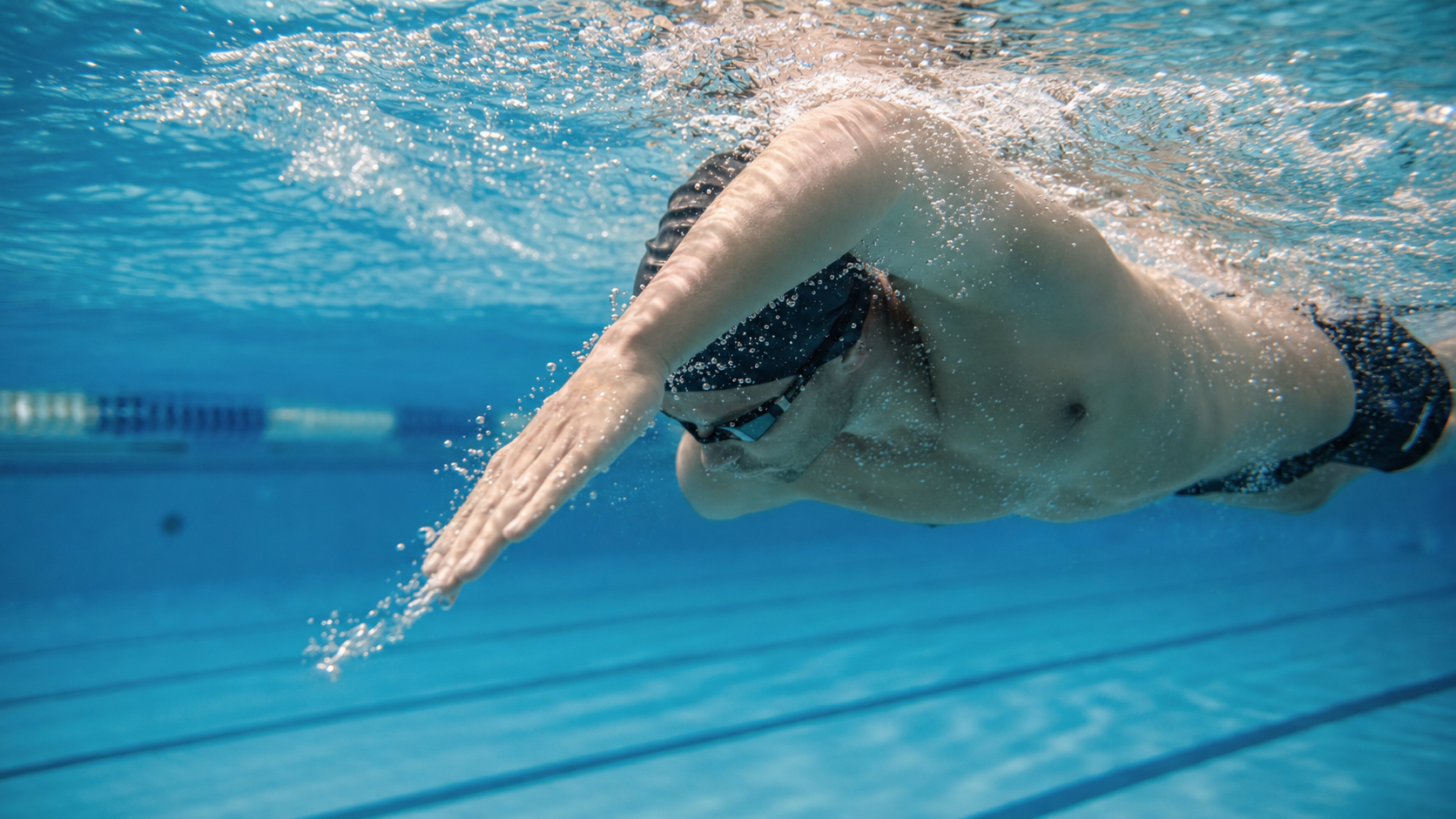
When a swimmer performs a “high elbow catch,” with the forearm entering the water vertically, the mechanoreceptors in the palm and forearm perceive maximum water pressure—this is the sensation of “pressing against a wall with the palm” when technique is good. When technique is poor, the hand slides through already-disturbed eddies, the pressure perceived by the receptors drops significantly, and the swimmer instinctively “feels that they didn’t catch the water.”
Vestibular-Proprioceptive Integration in Swimming
The unique challenge of swimming is that many common sensory cues are altered or disappear in the water:
Perceptual differences on land vs. in water:
- Gravity reference: Buoyancy partially counteracts gravity, weakening the body’s sense of “down,” making it easy to misjudge hip position
- Visual feedback: Surface glare and blurred underwater vision prevent vision from providing clear positional information
- Hearing: Sound travels differently in water, altering spatial perception
In this environment of reduced sensory information, the relative importance of the vestibular system and proprioception rises significantly. The brains of elite swimmers have learned to rely heavily on information from muscle spindles and skin receptors to control movement when visual information is lacking.
The Neurological Basis of Feel for the Water: The Sensorimotor Loop
The development of feel for the water is essentially the refinement of the sensorimotor loop:
- Perception: Palm receptors perceive water pressure information and transmit it to the sensory cortex
- Integration: The brain integrates proprioceptive, visual (limited), and vestibular information to compute the current body state
- Computation: Compares against an internal model of the “ideal movement” and calculates the error
- Adjustment: The motor cortex issues corrective commands, and the cerebellum coordinates movement execution
- Iterative refinement: After thousands of repetitions, the efficiency of this loop improves dramatically, and reaction time shortens
Key insight: Feel for the water is not an innate gift but an efficient sensorimotor loop built by the nervous system through extensive deliberate practice.
Training Methods to Improve Feel for the Water
Sensory Isolation Drills:
- Palm pressure perception drill: In still water, move the palm at different angles (parallel to the water surface, perpendicular to the water surface), feel the pressure changes, and build a perceptual map of palm pressure
- Closed-eye swimming (short distance): Under supervised safety, try swimming 15 meters with eyes closed, forcing the brain to rely entirely on proprioception rather than vision
- Slow technique swimming: Swim at an extremely slow pace, keeping every movement under conscious brain monitoring to reinforce perceptual details
Contrast Drills:
Alternate between “demonstrating errors” and “correct movements” to let the brain perceive the difference:
- First deliberately swim 25m with a “straight-arm entry” (no catch sensation), then swim 25m with a “high elbow catch”
- Feel the clear difference in palm pressure between the two situations, establishing a reference baseline for correct perception
Practical Advice
-
Use a pull buoy to train feel for the water: Eliminating leg interference allows full attention to focus on the hand’s feel for the water, building palm pressure perception more quickly.
-
Practice fingertip-first entry: Entering the water with the fingertips rather than the palm first reduces bubbles at entry (bubbles diminish feel for the water), allowing the hand to reach the catch position faster and perceive clear water pressure.
-
Keep a perception journal: After training, record “how was the feel for the water today” and “which stroke movement felt right.” This conscious reflection accelerates neural learning.
-
Don’t expect to maintain good feel for the water when fatigued: When the body is tired, both the sensitivity of sensory receptors and the brain’s integration capacity decline, so feel for the water also deteriorates. Fatigued training has its endurance benefits, but it is not the optimal time for developing feel for the water.
-
Expose yourself to different bodies of water: Swimming in pools, the ocean, lakes, and other environments allows the proprioceptive system to adapt to different buoyancy, currents, and pressure conditions, building a more versatile feel for the water.
Conclusion
“Feel for the water” is not a myth but the result of a highly trained proprioceptive system. From the mechanoreceptors in the palm to motor coordination in the cerebellum, from the vestibular system to the sensory cortex, behind feel for the water lies a complex and sophisticated neural sensory mechanism. Understanding this mechanism and stimulating it through purposeful perceptual training is the scientific path for any swimmer to improve their feel for the water—and their swimming efficiency.
Related Reading
- The Neuroscience of Swimming Feel: Proprioception and Feel-for-the-Water Training
- Swimming Feel (Feel for Water): What Is the Correct Perception of “Catching” the Water
- Is Feel for the Water Pseudoscience? Making It Scientific with Sculling Drills
- Neuromuscular Coordination in Swimming: Learning and Automating Movement Patterns in Water
[教學] Premiere 影片 手震 修正 教學 防抖 單眼 影像 GoPro 穩定 Video Stabilization
8 年前
[防寒衣體驗] 鐵人魂 三鐵 防寒衣試穿會 於松運 深水游泳池 鯨魚池
8 年前
CT 喇低賽) 武嶺牽車 才是王道 西進牽車四小時內秘訣 攝手位置 如何判斷 防抽筋小秘訣
7 年前
滑雪新手們慘摔學習全紀錄(請開字幕),滑雪好好玩 | Snowboard + Ski | 岩原 スキー場 | 滑雪APP使用 | GoPro Max
6 年前
#PUSHBIKE 原來這麼好玩! 小朋友 滑步車 初體驗 超可愛
6 年前
西進武嶺 免費訓練分析服務 Intervals | 練不夠還是練過頭?你哪一種類型選手?AI模型告訴你! | 備戰神器 | 公路車 訓練 | CT Yeh
4 年前
Insta 360 One 超級防手震技術實測
7 年前
松運深水池拍攝 作品 防寒衣品牌
8 年前