The Science of Aging and Swimming: How Regular Swimming Slows the Age-Related Decline in Aerobic Capacity
Introduction
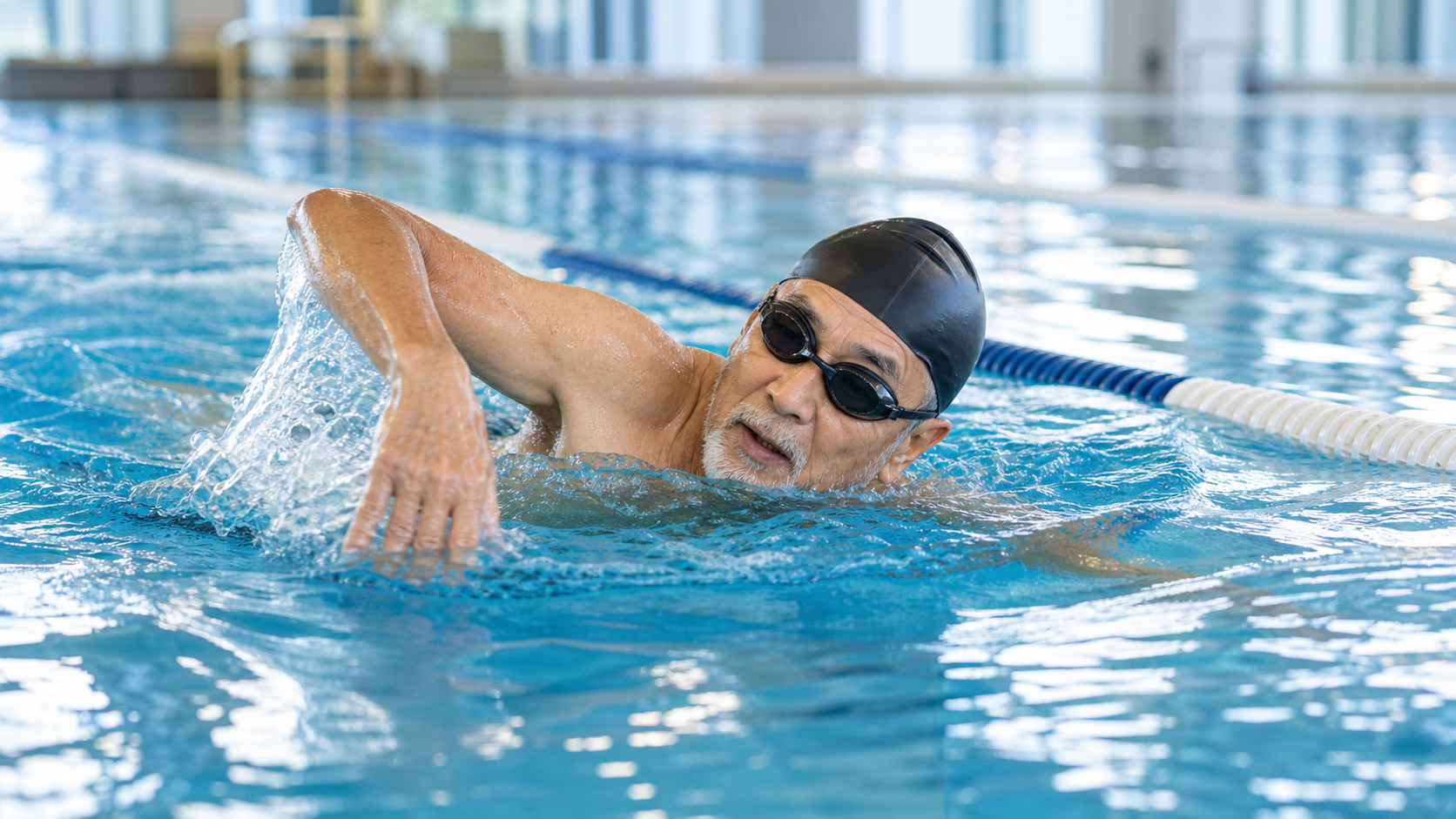
Aging is an irreversible physiological process, and the decline in cardiorespiratory capacity is particularly pronounced. Research shows that maximal oxygen uptake (VO₂max) declines by approximately 10% per decade after age 25, leaving only 40–50% of peak capacity by age 80. However, this decline curve is not destiny—it is closely tied to lifestyle. A large body of research shows that older adults who maintain a regular swimming habit retain their VO₂max and cardiorespiratory function far better than their sedentary peers, and in some metrics even approach levels seen in much younger individuals. Why is swimming so effective at countering the aging of aerobic capacity?
The Physiological Mechanisms of Age-Related Aerobic Decline
As we age, the decline of the cardiorespiratory aerobic system involves multiple levels:
| Physiological Parameter | Aging Trend | Primary Cause |
|---|---|---|
| Maximal heart rate | Declines ~6–10 beats/min per decade | Decreased sinoatrial node automaticity |
| Stroke volume | Declines 20–30% (age 70 vs. age 30) | Deterioration of ventricular diastolic function, arterial stiffness |
| VO₂max | Declines 10% per decade | The above two factors plus decreased muscle mitochondrial density |
| Vital capacity | Declines 5–10% per decade | Degeneration of lung elastic tissue, decreased respiratory muscle strength |
| Muscle mitochondrial density | Significant decline | Weakened mitochondrial biogenesis signaling |
| Arterial elasticity | Reduced (arterial stiffness) | Increased collagen cross-linking |
How Swimming Counters These Aging Mechanisms
The physiological characteristics of swimming give it a targeted counter-effect against the aging factors listed above:
1. Maintaining Cardiac Stroke Volume
The most critical cardiac issue in aging is diastolic dysfunction—the ventricles fail to fully relax and fill during diastole. The hydrostatic pressure of water promotes venous return, continuously providing the heart with a greater filling load (preload), which serves as a sustained training stimulus for ventricular diastolic function. Research shows that middle-aged and older adults who swim long-term have better diastolic function indices (E/A ratio) than sedentary peers of the same age, with some metrics even approaching those of younger groups.
2. Protecting Arterial Elasticity
Arterial stiffness is one of the core factors in age-related cardiovascular disease. Regular aerobic exercise, including swimming, maintains arterial elasticity through the following mechanisms:
- Increasing nitric oxide (NO) secretion, which dilates blood vessels and inhibits the stiffening process of the arterial wall
- Lowering resting blood pressure, reducing long-term pressure damage to the arterial wall
- Suppressing pro-inflammatory cytokines, slowing chronic inflammation of the arterial wall
Research shows that swimmers (average training history > 10 years) have an aortic stiffness index approximately 25–30% lower than sedentary peers of the same age.
3. Maintaining Muscle Mitochondrial Density
Mitochondrial aging (accumulation of mitochondrial DNA damage, reduced number) is an important peripheral mechanism in the decline of aerobic capacity. Swimming’s aerobic training continuously stimulates PGC-1α (the primary regulator of mitochondrial biogenesis), countering the decline in mitochondrial density that comes with natural aging.
4. Low-Impact Nature Makes Long-Term Adherence Possible
Perhaps swimming’s most important advantage in aging research is that its low-impact nature allows older adults to sustain high training volumes. The cumulative joint damage to knees and hips from running often forces people to drastically reduce training volume or stop entirely after age 50–60; swimming’s zero-impact environment allows athletes in their 70s and 80s to maintain training of 1–2 kilometers several times per week, with a substantial cumulative effect.
Research Cases: Swimming’s Long-Term Anti-Aging Benefits
Study 1: A study of male swimmers aged 35–70 (average training history > 15 years) found that the 70-year-old swimming group’s VO₂max (approximately 38 mL/kg/min) was higher than that of the 40-year-old sedentary group (approximately 35 mL/kg/min)—meaning that 30 years of swimming made the 70-year-olds’ cardiorespiratory capacity “30 years younger.”
Study 2: A long-term study at Indiana University in the United States tracked swimmers across multiple age groups and found that in the 25–70 age range, swimmers’ age-related VO₂max decline rate (approximately -5% per decade) was about half that of sedentary individuals (approximately -10% per decade).
Revisiting the Skeletal Limitations of Swimming for Older Adults
The previous discussion covered swimming’s challenges regarding bone density, and this issue is even more important for older swimmers:
Taiwan’s specific context: Osteoporosis is a serious problem among Taiwan’s elderly, with a prevalence exceeding 35% among women over 65. Pure swimmers who do not supplement with bone-loading exercise may face an elevated fracture risk.
Recommended strategy: Swimmers over 50 should combine swimming with twice-weekly strength training or high-impact land-based activities—using swimming to protect joints and maintain cardiorespiratory function, and land-based training to preserve bone density. This “water-land integration” strategy is the ideal combination in geriatric exercise science.
Anti-Aging Benefits of Swimming Across Different Populations
Chronic disease management:
- Hypertension: Swimming is one of the best-evidenced exercise modalities for lowering blood pressure; regular swimming can reduce systolic blood pressure by 6–8 mmHg
- Type 2 diabetes: Improves insulin sensitivity and blood glucose control
- Arthritis: Maintains joint mobility and muscle strength while completely avoiding joint impact
Neurocognitive benefits:
The protective effects of aerobic exercise on brain aging are well supported by research. As an aerobic activity, swimming promotes hippocampal neurogenesis by increasing the secretion of brain-derived neurotrophic factor (BDNF), which is beneficial for maintaining cognitive function.
Practical Recommendations
-
Build a swimming habit starting in middle age: The protective effect of swimming against cardiorespiratory aging is most pronounced in those who have trained for over 10 years. Establishing the habit at age 40 allows you to enjoy maximum dividends in your 60s and 70s.
-
Set age-appropriate training goals: For swimmers over 60, maintaining training of 1000–1500 meters three times per week is sufficient to obtain significant cardiorespiratory protection—there is no need to chase the distances and speeds of your youth.
-
Join senior swimming communities: Early-morning swimming groups and senior swimming clubs across Taiwan not only provide social support for regular training but also serve as an important safety net (with companions keeping watch).
-
Get regular cardiac function screenings: For swimmers over 50, an exercise ECG and echocardiogram every 2–3 years is recommended to detect abnormal changes in the athlete’s heart early.
-
Supplement swimming with strength training: Don’t let swimming be your only form of exercise. Twice-weekly strength training (compound movements such as squats, rows, and bench presses) can compensate for swimming’s shortcomings in muscle strength and bone density, maintaining more comprehensive physical function in old age.
Conclusion
Swimming is one of the aerobic exercises with the strongest scientific evidence for longevity. Its low-impact nature makes sustained high training volumes possible, the unique physical environment of water provides distinctive training stimuli for the heart and blood vessels, and the whole-body aerobic metabolic demand counters the aging of mitochondria and muscle. For Taiwan’s progressively aging society, promoting swimming as a core exercise for maintaining physical function in old age carries profound public health significance. Starting to swim today is the best gift you can give your future self.
Related Reading
- Cardiorespiratory Adaptations in Swimming: Research on the Magnitude of VO₂max Improvement from Regular Swimming
- VO₂max Decline in Masters Athletes: Genetically Set, but the Rate of Decline Is Negotiable
- Age and Cycling Performance: VO₂max Decline Rate and Maintenance Strategies
- Health Benefits of Swimming for Older Adults: Joint-Friendly Aerobic Training
#公路車 #Vo2Max #最大攝氧量 測驗 體驗 | 心肺測試
6 年前
西進武嶺 免費訓練分析服務 Intervals | 練不夠還是練過頭?你哪一種類型選手?AI模型告訴你! | 備戰神器 | 公路車 訓練 | CT Yeh
4 年前
[教學] Premiere 影片 手震 修正 教學 防抖 單眼 影像 GoPro 穩定 Video Stabilization
8 年前
靠單車減肥35公斤 心得分享與整理
7 年前
16/02/16 - 夜訪中社路 緩慢進步中
10 年前
實景訓練台) 彰化經典百K 高強度喵團 90分鐘 跟著一起練功 2019 Indoor workout Changhua Classic 100 Taiwan
7 年前
教學) 如何做出專業 慢動作 影片 Slow Motion 120fps GoPro 7 ActionCam AX700 A99II
7 年前
live) 超越北高 之一日北高12小時 策略
7 年前