Introduction
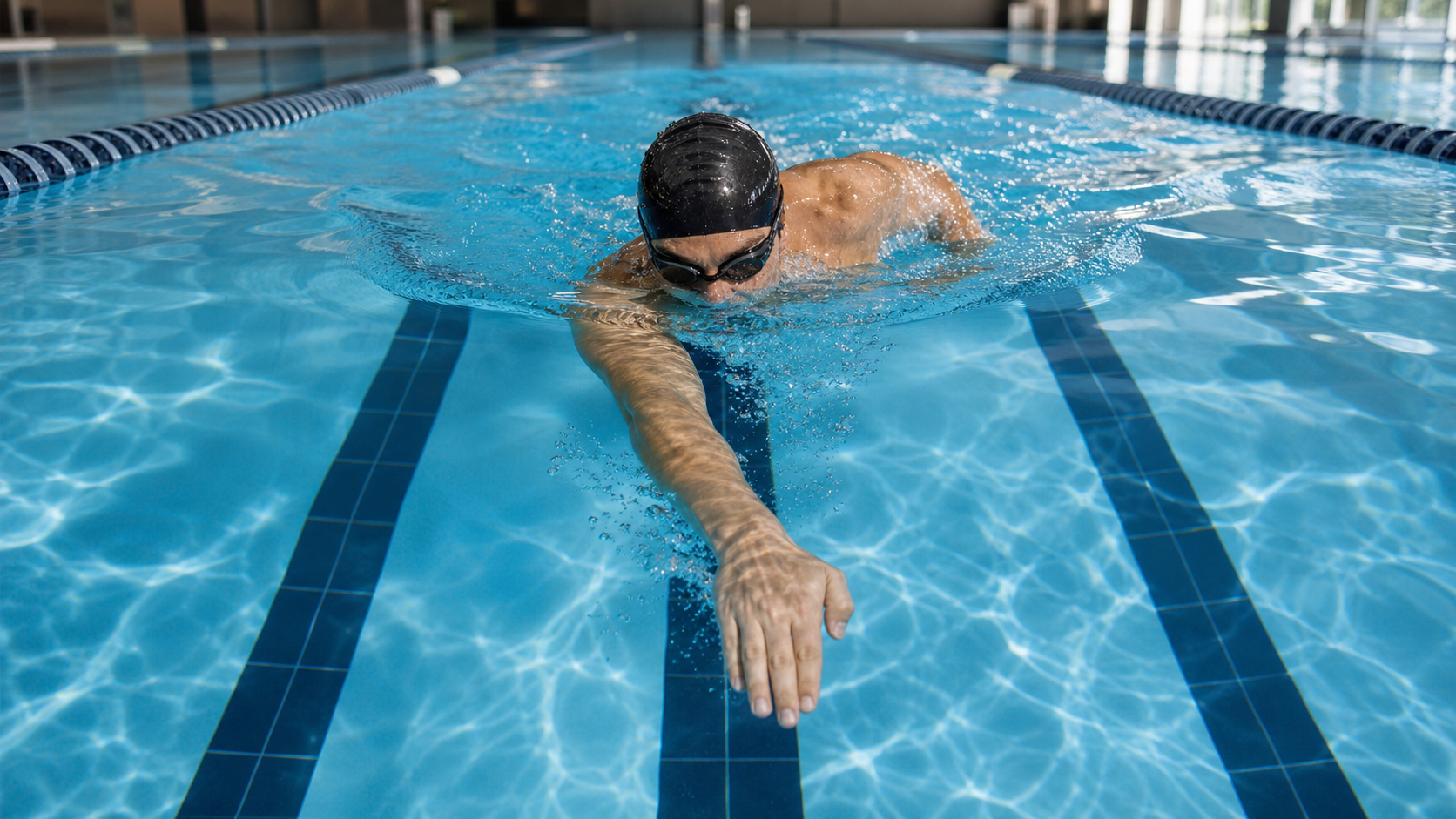
In the observation of swimming coaches, “hand crossing the centerline” is one of the most common technical issues among freestyle learners. When your hand crosses the body’s midline upon entry underwater, what seems like a minor deviation triggers a chain reaction: the body begins to snake, drag increases, and the shoulders endure unnecessary rotational stress. Many swimmers think they are swimming “pretty well” until a coach films them with an underwater camera and they are shocked. This article will delve into the causes of crossing the centerline and provide systematic corrective training.
What Is “Hand Crossing the Centerline”?
In a correct freestyle entry, the palm should land on the extension line of the shoulder on the same side, approximately at shoulder width in front of the top of the head. Once the hand crosses the centerline of the nose bridge and enters the water on the opposite side, it constitutes “crossing the centerline.”
| Criterion | Correct Position | Crossing the Centerline |
|---|---|---|
| Entry position | Directly in front of the same-side shoulder | Crosses the extension line of the nose bridge |
| Body response | Steady forward movement | Hips and lower back snake side to side |
| Shoulder sensation | Natural extension | Feeling of internal rotation and twisting |
| Drag performance | Low-resistance forward motion | Noticeable lateral swaying |
Common Cause Analysis
Head Held Completely Still
Many beginners habitually keep their head completely fixed, trying to “see clearly ahead.” This habit causes the shoulders to lose their correct reference axis during the roll, and the hand naturally drifts toward the centerline, or even crosses it.
Excessive Body Roll During Breathing
When the breathing motion is not yet refined, swimmers often rely on the arm “pulling” to supplement the rolling force, causing the entering hand to subconsciously reach toward the opposite side to balance the body.
Compensatory Movements from Weak Core
When the abdominal and gluteal muscles are not strong enough, the body seeks other ways to maintain balance. The hand crossing the centerline provides a brief sense of “stability,” but the cost is distorting the overall pull path.
Misleading Visual Habits
During pool training, swimmers subconsciously try to “align with the lane centerline” while swimming, which instead causes the hand to drift toward the middle. This is a technical deviation caused by psychological factors and requires special attention.
Injuries and Efficiency Loss Caused by Crossing the Centerline
- Shoulder impingement syndrome: When the arm pulls across the centerline underwater, the shoulder is in an unnatural internally rotated position, and long-term accumulation can easily lead to rotator cuff inflammation.
- Excessive lumbar rotation: The snaking compensatory movement causes the lower back to twist repeatedly left and right, leading to cumulative injury.
- Reduced speed: Every snake-like movement is unnecessary lateral displacement, consuming energy without producing forward speed.
- Disrupted rhythm: An unstable body axis makes it difficult to maintain breathing rhythm.
Corrective Drill Methods
Drill 1: Single-Arm Pull Confirmation
Keep one hand at your side (or hold a kickboard) and pull with only the other arm. This makes it easier to feel the hand’s entry position. Confirm that the entry point is directly in front of the same-side shoulder, and use a few slow strokes to internalize the correct entry sensation.
Drill 2: Magnetic Finger Imagery
During practice, imagine a magnetic connection between the same-side shoulder and your thumb. When the palm enters the water, it is “attracted by the magnet” to land directly in front of the shoulder. This mental cue is highly effective for many swimmers.
Drill 3: Lane Line Confirmation
In the shallow end of the pool, look down to observe the hand’s entry path underwater, confirming that the palm lands on both sides of the head rather than in the middle. This requires good feel for the water and body awareness, and it is recommended to practice with a coach present.
Drill 4: Pulling Pipeline Drill (Dogleg Drill)
Imagine a straight pipeline from the shoulder to the palm. The hand must move within this pipeline and must not deviate. After every 100 meters of practice, stop and recall whether the hand’s path remained straight.
Practical Advice
- Video review: Ask a training partner to film an overhead underwater shot—this is the most intuitive way to check. Many pools in Taiwan offer underwater filming services, and it is strongly recommended to take advantage of them.
- Prioritize slow practice: Correcting the centerline crossing requires building new neuromuscular memory. First practice the correct movement at a slow pace, then gradually increase speed.
- Strengthen the core simultaneously: Incorporate core training such as planks, side planks, and bird dogs to address the root source of compensatory movements.
- Practice volume recommendation: Dedicate the first 400–600 meters of each session to correcting the entry position. Noticeable improvement can be seen within 3–4 consecutive weeks.
Conclusion
Hand crossing the centerline may seem minor, but it is a key issue affecting freestyle efficiency and health. Through cause analysis, it becomes clear that it is often the combined result of a fixed head, improper breathing, and a weak core. The correction process requires patience: first build the correct sensation with single-arm drills, then add core training to eliminate compensatory movements, and finally confirm results through video review. Stick with 4–6 weeks of deliberate practice, and you will be surprised by the dual improvement in speed and shoulder comfort.
Related Reading
- Optimizing the Freestyle Hand Entry Point: Common Cross-Over Entry Errors and Fixes
- Breaststroke Pull Too Wide: Technical Correction for Lost Propulsion Efficiency
- Incorrect Backstroke Hand Entry Angle: Prevention and Correction of Shoulder Injuries
- Excessive Body Roll During Freestyle Breathing: Corrective Training for Bilateral Breathing
CT 喇低賽) 武嶺牽車 才是王道 西進牽車四小時內秘訣 攝手位置 如何判斷 防抽筋小秘訣
7 年前
西進武嶺 自製新版AI配速表產生器 x 賽前攻略 抱佛腳! 沒有功率計也可以產生配速表嗎?有什麼其他眉角賽前要注意的呢? | 西進武嶺 / 東進武嶺 KOM 攻略 | 公路車 | CT Yeh
4 年前
西進武嶺 免費訓練分析服務 Intervals | 練不夠還是練過頭?你哪一種類型選手?AI模型告訴你! | 備戰神器 | 公路車 訓練 | CT Yeh
4 年前
一日北高/長距離團騎 常見問題補充篇 / 組團或跟團的眉角 / 壯車友容易被瘦車友慢性拉爆 / 原來屁股痛可能是這個原因...? / 風場配速法 / 公路車 / CT Yeh
2 年前
[教學] Premiere 影片 手震 修正 教學 防抖 單眼 影像 GoPro 穩定 Video Stabilization
8 年前
FTL 與 SYB 車隊專訪 西進武嶺 實用攻略分享! 2小時 如何練?!你不知道的眉角!新手準備武嶺必看 EP1 | 實力派女車友 | 精華版 | 公路車 | CTYeh
4 年前
戰略) Zwift Race 如何咬在第一集團 如何評估自己要開多少推力 (請開1.5倍速看)
7 年前
#公路車 #西進武嶺 配速配瓦實驗 坡度分析 四小時內攻略 建大盃 NeverStop #西進武嶺攻略
6 年前