Introduction
“Swimmer’s shoulder” is a persistent problem for many swimming trainees. Statistically, shoulder injuries are the most common overuse injury in swimming, and the dropped elbow pull is often the main culprit. In contrast, the “high-elbow pull,” also known as the Early Vertical Forearm (EVF), is widely recognized as the most efficient and shoulder-friendly pulling technique. This article will analyze the dangers of the dropped elbow from a biomechanical perspective and provide practical, actionable high-elbow drills.
Definition and Identification of the Dropped Elbow Pull
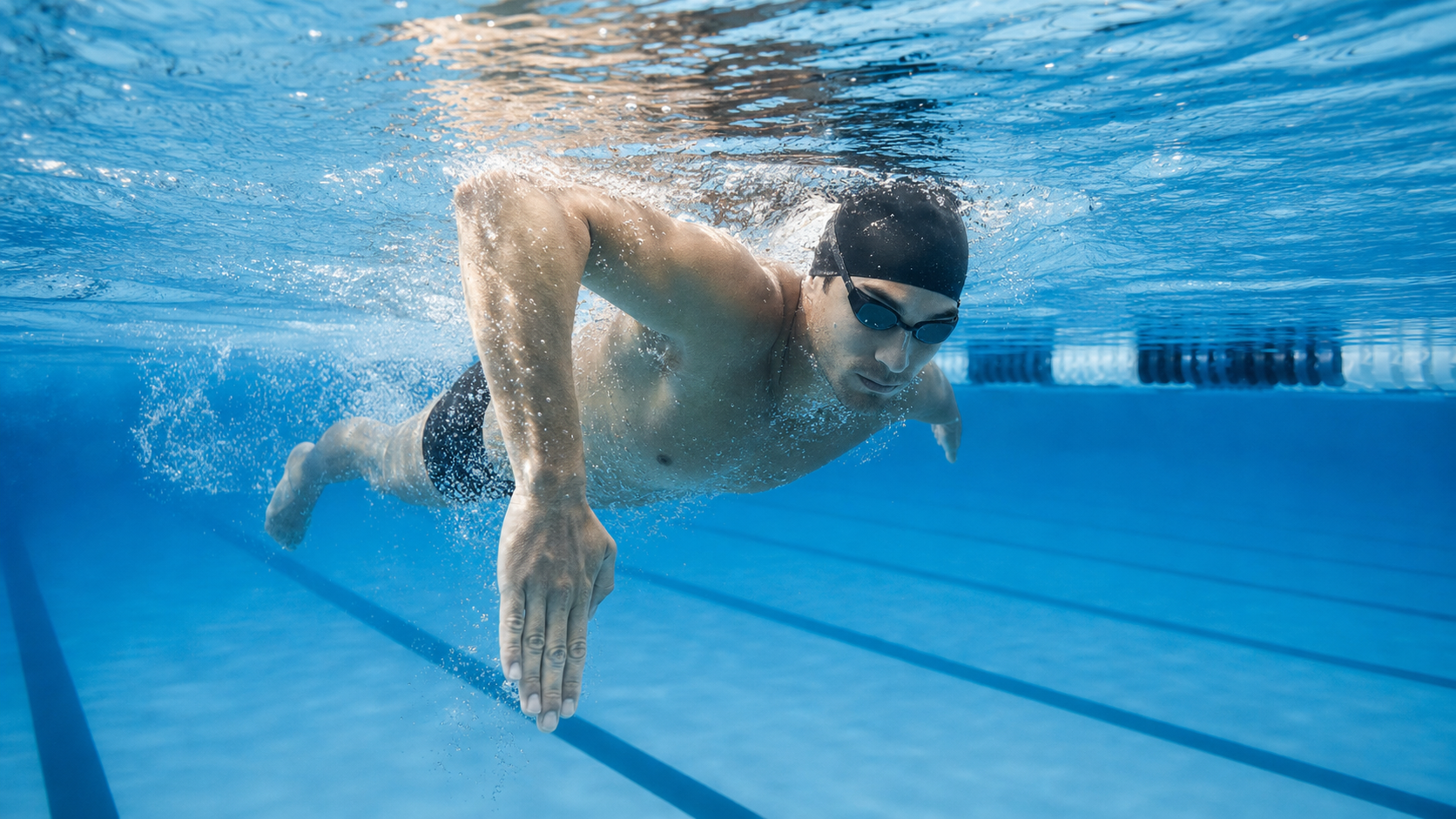
The dropped elbow pull refers to the elbow sinking below the wrist or shoulder during the underwater pulling phase, preventing the forearm from being perpendicular to the direction of travel and significantly reducing propulsion efficiency.
| Pull Type | Elbow Position | Forearm Angle | Propulsion Efficiency | Shoulder Load |
|---|---|---|---|---|
| Dropped Elbow Pull | Below the wrist | Diagonal, backward and downward | Low (estimated 30-40% loss) | High (high impingement risk) |
| High-Elbow Pull (EVF) | Above the wrist | Nearly vertical | High (maximal resistance area) | Low (force distributed evenly) |
Why Does the Dropped Elbow Cause Shoulder Injuries?
Biomechanical Analysis
During a dropped elbow pull, the arm’s propulsion angle underwater forces the shoulder into the “impingement zone”—a position where the arm is elevated and internally rotated. At this point, the space between the acromion and the rotator cuff narrows, and repeated friction eventually leads to subacromial bursitis or rotator cuff tendinitis.
Compensatory Movements Worsen the Injury
To “grab water,” swimmers with a dropped elbow typically:
- Shrug their shoulders to try to raise the elbow (increasing trapezius strain)
- Increase stroke rate to compensate for reduced force per stroke (increasing total stroke count and accumulating more damage)
- Scull the hand outward instead of pushing backward (increasing external rotation stress on the shoulder)
Core Principles of the High-Elbow Pull (EVF)
The key to EVF is to immediately “lock the elbow and rotate the forearm downward” after hand entry, so the forearm faces the direction of travel, standing vertically in the water like a paddle. This action:
- Maximizes the propulsive surface area of the forearm and hand
- Allows large muscle groups such as the latissimus dorsi and teres major to dominate the pull, rather than small muscles (rotator cuff)
- Keeps the shoulder within a safe biomechanical range
High-Elbow Drills (Progressive)
Phase 1: Dry-Land Feel Drill
Stand with your arm extended forward at shoulder height, keeping the elbow at shoulder level, and rotate the forearm downward until it is perpendicular to the ground. Feel the sensation of the elbow “suspended high with the forearm hanging down.” Perform 2-3 sets of 15 repetitions daily.
Phase 2: Kickboard High-Elbow Drill
Hold a kickboard with both hands and practice only the first half of the pulling arm’s stroke (from entry to the lowest point of the elbow joint). The focus is on immediately raising the elbow after hand entry, feeling the forearm “stand up” and push backward, rather than dragging the entire arm diagonally downward.
Phase 3: Slow Single-Arm Swimming
Use a pull buoy to float your legs and perform single-arm pulls at a very slow pace, deliberately feeling the elbow position on each stroke. Have a partner observe from the poolside, or record yourself on video to confirm.
Phase 4: Fingertip Entry Drill
On each entry, let your fingertips enter the water first, then sequentially complete the “extend the forearm, raise the elbow” motion. This sequence helps build the correct transition from entry to catch.
Common Misconceptions and Solutions
-
Misconception 1: Forcefully raising the elbow tenses the shoulder
Correct EVF is not achieved by shrugging to lift the elbow, but by rotating the forearm. Keep the shoulder relaxed and let the forearm rotate actively. -
Misconception 2: High elbow makes swimming feel more tiring
This is true initially, because larger muscle groups are being engaged. After 2-3 weeks of consistent practice, once the large muscles adapt, it will actually feel more effortless. -
Misconception 3: Watching videos is enough to learn it
EVF is a proprioceptive skill—knowing it in your head doesn’t mean your body can do it. Muscle memory must be built through repeated, deliberate practice.
Practical Recommendations
- Pair with shoulder mobility training: High-elbow pulling requires good shoulder joint mobility. Perform daily stretches for shoulder external rotation and thoracic extension to help execute the movement fully.
- Use paddles: Moderate use of paddles can increase water resistance feedback, helping you feel the force of the forearm “standing up” to push water. Start with small paddles.
- If you already have shoulder pain: Pause high-intensity training first, consult a physical therapist to confirm the condition, then correct your technique within a pain-free range.
- Track progress: Record an underwater front-view video every 2 weeks, compare changes in elbow height, and maintain motivation to improve.
Conclusion
Transitioning from a dropped elbow to a high-elbow pull is a journey that requires patience, but it is the most worthwhile swimming technique improvement you can invest in. It’s not just about gaining speed—more importantly, it frees your shoulders from a high-risk state of injury. By following the four-phase drills provided in this article, combined with daily dry-land mobility training, most swimmers will feel a noticeable difference within 4-6 weeks. Protecting your shoulders is protecting the foundation that allows you to train consistently for the long term.
Related Reading
- Freestyle High-Elbow Pull: The Core Key to Water Feel Technique
- Freestyle High-Elbow Catch Fully Broken Down: The Mechanics Secrets from Entry to Push
- The “High-Elbow Entry” Technique in Freestyle Strokes: The Impact of Elbow Angle on Propulsion Efficiency
- Freestyle High-Elbow Sculling Technique: Muscle Activation Sequence and Common Error Analysis
CT 喇低賽) 武嶺牽車 才是王道 西進牽車四小時內秘訣 攝手位置 如何判斷 防抽筋小秘訣
7 年前
抖肩舞 台灣x日本交流版 (台灣 vs 前橋) 赤城山登山賽 coincidance
8 年前
西進武嶺 免費訓練分析服務 Intervals | 練不夠還是練過頭?你哪一種類型選手?AI模型告訴你! | 備戰神器 | 公路車 訓練 | CT Yeh
4 年前
[教學] Premiere 影片 手震 修正 教學 防抖 單眼 影像 GoPro 穩定 Video Stabilization
8 年前
一日北高/長距離團騎 常見問題補充篇 / 組團或跟團的眉角 / 壯車友容易被瘦車友慢性拉爆 / 原來屁股痛可能是這個原因...? / 風場配速法 / 公路車 / CT Yeh
2 年前
NEKO's Fun 高美濕地團練
8 年前
碟煞公路車 銑面器 !? 原來銑完差這麼多! 降低蹭碟機率! | TIME 公路車 保養小記錄 | CT Yeh
3 年前
JJSC一槍北港 百K團實錄!跟團技巧分享 ft. Roden / 中部練車新選擇 / 開箱全台最便宜早餐店!/ 公路車 / CT Yeh
1 年前