Introduction
If you’ve ever felt like “swimming gets more tiring as you go, and your legs feel like they’re dragging a heavy weight,” the problem may well be your head position. In freestyle, the head acts as the body’s “ballast”—raise the head and the legs sink; lower the head and the body levels out. This lever principle is simple, yet it’s a key factor many swimmers overlook for years. This article explains the effects of a head position that’s too high and provides specific corrective methods.
The Correct Standard for Head Position
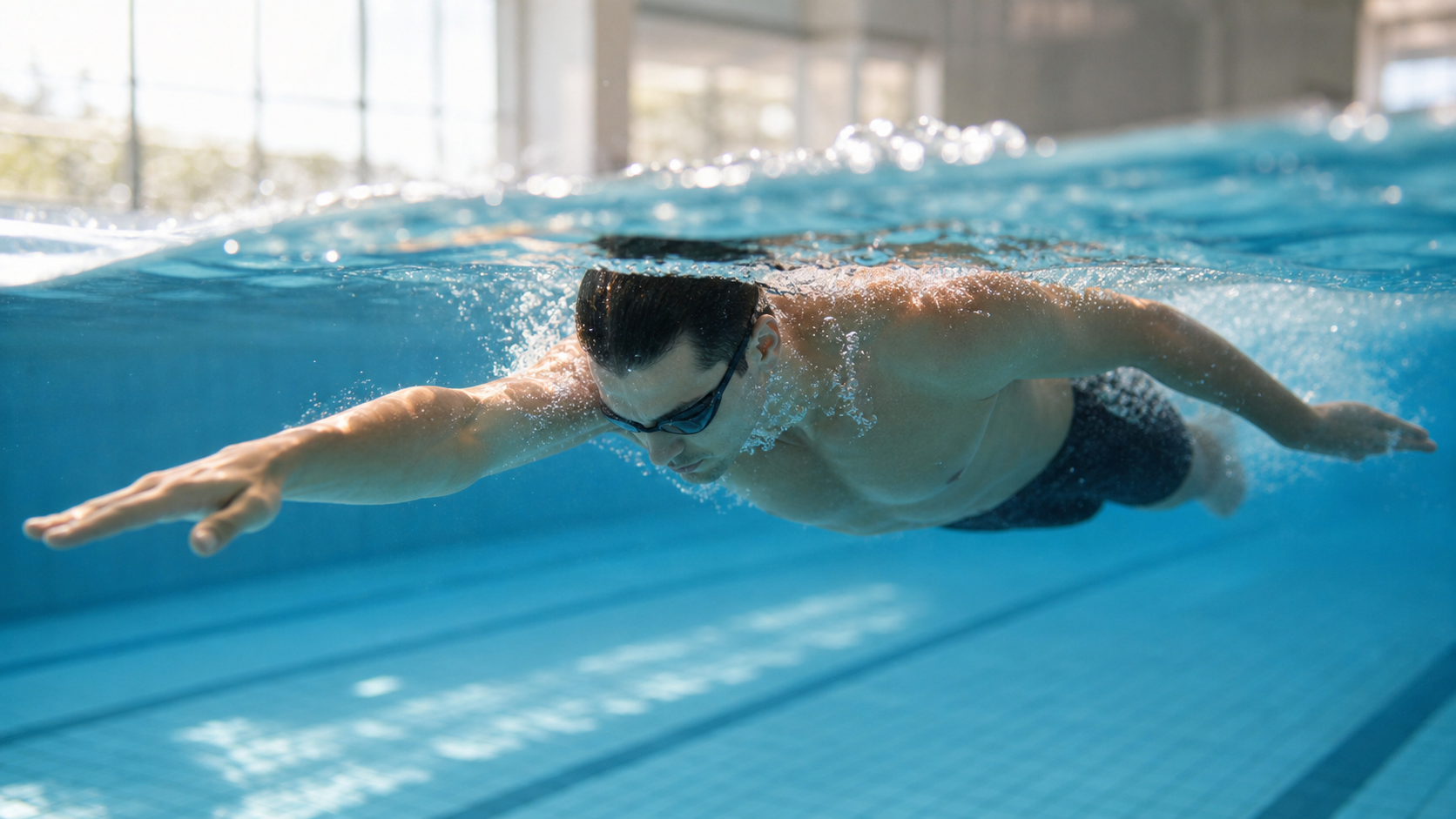
In freestyle, the correct head position is:
- The waterline cuts across the upper forehead, roughly between the crown of the head and the hairline
- Eyes look downward, with the gaze directed at the pool bottom about 45 degrees ahead
- The neck extends naturally, without deliberately tucking the chin or lifting the head
A common habit among beginners is lifting the head to “look ahead,” with the waterline cutting across the eyes or chin—this is the state of having the head too high.
Effects of a Head Position That’s Too High
| Affected Area | Description |
|---|---|
| Legs sink | The weight of the head rises, and the hips and legs sink in the opposite direction, creating a sloped body position |
| Increased drag | The cross-sectional area of the sloped body increases significantly, raising resistance by more than 50% |
| Energy expenditure | Constant kicking is needed to maintain leg position, wasting unnecessary energy |
| Neck fatigue | The neck extensor muscles resist water pressure for extended periods, leading to soreness and stiffness |
| Difficulty breathing | With the head already high, breathing requires going “even higher,” making the breathing motion more strenuous |
Why Do Swimmers Get Into the Habit of Lifting Their Heads?
The Psychology of Feeling Safe
In open water or an unfamiliar pool, lifting the head to see where you’re going provides a sense of security. Once this habit is brought into the pool, it’s hard to break.
Breathing Anxiety
Swimmers worried about not getting enough air subconsciously lift their heads early to get their mouths out of the water sooner. This keeps the head in a persistently higher position.
Incorrect Visual Feedback
Swimmers can’t directly see their own body position, so they usually feel like they “look like they’re looking down” when in reality their head is still too high.
Corrective Drill Steps
Drill 1: Hairline Waterline Awareness
Stand in shallow water, face down and submerged, and feel where the waterline cuts across your forehead (rather than below the nose). Repeat several times to build the correct tactile memory, then carry it into your swimming stroke.
Drill 2: Torpedo Drill
Extend both arms forward in a streamlined position and propel yourself with kicking, keeping your face fully down and your head tucked between your arms. This drill helps swimmers experience the “buoyancy miracle” when the head is lowered—the legs float up naturally, and you can stay horizontal with almost no kicking effort.
Drill 3: Thumb-Brush-Kick Drill
During kicking practice, require your thumbs to lightly brush the outside of your thighs on every kick cycle. This forces the hips to stay near the surface, indirectly helping to keep the head in a low position.
Drill 4: Rotate the Head Only at the Last Moment Before Breathing
For many people, the head lifting starts with the breathing motion. Practice rotating your head only at the last moment before breathing, rather than lifting it in advance to “get ready to breathe.” After breathing, return your head to the water immediately—don’t linger at the surface.
Coordinating Head Position with Breathing
The correct breathing motion is “rotating the head,” not “lifting the head”:
- The body rolls naturally 30-45 degrees with the pulling motion
- The head follows the body’s rotation, allowing the mouth to clear the water from the side of the body (rather than the front)
- After breathing, the head and body return to center together
This coordinated motion means the head barely needs to be actively lifted throughout the entire stroke; the mouth clearing the water for breathing is accomplished naturally through the body roll.
Practical Tips
- Underwater video is the best teacher: The head position you feel and the actual position are often very different. One underwater video is worth a hundred verbal reminders.
- Foam noodle assisted training: Place a foam noodle near the top of your head—if your head lifts, it will touch the noodle, providing instant feedback.
- Combine with kickboard kicking: While kicking with both hands holding a kickboard, deliberately keep your face down and your forehead in the water to reinforce the feeling of kicking with a lowered head.
- Progress gradually: At first, lowering your head may make you feel like you’re “about to sink.” This is a normal psychological response. Stick with it for a few sessions and you’ll find your body becomes much more stable.
Conclusion
Head position is a key technical point in freestyle where a small change affects the whole body. Fixing a head position that’s too high doesn’t require special strength or flexibility—it requires proper body awareness and deliberate habit change. Starting with today’s training, give yourself a reminder: “Head down, feel the water flowing over your forehead.” This small change will bring an unexpectedly big leap in your swimming efficiency.
Related Reading
一日北高/長距離團騎 常見問題補充篇 / 組團或跟團的眉角 / 壯車友容易被瘦車友慢性拉爆 / 原來屁股痛可能是這個原因...? / 風場配速法 / 公路車 / CT Yeh
2 年前
一日北高常見問題大集合 | 攻略 | 路線 | 訓練 | 補給 | 自行車 單車 | 一日雙城 | 雙塔 | TWB北高360 | 屁股痛
6 年前
西進武嶺 自製新版AI配速表產生器 x 賽前攻略 抱佛腳! 沒有功率計也可以產生配速表嗎?有什麼其他眉角賽前要注意的呢? | 西進武嶺 / 東進武嶺 KOM 攻略 | 公路車 | CT Yeh
4 年前
CT 喇低賽) 武嶺牽車 才是王道 西進牽車四小時內秘訣 攝手位置 如何判斷 防抽筋小秘訣
7 年前
16/02/16 - 夜訪中社路 緩慢進步中
10 年前
抖肩舞 台灣x日本交流版 (台灣 vs 前橋) 赤城山登山賽 coincidance
8 年前
[教學] Premiere 影片 手震 修正 教學 防抖 單眼 影像 GoPro 穩定 Video Stabilization
8 年前
戰略) Zwift Race 如何咬在第一集團 如何評估自己要開多少推力 (請開1.5倍速看)
7 年前