Introduction
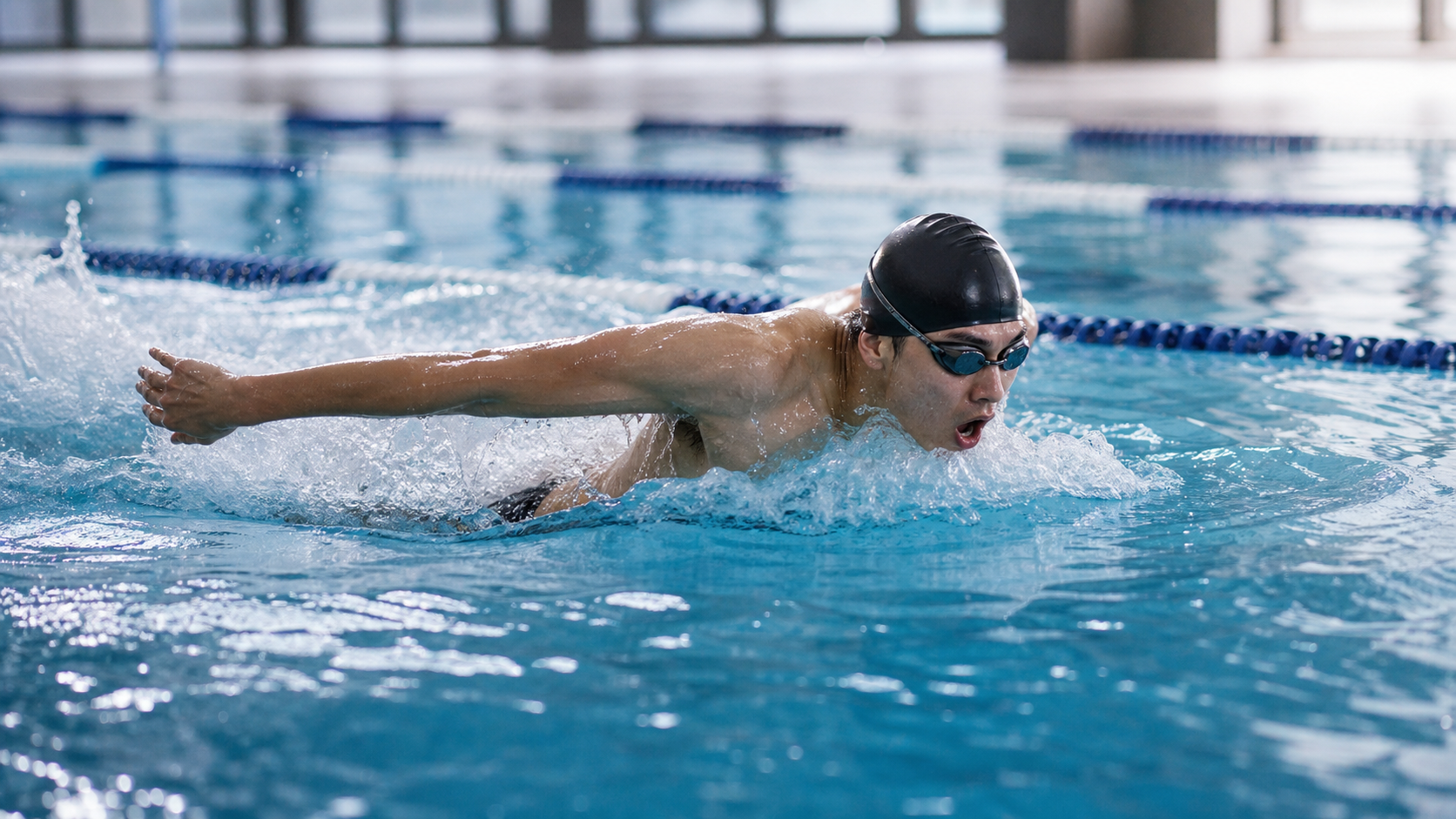
The butterfly stroke is widely recognized as the most technically complex and physically demanding stroke. Many swimmers, after mastering the basic movements, still feel “stuck” when swimming, experience lower back soreness quickly, and struggle to improve their speed. This is often because the wave propulsion in butterfly comes from “excessive lower back bending” rather than “hip drive.” The two may seem similar, but they differ vastly in efficiency and safety.
The Correct Principles of the Butterfly Wave Motion
Butterfly propulsion relies on the body’s full “undulation.” The correct sequence of movements is:
Sternum presses forward and down → Hips sink downward → Hips spring upward → Legs whip
The power source of this wave is the up-and-down oscillation of the hips, not excessive bending of the lower back.
| Technique Comparison | Hip Drive (Correct) | Lower Back Bending (Incorrect) |
|---|---|---|
| Wave origin | Sternum, hips | Lumbar spine |
| Lumbar spine angle | Relatively stable | Excessive bending |
| Propulsion efficiency | High (large muscle groups involved) | Low (mainly small muscle groups) |
| Lower back injury risk | Low | High (repeated lumbar hyperflexion) |
| Body appearance | Smooth undulation | Violent up-and-down movement |
Causes of Excessive Lower Back Bending
Insufficient Core Strength
When the core muscles (especially the transversus abdominis and multifidus) are not strong enough, the body cannot maintain adequate spinal stiffness. The lumbar spine becomes overly “compliant” during the wave motion, resulting in exaggerated bending.
Incorrect Technical Understanding
Some beginners hear “wave motion” and assume they should bend their lower back as much as possible. In reality, the butterfly wave comes primarily from the coordination of the shoulders, chest, and hips, not from active flexion of the lumbar spine.
Lack of Thoracic Spine Mobility
The sternum-pressing-down motion in butterfly requires good thoracic spine extension mobility. If the thoracic spine is stiff, swimmers often compensate with excessive lumbar flexion, causing the movement to concentrate in the lower back.
Corrective Drills for Hip Drive
Dry-Land Drill: Dolphin Wave
Lie face down on a mat with both arms extended forward. Practice the sequence: chest sinks and touches the mat → hips sink → the whole body moves forward like an inchworm. Focus on feeling the hips (not the lower back) actively sinking and rising. Perform 2-3 sets of 10 repetitions per session.
Water Drill 1: Streamlined Dolphin Kick
Extend both arms forward, keep the body in a streamlined position, and move forward with a dolphin kick. Focus on feeling that the power of each kick comes from the whipping of the hips, not the bending of the lower back. You can practice with both hands holding your head to remove arm movement interference.
Water Drill 2: One-Arm Butterfly
Extend one arm forward while the other rests along the body, swimming with a one-arm butterfly. This drill helps swimmers more clearly feel the corresponding hip drive during each arm pull.
Water Drill 3: Slow-Motion Butterfly Breakdown
Swim the butterfly wave motion “3 times slower,” consciously feeling the sequence of the wave starting from the chest, transmitting through the hips, and reaching the legs at a slow pace. This sensation is difficult to detect when swimming fast; slow practice helps build the correct movement pattern.
Supplementary Thoracic Spine Mobility Training
- Cat-Cow: Start on all fours, alternately arching the back (cat) and dropping the belly (cow). Perform 10-15 repetitions per set, focusing on segmental movement of the thoracic spine.
- Thoracic Spine Foam Rolling: Sit on the floor with a foam roller placed horizontally under the mid-thoracic spine. Clasp your hands behind your head and slowly lean back into extension. Hold each position for 10-15 seconds and move up and down along the thoracic spine.
- Thread the Needle from Child’s Pose: In child’s pose, reach one arm across the body toward the opposite side to help with thoracic spine rotation and extension.
Practical Advice
- Don’t rush into full butterfly: Intersperse 25-meter dolphin kick drills in each training session. Ensure the feeling of hip drive is “fresh in your memory” before swimming full butterfly.
- Focus on the “pushing sensation” rather than the “bending sensation”: With each kick, imagine the glutes actively pushing down against the water, rather than the lower back bending—this mental cue often works wonders.
- If your lower back is already painful: Stop butterfly training. First, perform core strengthening and thoracic spine mobility exercises for at least 2 weeks, then restart with low-intensity, slow butterfly.
- Control the volume of butterfly practice: Butterfly places far greater cumulative stress on the lumbar spine than other strokes. It is recommended that butterfly make up no more than 20% of total training volume per session, gradually increasing as technique improves.
Conclusion
The beauty and efficiency of butterfly come from a smooth wave generated by the hips, not from excessive bending of the lumbar spine. By combining dry-land dolphin wave drills, in-water dolphin kick feel, and thoracic spine mobility training, swimmers can progressively build a correct butterfly technique foundation. Remember: protecting the lumbar spine is not just about avoiding injury—it’s about ensuring every butterfly stroke achieves maximum propulsion efficiency.
Related Reading
- Butterfly Wave Motion: Coordination Training for Hip Drive and Arm Synchronization
- The Science of Butterfly Wave Motion: A Guide to Hip Drive and Rhythm Coordination Training
- Butterfly Wave Motion: Coordination Training for Chest and Hip Rise-and-Fall
- Butterfly Dolphin Wave: An Introductory Breakdown of Spinal Rhythm and Core Transmission
[教學] Premiere 影片 手震 修正 教學 防抖 單眼 影像 GoPro 穩定 Video Stabilization
8 年前
CT 喇低賽) 武嶺牽車 才是王道 西進牽車四小時內秘訣 攝手位置 如何判斷 防抽筋小秘訣
7 年前
Nepest NOVA 碳條輪組:輕量、空力、舒適一次滿足!/ 公路車 / CT Yeh
7 個月前
一日北高/長距離團騎 常見問題補充篇 / 組團或跟團的眉角 / 壯車友容易被瘦車友慢性拉爆 / 原來屁股痛可能是這個原因...? / 風場配速法 / 公路車 / CT Yeh
2 年前
鉅齒紋輪組!? ControlTech MEG-T50 EVO 碳纖維幅條輪組/ 功率對比實驗 / 公路車 / CT Yeh
2 年前
風櫃嘴 衝刺慢動作回放!
8 年前
下次拍照前要查清楚啦🤣 #cycling
7 個月前
西進武嶺 自製新版AI配速表產生器 x 賽前攻略 抱佛腳! 沒有功率計也可以產生配速表嗎?有什麼其他眉角賽前要注意的呢? | 西進武嶺 / 東進武嶺 KOM 攻略 | 公路車 | CT Yeh
4 年前