Introduction
The swimming turn is often called “the most overlooked source of speed in a race.” A perfect turn allows you to change direction with minimal speed loss, and the timing of the wall touch—whether too far or too close—is the key factor determining turn efficiency. Many swimmers “take a guess” every time they approach the wall in training, or even have to stop and readjust after a misjudgment. This article will systematically explain how to calibrate your wall touch timing.
The Importance of Wall Touch Timing
| Wall Touch Situation | Problem | Speed Loss |
|---|---|---|
| Touching too far (excessive distance) | Arms not long enough, head and shoulders hit the wall first, awkward movement | Large (requires repositioning) |
| Touching too close (insufficient distance) | Need to extend early or bend arms to decelerate | Moderate (loses optimal push-off angle) |
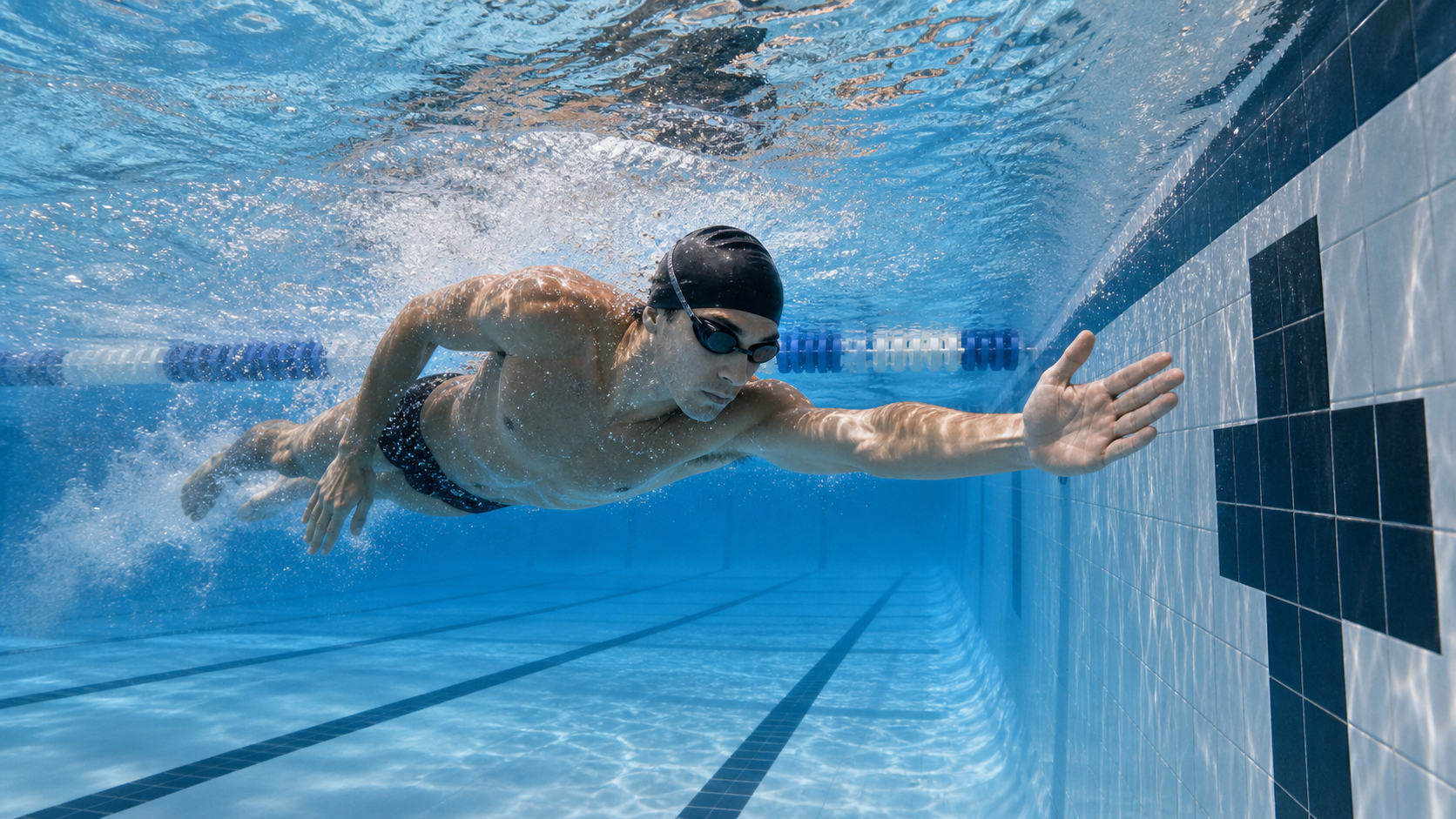
| Precise wall touch distance | Arms extend naturally to touch the wall, immediate push-off | Minimal (smooth with no pause) |
Common Causes of Incorrect Wall Touch
Lack of “Stroke Rhythm Awareness”
Experienced swimmers can anticipate the relationship between their stroke cycle and the pool length, knowing where to take a stroke so that the next one lands exactly at the wall. Beginners lack this spatial awareness and often resort to “improvisation” only when approaching the wall.
Speed Fluctuations
Training condition, fatigue level, water currents, and other factors cause slight variations in speed for each lap, making a fixed “stroke rhythm” prone to error when speed changes.
Breathing Distractions
If you need to breathe just as you approach the wall, your attention is occupied by the breathing motion, reducing your distance judgment.
Turn Anxiety
In competition, turn points are often accompanied by nervousness, causing swimmers to speed up or slow down, disrupting the rhythm they are accustomed to in training.
Wall Touch Calibration for Freestyle Flip Turns
Freestyle uses the flip turn, and the technical points are:
- Spot the “T-marking” at the top of the lane: This marking is typically about 2 meters from the wall (slightly varies by pool specifications) and serves as the visual cue to initiate the turn.
- Count how many strokes it takes from the “T-marking” to the wall: Without speed pressure, repeatedly test the number of strokes from the T-marking to the flip turn (usually 1-2 strokes) and note this number.
- Fine-tune based on speed: When pacing fast, the “T-marking to wall” may only require 1 stroke; when slow, it may require 2. Confirm the day’s stroke count during warm-up before a race.
Wall Touch Precision for Breaststroke and Butterfly
Breaststroke and butterfly use two-hand touches, with different technical points:
- Both hands touch the wall simultaneously (required by competition rules): Arms need to extend at the correct distance.
- If too far from the wall: Take a half-step kick earlier (add one kick) to close the distance to the wall.
- If too close to the wall: Shorten the length of the final stroke early to “brake” the body at the correct position.
Wall Touch Practice Drills
Drill 1: Mark the Wall Touch Point in Your Lane
Use waterproof tape (or ask a coach for assistance) to mark your ideal wall touch point at the pool edge (corresponding to the height of your fingertips when arms are extended). Initially, repeatedly practice “precisely touching the marked point” to build distance awareness.
Drill 2: “Stroke Counting” Drill
When about 5 meters from the wall, start counting down your strokes, comparing wall touch timing on each lap. This drill helps build muscle memory for the “distance–stroke count” relationship.
Drill 3: Variable-Speed Wall Touch
Over the same 25 meters, swim 3-4 laps at 80%, 90%, and 100% speed respectively, practicing adjusting the length and force of the final few strokes at different speeds to maintain a precise wall touch point.
Drill 4: Approaching the Wall with Eyes Closed
Over a very short distance (5 meters), try approaching and touching the wall with your eyes closed. This drill trains proprioception rather than visual reliance, and advanced swimmers often use this method to strengthen distance perception.
Coordination with Push-Off Technique
A perfect wall touch is only the first step; the push-off is the biggest factor in turn efficiency:
- At the moment of wall contact, knees should bend to approximately 90 degrees (optimal push-off angle)
- Feet should plant on the wall at a depth of about 30-40 cm below the water surface
- After pushing off, maintain a streamlined body position and glide underwater for at least 1 second before starting to stroke
Practical Tips
- Do 5-10 turn sprints at the end of each training session: Swimming the final 10 meters at race pace into a turn is the most effective way to calibrate wall touch timing.
- Video-analyze your turn timing: Have a teammate film from the side of the turning wall to compare the degree of arm bend at wall contact and determine whether the distance is appropriate.
- Taiwan’s 25-meter standard pools: The distance from the T-marking to the wall is 2.0 meters. At typical training pace, this corresponds to approximately 1.5-2 strokes.
Conclusion
Precise wall touch timing is an often-underestimated aspect of swimming technique. Through “stroke counting” drills and variable-speed wall touch training, swimmers can build reliable distance perception within a few weeks. In competition, each perfect turn can save you 0.3-0.5 seconds compared to your opponent, and in a 50-meter race, a single turn presents an opportunity to open up a significant gap.
Related Reading
- Refining Turn Technique: Hand-Foot Coordination and Push-Off Power Optimization in Flip Turns
- The Mechanics of Push-Off in Swimming Turns: Technical Details for Maximum Propulsion
- Complete Analysis of Swimming Turns: Flip vs. Touch Turn—Which Is Really Faster?
- Analyzing Swimming Turn Efficiency: Maximizing Push-Off Force and Glide Distance in Flip Turns
西進武嶺 免費訓練分析服務 Intervals | 練不夠還是練過頭?你哪一種類型選手?AI模型告訴你! | 備戰神器 | 公路車 訓練 | CT Yeh
4 年前
西進武嶺 自製新版AI配速表產生器 x 賽前攻略 抱佛腳! 沒有功率計也可以產生配速表嗎?有什麼其他眉角賽前要注意的呢? | 西進武嶺 / 東進武嶺 KOM 攻略 | 公路車 | CT Yeh
4 年前
備戰 戀戀197 賽前關門點分析 西濱團練 #公路車 4K高畫質
6 年前
CT 喇低賽) 武嶺牽車 才是王道 西進牽車四小時內秘訣 攝手位置 如何判斷 防抽筋小秘訣
7 年前
[教學] Premiere 影片 手震 修正 教學 防抖 單眼 影像 GoPro 穩定 Video Stabilization
8 年前
碟煞公路車 優缺點?換車一年半實際經驗分享 / 公路車 / CT Yeh
2 年前
Insta 360 One 超級防手震技術實測
7 年前
大禹嶺 到 武嶺牌樓 全程前後實況錄影 | 北進武嶺 | 東進武嶺 | KOM | 訓練台 | 坡度分析 | Taiwan KOM Last 10 km HARD | 公路車
6 年前