Introduction
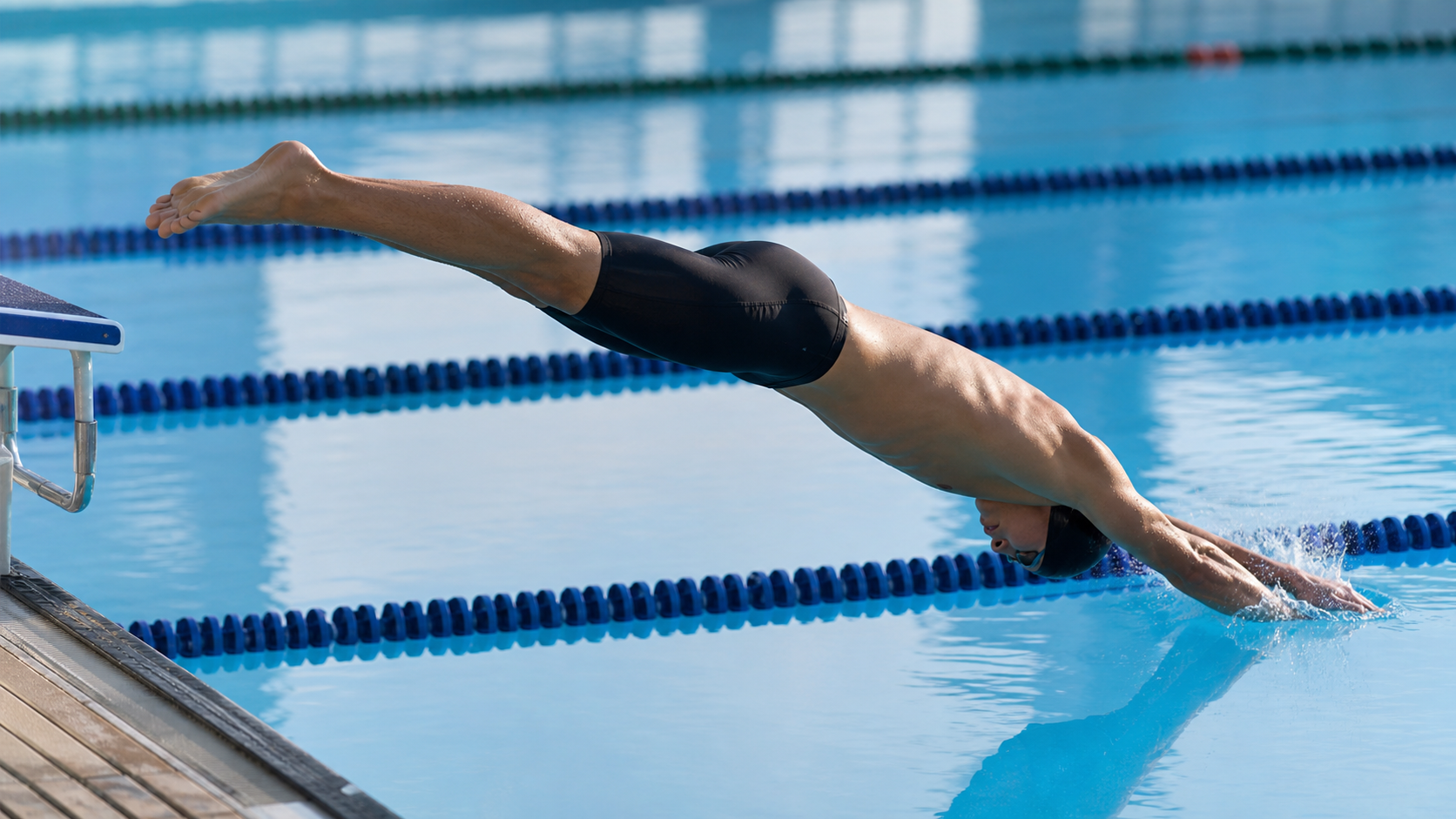
The starting dive is the fastest moment in a swimming race and one of the phases where technical details have the greatest impact on performance. Many swimmers enter the water at too steep an angle (commonly called “spearing in”), and the large splash at entry represents starting kinetic energy wasted on spray rather than converted into forward speed. This article analyzes the causes of excessive entry angles and provides specific corrective drills.
Standard for Starting Dive Entry Angle
The ideal freestyle starting dive entry angle is approximately 30-40 degrees (relative to the horizontal plane). This angle allows the body to “slice” into the water in a streamlined position, preserving kinetic energy to the greatest extent.
| Entry Angle | Effect | Typical Manifestation |
|---|---|---|
| Too shallow (10-20 degrees) | Body enters flat, abdomen hits water first (belly flop) | Painful entry, significant speed loss |
| Ideal angle (30-40 degrees) | Streamlined slice, minimal splash | Nearly silent entry, long glide distance |
| Too steep (50 degrees and above) | Vertical spear-in, excessive splash | Huge splash, rapid deceleration |
Causes of Excessive Entry Angle
Dropping the Head Too Early After Takeoff
Dropping the head too early in the air shifts the center of mass downward, resulting in a steeper entry angle. The correct approach is to time the head drop with the moment of entry, not during the middle of the flight.
Hands Separating at Entry
If the hands separate at entry (rather than being tightly stacked above the head), entry drag increases, and the body is also more likely to assume a steeper entry angle.
Hips Sagging Excessively in the Air
If core contraction is insufficient after takeoff, the hips sag and the body forms a “banana shape,” causing a large portion of the kinetic energy in the legs and feet to be wasted on splash after entry.
Lack of “Reach” Awareness
Many swimmers focus on “jumping high” rather than “jumping far,” resulting in an overly high arc and an excessively steep entry angle.
Complete Sequence of the Entry Motion
A proper starting dive includes the following连贯 movements:
- Takeoff: Squat low, then explode forward and upward, aiming for a “forward parabola” rather than an “upward vertical jump”
- Streamline in the air: Arms extended forward with elbows squeezing the ears, hands stacked, core tightened, body in a straight line
- Moment of entry: Fingertips enter first, head tucked between the arms, gaze directed toward the bottom
- Glide underwater: Maintain streamline, feel the water’s resistance, and begin stroking only when speed drops to swimming pace
Corrective Drills
Drill One: Side-View Video Analysis at the Block
Have a partner stand beside the starting block (not in front, for safety) and film the continuous takeoff and entry motion from a side angle. Compare the entry angle to identify at which stage the angle begins to deviate, and correct accordingly.
Drill Two: Kneeling Streamline Entry
Stand at the pool edge, squat down on both knees, extend both arms forward, and practice the feeling of “sliding into the water in a streamlined position.” The key is that after the hands enter, the entire body pierces the water like a needle without creating splash. This is the safest way to practice entry posture.
Drill Three: Low Takeoff Point Practice
Practice entry from the pool edge (rather than the starting block) to reduce the influence of height on entry angle. First establish correct entry posture, then gradually return to block height.
Drill Four: “Jump Forward” Cue
Before takeoff, mentally cue “I want to jump 5 meters forward” rather than “I want to jump into the water.” This cue shifts the mental orientation of the takeoff direction, making the arc flatter.
Optimizing the Underwater Glide
Once the entry angle is correct, underwater glide technique is equally important:
- Maintain streamline for at least 1.5-2 seconds: Do not begin stroking too early; let the takeoff’s kinetic energy be fully utilized.
- Sense the signal of speed decay: Only begin the first dolphin kick or stroke when water resistance increases noticeably and speed drops significantly.
- Timing of dolphin kicks: After the underwater glide in freestyle and butterfly, 3-5 dolphin kicks can be added to maintain speed before transitioning to normal stroking.
Practical Recommendations
- Incorporate start practice into daily routine: Begin 5-10 repetitions of each training session with a start, using high-quality starts to establish training rhythm.
- Watch entry videos of elite swimmers: Taiwanese swimming live broadcasts or competitive swimming videos on YouTube—carefully observing how top athletes enter almost silently is the best visual teaching material.
- Beginners should avoid practicing from high blocks: Before technique is stable, practicing entry from the pool edge is sufficient. Add the challenge of height differences only after technique is solidified.
Conclusion
The starting dive may appear to be a split-second action, but it is one of the phases richest in technical detail. From the orientation of the takeoff direction, to maintaining streamline in the air, to controlling the entry angle, every detail affects whether precious kinetic energy is converted into forward speed. Through side-view video analysis and systematic practice, your start technique can show significant improvement within weeks, allowing every race to begin with optimal initial speed.
Related Reading
- Start Angle and Entry: How to Maximize Starting Distance
- Swimming Start Entry Angle: Optimal Start Strategies for Different Distance Events
- Swimming Start Technique: Complete Analysis of Block Stance, Crouch, and Entry Angle
- Backstroke Hand Entry Angle Errors: Prevention and Correction of Shoulder Injuries
[教學] Premiere 影片 手震 修正 教學 防抖 單眼 影像 GoPro 穩定 Video Stabilization
8 年前
CT 喇低賽) 武嶺牽車 才是王道 西進牽車四小時內秘訣 攝手位置 如何判斷 防抽筋小秘訣
7 年前
滑雪新手們慘摔學習全紀錄(請開字幕),滑雪好好玩 | Snowboard + Ski | 岩原 スキー場 | 滑雪APP使用 | GoPro Max
6 年前
教學) 如何做出專業 慢動作 影片 Slow Motion 120fps GoPro 7 ActionCam AX700 A99II
7 年前
戰略) Zwift Race 如何咬在第一集團 如何評估自己要開多少推力 (請開1.5倍速看)
7 年前
#PUSHBIKE 原來這麼好玩! 小朋友 滑步車 初體驗 超可愛
6 年前
一日北高/長距離團騎 常見問題補充篇 / 組團或跟團的眉角 / 壯車友容易被瘦車友慢性拉爆 / 原來屁股痛可能是這個原因...? / 風場配速法 / 公路車 / CT Yeh
2 年前
海豚島滑沙
11 年前