Introduction
When observing swimmers in training, a frequently overlooked issue is “rhythm instability”—the first lap has a fast stroke rate, the second is slow, or even within a single lap, the first half is tightly paced while the second half gradually falls apart. Unstable rhythm doesn’t just affect speed; it also leads to poor energy distribution, causing a sharp decline in stamina later on. An underwater metronome (Swim Metronome) is an effective tool for solving this problem. This article will explain how to use metronome training to establish a stable rhythm.
Why Is Rhythm Stability So Important?
| Training Goal | Benefits of Rhythm Stability |
|---|---|
| Aerobic Training | Maintains target heart rate zone, ensuring training effectiveness |
| Pacing Management | Precisely controls pace per 100 meters, avoiding starting fast and finishing slow |
| Technique Consolidation | A stable rhythm allows technical movements to be executed within a unified time frame, making them easier to consolidate |
| Race Performance | Paces according to plan, avoiding a collapse in the second half after an overexcited start |
| Efficiency Improvement | A stable stroke rate makes the timing of force application in each stroke more accurate, improving propulsion efficiency |
How to Use a Swimming Metronome
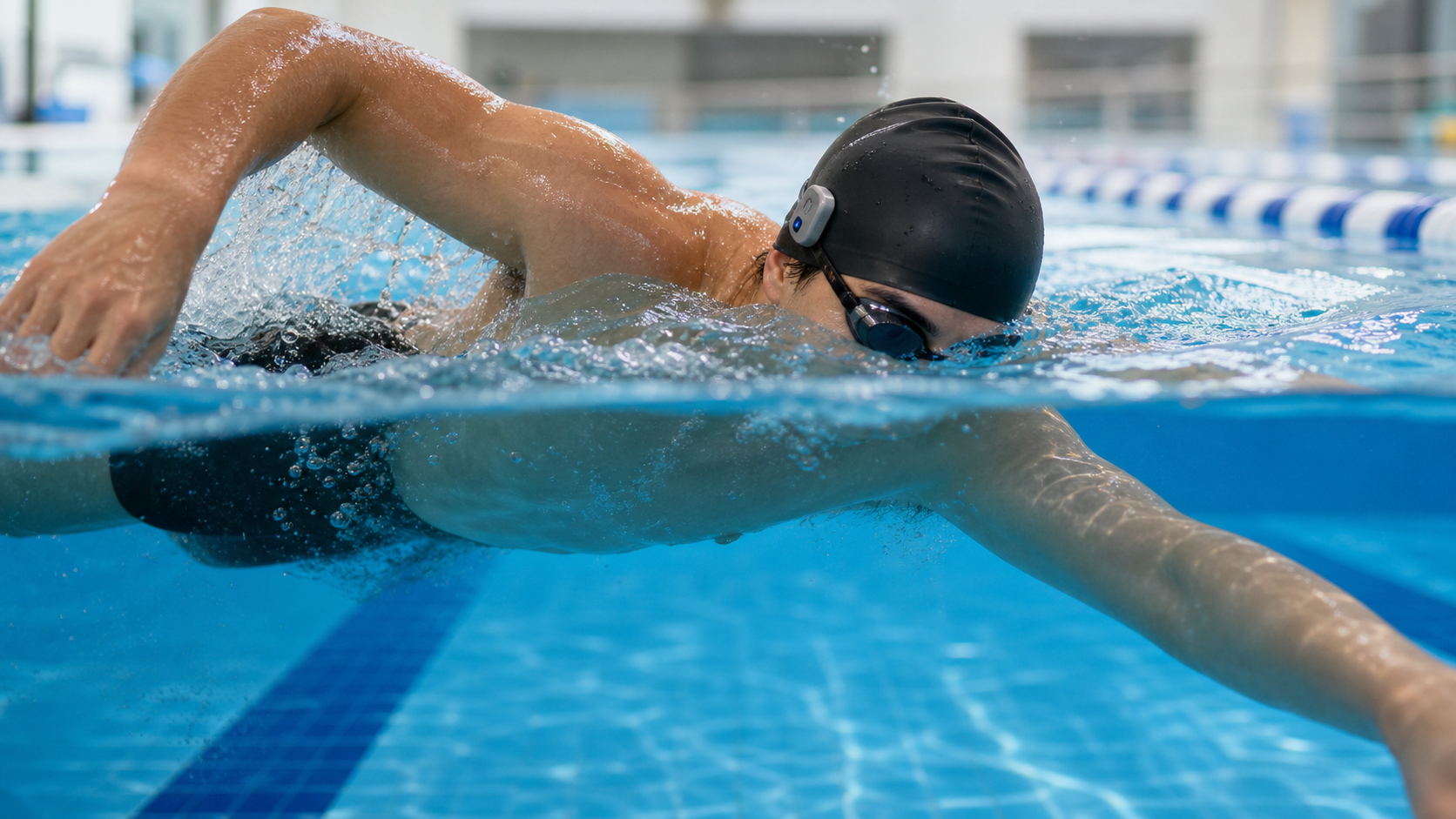
An underwater metronome (such as the Finis Tempo Trainer) is a small waterproof device clipped to your swim cap or near your ear, emitting an audible beat underwater. How to use it:
- Mode 1 (one beep per stroke): Suitable for beginners or during technique correction phases; each stroke movement corresponds to one beat
- Mode 2 (one beep per full stroke cycle): Suitable for advanced training; one cycle (one stroke with each arm) corresponds to one beat
- Mode 3 (time-based setting): Set a target time per 100 meters; suitable for pace training
How to Determine Your Target Stroke Rate
There is no absolute correct stroke rate; it depends on height, arm length, and swimming distance. General reference ranges:
| Distance | Recreational Swimming | Training Swimming | Competitive Racing |
|---|---|---|---|
| 50m Freestyle | 50-60 strokes/min | 60-70 strokes/min | 70-85 strokes/min |
| 400m Freestyle | 45-55 strokes/min | 52-62 strokes/min | 58-70 strokes/min |
| 1500m Freestyle | 42-52 strokes/min | 48-58 strokes/min | 55-65 strokes/min |
Self-Test Method: While swimming at a comfortable moderate intensity, have a partner count your stroke count (one arm) over 30 seconds at poolside; multiply by 2 to get your strokes per minute.
Metronome Training Plan
Step 1: Find Your Natural Stroke Rate
Swim 200 meters and have a partner record your stroke rate. This is your “natural stroke rate baseline.”
Step 2: Stability Training
Set the metronome to your natural stroke rate and try to swim 400 meters in sync with the beat. Note: it’s not about “swimming faster” but about “matching the timing of each stroke to the beat.”
Step 3: Progressive Challenge
While maintaining technical quality, increase your stroke rate by 1-2 strokes per minute every two weeks. When increasing stroke rate, ensure your stroke length does not shrink (DPS, distance per stroke, must remain unchanged or improve).
Example Training Set
- Warm-up: 400m easy freestyle, feel your natural rhythm
- Main set: 6×100m, set the metronome to your target stroke rate, 20 seconds rest between reps
- Cool-down pace: 4×50m, set the metronome 5 strokes/min lower, practice “controlling the rhythm” rather than “speeding up the rhythm”
- Easy swim: 200m relaxed swimming, feel your body’s state after rhythm stabilization
Rhythm Training Without a Metronome
- Counting and Chanting Method: Mentally count “1-2-3-4” in your head, with each number corresponding to one stroke, training rhythm awareness.
- Breathing Rhythm Method: Use your breathing cadence as the beat reference (e.g., breathe every 3 strokes), ensuring consistent breathing rhythm throughout each segment.
- Lap Timing Method: Time each lap, ensuring the time difference between laps stays within ±1 second, indirectly ensuring rhythm stability.
Practical Tips
- The metronome is a tool, not a constraint: Use the metronome during training; once rhythm awareness is established, you don’t need to rely on it in races—let muscle memory take over.
- It may feel awkward initially: If there’s a gap between your natural stroke rate and the metronome setting, feeling like you “can’t keep up” or are “being slowed down” at first is normal; stick with it for 2-3 weeks and you’ll adapt.
- Track DPS alongside: Record your stroke count per 25 meters (an indirect indicator of distance per stroke) to ensure you don’t sacrifice stroke efficiency when increasing stroke rate.
Conclusion
Rhythm stability is the cornerstone of swimming efficiency. Through assisted training with an underwater metronome, swimmers can establish a more consistent stroke rate within 4-6 weeks, directly reflected in more stable pacing, better energy distribution, and the ability to maintain good technique even at the end of a training session. Starting today, make the metronome a regular companion in your training kit.
Related Reading
[教學] Premiere 影片 手震 修正 教學 防抖 單眼 影像 GoPro 穩定 Video Stabilization
8 年前
西進武嶺 免費訓練分析服務 Intervals | 練不夠還是練過頭?你哪一種類型選手?AI模型告訴你! | 備戰神器 | 公路車 訓練 | CT Yeh
4 年前
教學) 如何做出專業 慢動作 影片 Slow Motion 120fps GoPro 7 ActionCam AX700 A99II
7 年前
風櫃嘴 衝刺慢動作回放!
8 年前
如何把 GoPro 影片 翻轉 批次 轉正?
6 年前
西進武嶺 自製新版AI配速表產生器 x 賽前攻略 抱佛腳! 沒有功率計也可以產生配速表嗎?有什麼其他眉角賽前要注意的呢? | 西進武嶺 / 東進武嶺 KOM 攻略 | 公路車 | CT Yeh
4 年前
類空拍神器 Feiyu Pocket 2s (有優惠連結)三軸穩定 運動攝影機 開箱!比GoPro 還強的滑順視角!三小時長時間錄影 行車記錄器 | 環花東365實測 | 公路車 CT Yeh
4 年前
[教學] Dashware 教學 如何製作有 速度 功率 心律的 騎車影片 Guages Video
8 年前