GPS Watch Optical Heart Rate vs. Heart Rate Strap: Which Is More Accurate? A Practical Guide for Taiwanese Runners
Introduction
Heart rate is one of the most important physiological metrics in road running training. Almost all GPS watches come with built-in optical heart rate sensors, claiming to “monitor heart rate accurately.” But during actual training, have you ever noticed the heart rate displayed on your watch suddenly spiking or dropping abnormally during interval runs? How accurate is optical heart rate, really, and when should you switch to a heart rate strap? This article walks you through the differences between the two technologies.
Measurement Principles: Why Can Optical Heart Rate Be Inaccurate?
How optical heart rate works (PPG, Photoplethysmography):
The LED light on the bottom of the watch (usually green light) shines onto the skin, and the sensor captures changes in light reflection as blood flows through the vessels to calculate heart rate. The problems with this method are:
- Motion Artifact: When running, arm swing and skin vibration on the wrist can cause unstable LED readings
- Skin Tone Effects: Darker skin has a lower reflectance for certain LED wavelengths, which may affect accuracy
- Wearing Position: Wearing the watch too loose or too close to the wrist bone reduces accuracy
- Temperature Effects: In cold environments, blood vessels in the hands constrict, weakening the optical signal
Heart rate strap (electrode-based ECG measurement):
The chest strap uses two electrodes to detect the heart’s electrical signals (just like an ECG). It is almost unaffected by motion artifacts, and its accuracy approaches medical-grade levels.
Accuracy Comparison Across Optical Heart Rate Brands
Based on multiple academic studies and runner community tests (using the Polar H10 chest strap as the gold standard):
| Watch Brand/Model | Steady Aerobic Run Error | High-Intensity Interval Error | Performance Rating |
|---|---|---|---|
| Garmin Forerunner 965 | ±3–5 bpm | ±8–15 bpm | Excellent |
| Apple Watch Ultra 2 | ±3–5 bpm | ±6–12 bpm | Excellent |
| COROS Pace 3 | ±4–6 bpm | ±10–18 bpm | Good |
| Polar Vantage V3 | ±2–4 bpm | ±5–10 bpm | Excellent |
| General Mid-Range Watches | ±5–8 bpm | ±15–25 bpm | Acceptable |
Note: The values above are estimated ranges under typical conditions; individual variation can be significant
Scenarios Where Optical Heart Rate Performs Worst
Optical heart rate is particularly unreliable in the following situations:
- High-intensity interval runs: When heart rate rises or falls rapidly, the optical sensor lags behind, often with a 10–30 second delay
- Running in cold weather: In Taiwan’s mountainous areas during winter, readings can be severely off when hands are cold
- Sprint segments: During the final 1 km sprint, vigorous arm swinging creates motion artifacts
- Gripping treadmill handles: The fixed wrist position is unnatural and affects optical readings
- Wearing the watch over the wrist bone: The sensor is not in the correct position
Heart Rate Strap Selection Guide
Recommended heart rate straps:
- Polar H10: Universally recognized as the gold standard. Supports Bluetooth + ANT+, can connect to multiple devices, and simultaneously records heart rate strap data to your phone (suitable for HRV measurement with the Elite HRV app). Priced around NT$2,800–3,200 in Taiwan
- Garmin HRM-Pro Plus: The best choice for Garmin users. Records running dynamics and automatically stores data when the watch loses signal. Priced around NT$4,500–5,000
- Wahoo TICKR: Lightweight and affordable (around NT$1,600–2,000), suitable for runners on a budget
How to wear a heart rate strap correctly:
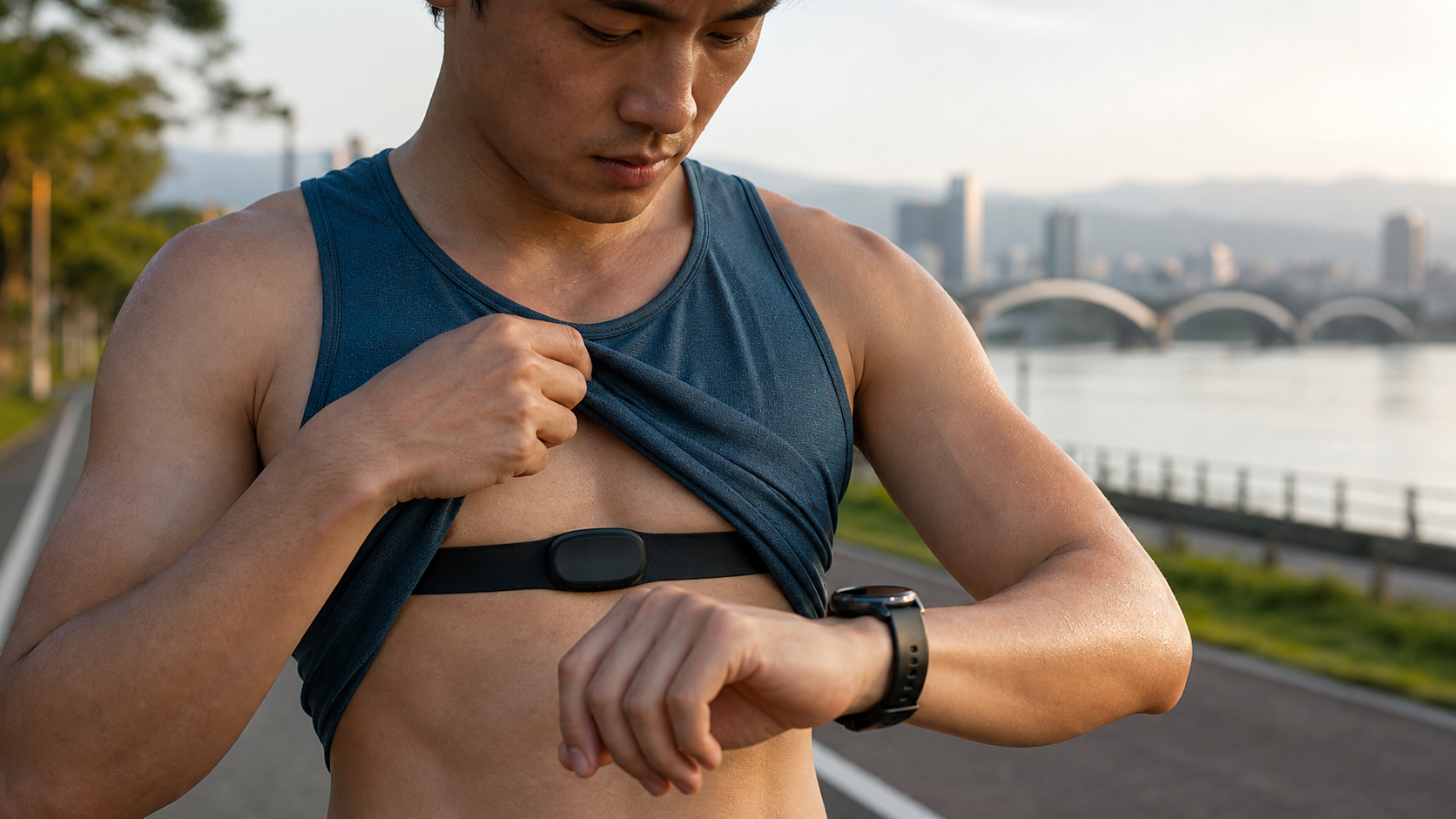
- Position: Place the strap just below the sternum (directly above the xiphoid process), centered left-to-right
- Tightness: It should just barely not slip when you inhale, and not feel too constricting when you exhale
- Conductivity: Wet the electrode pads before running; in winter, apply a small amount of conductive gel
Practical Recommendations
- Daily easy runs: Optical heart rate is sufficient; no need to add the hassle of wearing a heart rate strap
- Lactate threshold runs and interval runs: Strongly recommend using a heart rate strap to ensure accurate heart rate zone control
- Marathon races: A heart rate strap is recommended. Race-day excitement can cause slight trembling in the wrist, affecting optical heart rate readings
- Improving optical heart rate accuracy: Tighten the watch band and wear it 2–3 cm above the wrist bone (on the forearm) to significantly reduce motion artifacts
- Double-checking optical heart rate: During easy runs, compare the watch against a heart rate strap. If the difference exceeds 10 bpm, you’ll know at which heart rate value your watch starts becoming inaccurate
Conclusion
The convenience of optical heart rate makes it a great companion for daily training, but for intensity workouts and races that require precise heart rate control, the heart rate strap remains an irreplaceable choice. Understanding the limitations of each and choosing the right tool based on your training purpose is the key to making heart rate data truly serve your training goals.
Related Reading
- Running Heart Rate Monitoring: An In-Depth Accuracy Comparison Between Heart Rate Straps and Optical Heart Rate
- Running Heart Rate Straps vs. Optical Heart Rate: Choosing Between Accuracy and Usage Scenarios
- Running Heart Rate Straps vs. Optical Heart Rate: Comparing Measurement Accuracy and Wearing Comfort
- Road Running Heart Rate Straps vs. Optical Heart Rate Watches: Accuracy Differences and Best-Use Case Analysis
2026 車錶排行榜!誰是最多車友正在使用?練家子最愛哪款?🏆 (2萬名車友數據) / 公路車 / CT Yeh
5 個月前
全台首發神車錶! iGPSPORT iGS630 兩趟一日北高的續航! 超強導航、功率訓練、超人性APP! Garmin & Bryton 有對手了嗎? | 公路車 |CT Yeh
3 年前
Garmin Edge 1050 旗艦車錶 全台首測!/ 環法冠軍指定 / 對比Edge 1040改進哪些? / 公路車 / CT Yeh
2 年前
首發 Garmin Edge 850 車錶 深入開箱!? / 公路車 / CT Yeh
10 個月前
2022 前十五大自行車錶 !? 兩萬名車友大數據統計 | 你的上榜了嗎? | 菁英車友都用哪些錶? | Bryton Garmin 誰能拔得頭籌?| 車錶推薦 | 公路車 CT Yeh
4 年前
Garmin Edge 540/840 Solar 台灣首發開箱!完整車錶功能 道路實測 / ClimbPro 爬坡提示超級牛 / 強大續航實測 / 公路車 / CT Yeh
3 年前
2023 自行車錶排名 大數據 23,000位車友用什麼錶? Garmin Edge 對決 Bryton Rider 誰市佔高? 你用的上榜了嗎? | 公路車 | CT Yeh
3 年前
#公路車 #Vo2Max #最大攝氧量 測驗 體驗 | 心肺測試
6 年前