Introduction
Open Garmin Connect and your estimated VO2max might read “53 ml/kg/min.” That number looks precise, but is it actually accurate? VO2max (maximal oxygen uptake) is the gold-standard indicator of aerobic capacity, long regarded as one of the most reliable single predictors of endurance performance. Yet the VO2max estimated by watch algorithms often diverges significantly from lab test results. This article explores the reasons behind that gap and how to use your watch’s VO2max data correctly.
The Scientific Definition of VO2max
VO2max is the maximum amount of oxygen the body can consume per kilogram of body weight per minute during maximal effort exercise (ml/kg/min). It is influenced by:
- Cardiac output (blood volume pumped per heartbeat)
- Blood oxygen-carrying capacity (hemoglobin concentration)
- Muscle oxygen extraction efficiency (mitochondrial density)
- Body weight (the denominator)
VO2max and Running Performance Correspondence (Male):
| VO2max (ml/kg/min) | Predicted Marathon Finish Time | Level Assessment |
|---|---|---|
| < 35 | > 5:00 | Average |
| 35–44 | 4:00–5:00 | Moderate |
| 45–54 | 3:00–4:00 | Good |
| 55–64 | 2:30–3:00 | Excellent |
| > 65 | < 2:30 | Elite |
How Watch Algorithms Estimate VO2max
Garmin’s Firstbeat Algorithm:
Garmin uses Firstbeat Analytics’ algorithm, based primarily on:
- Running pace
- Heart rate
- Elevation (if available)
- Your personal data (age, weight, gender)
The core assumption of the algorithm is: by running a specific pace at a specific heart rate, VO2max can be inferred from heart-rate efficiency.
Apple Watch’s Fitness Level (Cardio Fitness):
Apple Watch uses an algorithm developed in-house by Apple, also estimating from the relationship between heart rate and pace, though the methodology details are not fully disclosed.
The Gap Between Watch Estimates and Lab Testing
Multiple studies show:
| Study Source | Watch Estimate Error Range | Direction |
|---|---|---|
| Garmin Forerunner multi-generation studies (combined) | ±4–8 ml/kg/min | Usually overestimates |
| Apple Watch Series studies | ±5–10 ml/kg/min | Inconsistent |
| COROS watch studies | ±5–9 ml/kg/min | Usually overestimates |
Why do watches often overestimate VO2max?
- Heart rate underestimation: Optical heart rate sensors lag at high intensity, causing the algorithm to think heart rate is lower than it actually is, which inflates the inferred efficiency
- Terrain not accounted for: Running downhill produces fast pace with lower heart rate, which the algorithm misreads as high efficiency
- No temperature correction: Taiwan’s summer heat elevates heart rate; if the algorithm doesn’t correct for this, it will underestimate VO2max
- Abnormal training status: The first run after a break tends to show a higher heart rate (deconditioned), but that doesn’t mean actual VO2max has truly dropped
The Lab VO2max Testing Process
Where can you get tested in Taiwan?
- Sports science departments at major universities (such as NTNU, NTSU, UTaipei) typically offer VO2max testing services
- Some sports medicine clinics or high-end fitness centers
- Cost is approximately NT$2,000–5,000
Testing procedure:
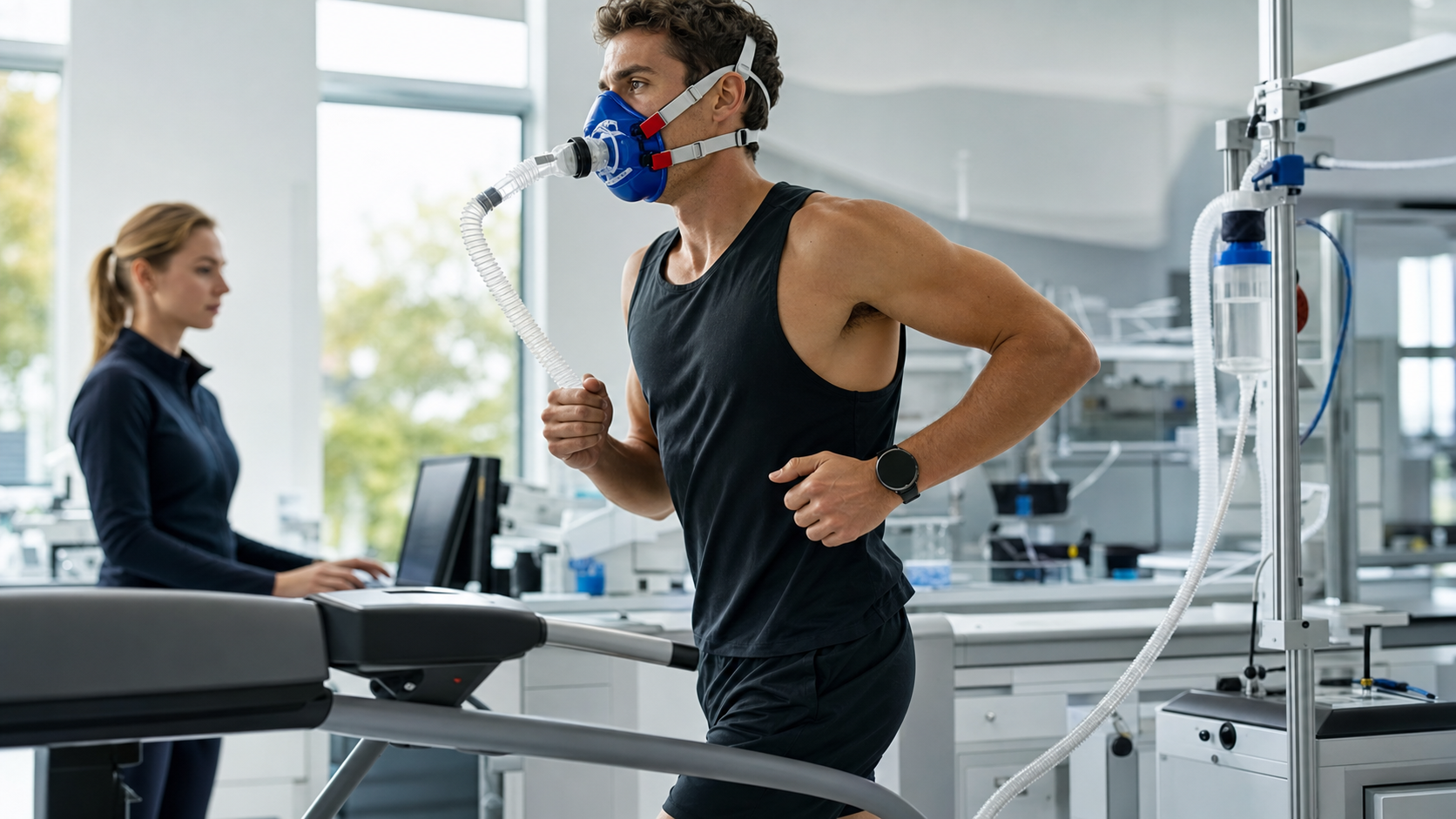
- Wear a breathing mask connected to a gas analyzer
- Run on a treadmill at progressively increasing speeds (increasing every 3 minutes)
- Continue until exhaustion, recording the average oxygen consumption of the final 30 seconds
- Simultaneously record heart rate and lactate levels (optional) to produce a complete metabolic profile
How to Correctly Use Your Watch’s VO2max
What you shouldn’t do:
- Compare your watch VO2max value with other people’s (results vary significantly between different watches/algorithms)
- Use watch VO2max to predict precise race finish times (the margin of error is too large)
What you should do:
- Track your own long-term trend: with the same watch and same algorithm, if VO2max rises steadily from 48 to 52, that indicates training is effective (even if the absolute value isn’t accurate, the relative change is meaningful)
- Assess training effectiveness: after a month-long training block, has the estimated VO2max increased?
- Roughly gauge fitness level: track the VO2max trend under similar conditions (same season, same pace)
Practical Recommendations
- If you’re a serious marathon runner, getting a lab VO2max and lactate threshold test once a year offers a very high return on investment
- Your watch’s VO2max is most meaningful as a “trend,” not as a single day’s “value”
- Make sure to pair a heart rate strap (not optical) for every run to give the algorithm more accurate input
- VO2max measured during Taiwan’s summer is typically 3–5 ml/kg/min lower than in winter — this is caused by the hot environment, not genuine decline
Conclusion
Watch-estimated VO2max is a useful reference tool, but it is not a precise scientific measurement. Understanding its limitations, using it to track trends rather than fixating on absolute values, and pairing it with occasional lab testing for calibration will let this metric truly serve your training.
Related Reading
- Practical Applications of VO2max in Running: The Relationship Between Maximal Oxygen Uptake and Race Pace
- Estimating VO2max for Running: Comparing the Accuracy of Various Field Tests
- A Complete Breakdown of VO2max: Measurement, Meaning, and Trainability
- Cycling VO2max Testing: Comparing the Lab Gold Standard with Field Tests
#公路車 #Vo2Max #最大攝氧量 測驗 體驗 | 心肺測試
6 年前
2025 自行車錶排行榜 兩萬車友大數據 / Garmin Bryton 排名會大洗牌嗎? / 全新的碼表前身分析 /公路車 / CT Yeh
1 年前
2026 車錶排行榜!誰是最多車友正在使用?練家子最愛哪款?🏆 (2萬名車友數據) / 公路車 / CT Yeh
5 個月前
全台首發神車錶! iGPSPORT iGS630 兩趟一日北高的續航! 超強導航、功率訓練、超人性APP! Garmin & Bryton 有對手了嗎? | 公路車 |CT Yeh
3 年前
西進武嶺 免費訓練分析服務 Intervals | 練不夠還是練過頭?你哪一種類型選手?AI模型告訴你! | 備戰神器 | 公路車 訓練 | CT Yeh
4 年前
2022 前十五大自行車錶 !? 兩萬名車友大數據統計 | 你的上榜了嗎? | 菁英車友都用哪些錶? | Bryton Garmin 誰能拔得頭籌?| 車錶推薦 | 公路車 CT Yeh
4 年前
Garmin Edge 1050 旗艦車錶 全台首測!/ 環法冠軍指定 / 對比Edge 1040改進哪些? / 公路車 / CT Yeh
2 年前
Garmin Edge 540/840 Solar 台灣首發開箱!完整車錶功能 道路實測 / ClimbPro 爬坡提示超級牛 / 強大續航實測 / 公路車 / CT Yeh
3 年前