The Future of Running Technology: AI Real-Time Pacing Advice and the Development Trends of Smart Running Shoes
Introduction
In 2010, GPS watches could tell you how far you had run. In 2020, AI algorithms could estimate your training status and VO2max. After 2025, running technology is crossing the next threshold—not just “recording” your run, but “intervening in real time” to guide you to run better and safer. This article reviews the cutting-edge technologies that already exist and looks ahead to the technological directions most likely to transform road running training over the next five years.
The Most Cutting-Edge Road Running Technology Today (2025)
AI Real-Time Pacing Suggestions
The commercial products closest to an “AI real-time coach” today include:
Garmin Real-Time Stamina:
Garmin’s real-time stamina prediction feature calculates during a run “how much longer you can sustain your current effort level” and suggests whether you need to slow down to complete your full target distance.
Coros EvoLab:
COROS’s EvoLab system provides marathon time prediction, adjusting your projected finish time in real time based on your heart rate, pace, elevation gain, and temperature, allowing you to make more accurate pacing decisions mid-race.
NURVV Run Smart Insoles (discontinued, but the technology lives on):
NURVV was the first insole-embedded foot pressure sensing system, capable of tracking foot strike position (forefoot/midfoot/rearfoot), left-right foot balance, and stride symmetry. Although the company has stopped selling the product, its technological concept is being carried forward by other manufacturers.
Current Smart Running Shoe Prototypes
| Product | Technological Feature | Current Status |
|---|---|---|
| Under Armour HOVR Series | Insole sensors record cadence, stride length, and foot strike pattern | Commercially available |
| Salted Line IOFIT (first generation) | Foot pressure distribution sensing | Golf version successful; running shoe version still in concept phase |
| NURVV Run | Complete foot dynamics analysis insole | Discontinued, but the technology continues to develop |
| ASICS shoe model in development | AI adaptive cushioning materials | Research stage |
Technology Roadmap for the Next 5 Years
1. AI Dynamic Pacing Adjustment (2025–2027)
Current state: Watches suggest a “projected finish time,” but this is a static calculation, not a real-time dynamic adjustment.
Future: AI systems will integrate real-time data—heart rate, power, gait, body temperature, blood oxygen saturation—to continuously update recommendations for “optimizing your current pace.” Imagine a system that detects early signs of rising muscle fatigue indicators when you reach the 30 km mark and suggests slowing down by 3 seconds/km five kilometers in advance, helping you avoid “hitting the wall.”
2. Smart Running Shoe Sensor Integration (2026–2028)
Technology pathway:
- Piezoelectric sensors embedded in the outsole to measure ground reaction force (GRF) on every step
- Flexible circuit boards integrated into the midsole without affecting the feel of the run
- Bluetooth 5.3 low-energy transmission to a watch or phone
- Battery (possibly solar charging or energy harvesting) lasting 50+ hours
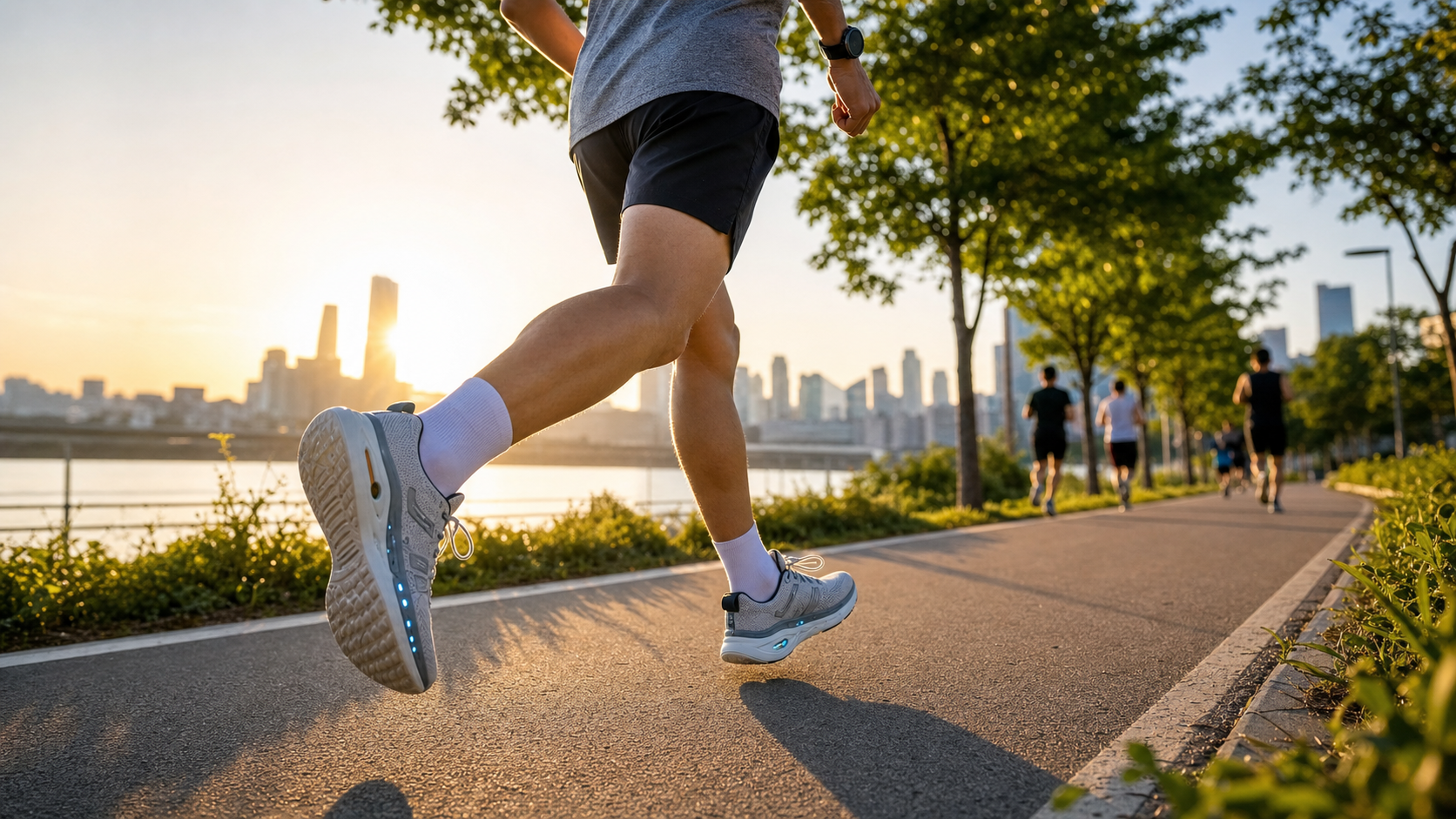
Application scenarios: Smart running shoes can detect in real time whether your foot strike pattern has changed (e.g., degrading from a midfoot strike to a rearfoot strike due to fatigue) and alert you via a watch vibration to adjust.
3. Non-Invasive Lactate Monitoring (2027–2030)
The most groundbreaking future technology: Currently, lactate testing requires blood sampling. In the future, near-infrared spectroscopy (NIRS) technology is expected to detect blood lactate concentration directly through the skin, without the need for blood draws.
Epson and several biotech startups are already researching “optical lactate sensors,” with commercialization potentially arriving between 2027 and 2030. If this becomes a reality, running watches will be able to display blood lactate concentration in real time, bringing “training zone control” to an unprecedented level of precision.
4. Generative AI Personal Coaches (2025–2026, partially realized already)
AI in apps like Runna and Coopah can already adjust training plans conversationally. Future directions include:
- Integrating all health data (sleep, HRV, stress, menstrual cycle)
- Understanding your life context (business travel, seasonal changes)
- Automatically adjusting the entire training cycle, not just a single workout
- Predicting injury risk and intervening early
5. Augmented Reality (AR) Running Navigation (2027+)
If AR glasses become widespread after 2027, while running you could:
- See pace and heart rate in your field of view without looking down at your watch
- Trail routes overlaid as arrows on your real-world view
- See fellow runners’ positions in real time (if they are on the same route)
- Receive both voice and visual coaching cues
Local Technological Running Developments in Taiwan
Several noteworthy local developments in road running technology in Taiwan:
- ITRI (Industrial Technology Research Institute) researching flexible electronics for sports sensing
- Taiwanese shoe manufacturers (such as Feng Tay and Bestway) researching smart soles
- Taipei Marathon and Wan Jin Shi Marathon gradually introducing finer-grained data analysis from chip timing
Practical Advice
- Don’t over-chase “the latest technology” right now—the most effective tools currently available (Garmin/COROS + heart rate strap + Stryd) already far exceed the depth of use of most amateur runners
- Keep an eye on Garmin and COROS firmware updates; AI features are usually pushed as free upgrades
- Buying advice for future smart running shoes: wait for mainstream brands (Nike, adidas, ASICS) to release theirs; don’t rush to buy first-generation products from smaller brands
- The most important “technology” will always be consistent training and adequate recovery; gear is merely a supplement
Conclusion
The pace of evolution in road running technology is astonishing, but the ultimate goal remains the same: helping every runner run healthier, enjoy it more, and improve. AI pacing suggestions and smart running shoes represent not just a technological upgrade, but the democratization of sports science—giving every amateur runner access to the training support that was once reserved for elite athletes alone. The future is already here. Are you ready to embrace the power of technology?
Related Reading
- The Future of Cycling Technology: AI Coaches, Smart Components, and the Riding Revolution of the Next Decade
- The Pacing Guidance Benefits of Road Running GPS Watches: A Study on Real-Time Feedback and Pace Control
- Complete Guide to Advanced GPS Running Watch Features: Training Readiness, Recovery Suggestions, and Fitness Status Tracking
- Complete Guide to Running Watch Features: An In-Depth Comparison of GPS Accuracy, Heart Rate Monitoring, and Training Metrics
單車AI教練!全新 ChatGPT4o 幫你分析訓練成果!排武嶺課表,分析騎車姿勢! 太神了! / 公路車 / CT Yeh / feat. 緯緯
2 年前
#公路車 #Fitting 靠人工智慧APP 幫你調整單車
6 年前
西進武嶺 免費訓練分析服務 Intervals | 練不夠還是練過頭?你哪一種類型選手?AI模型告訴你! | 備戰神器 | 公路車 訓練 | CT Yeh
4 年前
全台首發神車錶! iGPSPORT iGS630 兩趟一日北高的續航! 超強導航、功率訓練、超人性APP! Garmin & Bryton 有對手了嗎? | 公路車 |CT Yeh
3 年前
Garmin Edge 1050 旗艦車錶 全台首測!/ 環法冠軍指定 / 對比Edge 1040改進哪些? / 公路車 / CT Yeh
2 年前
白沙屯媽祖進香在家走!UREVO 坡度自調走步機 / 可連接訓練遊戲APP MyWhoosh / 邊看直播邊走起來 / CT Yeh
11 個月前
再快都跟的上!? 單車跟隨攝影機之王 HOVERAir X1 PROMAX 全面實測 / 唯一!8K畫質&自行車專用模式和跟蹤信標&前後避障 / DJI Neo 可參考/ 公路車 / CT Yeh
1 年前
2025 自行車錶排行榜 兩萬車友大數據 / Garmin Bryton 排名會大洗牌嗎? / 全新的碼表前身分析 /公路車 / CT Yeh
1 年前