Introduction
If there is one event in Taiwan that can make hundreds of thousands of people set aside everything they are doing and walk or cycle along for nine days and eight nights, it is the Dajia Mazu Pilgrimage. Known as one of the “three largest religious events in the world,” this pilgrimage departs every year in the third month of the lunar calendar from Jenn Lann Temple in Dajia, Taichung, traversing dozens of townships across central Taiwan before finally reaching Fengtian Temple in Xingang, Chiayi. The round trip covers more than 300 kilometers.
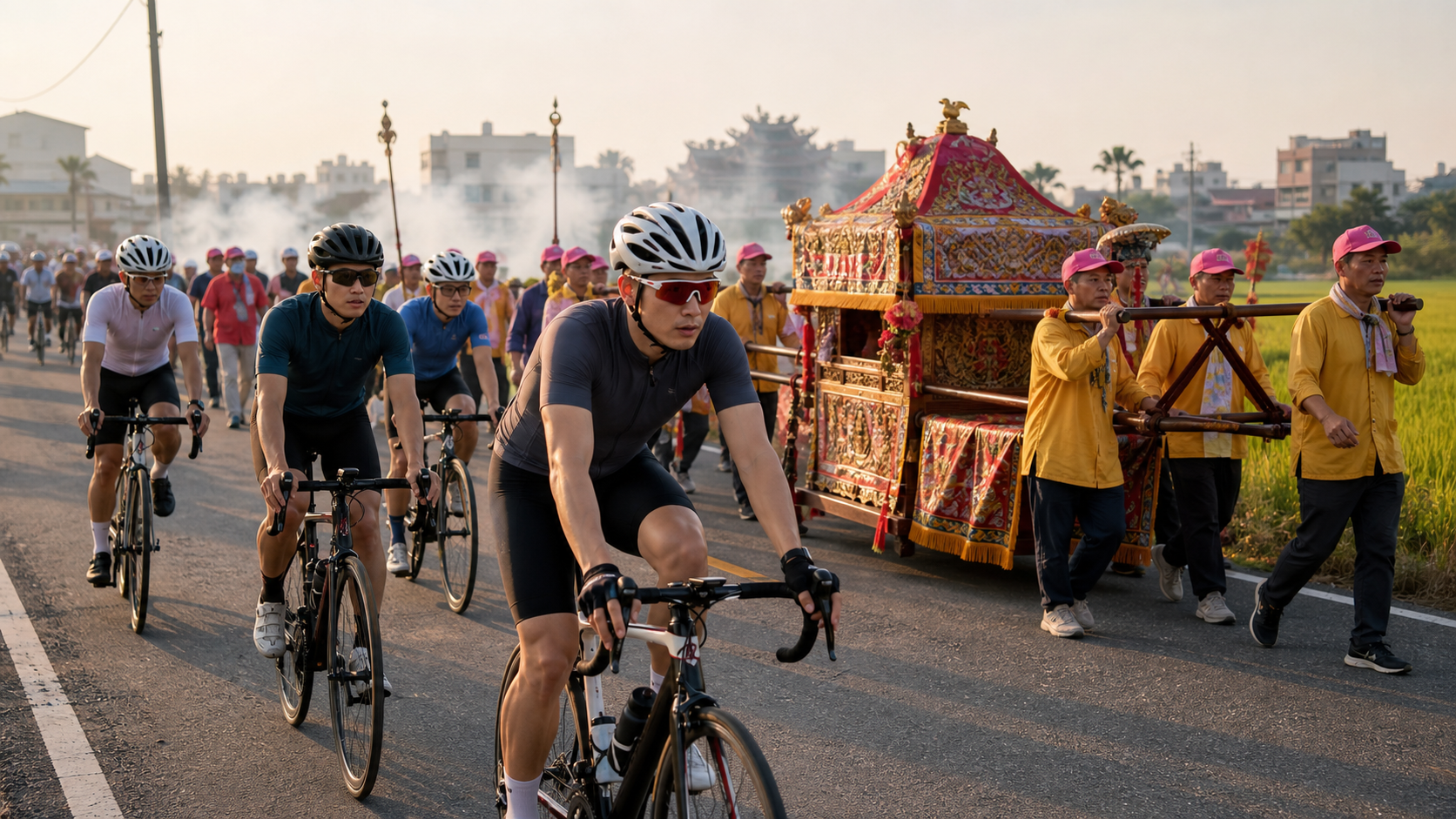
In recent years, an interesting phenomenon has quietly spread through Taiwan’s cycling community: more and more riders are choosing two wheels over two feet, following the palanquin carrying Mazu, creating a unique culture of “cycling the pilgrimage.”
When Pilgrimage Meets Cycling
The Mazu Pilgrimage tradition has always been dominated by walking devotees. However, with the growing popularity of cycling in Taiwan, and the fact that the pilgrimage route happens to cover many provincial highways in central Taiwan that are ideal for riding, bicycles have gradually become one of the new ways to participate in the pilgrimage.
This fusion happened naturally rather than as a deliberately planned event:
- The pilgrimage palanquin procession typically moves at 5–8 km/h, so cyclists can easily keep pace
- The route passes through the flat plains of Taichung, Changhua, Yunlin, and Chiayi, making it suitable for riders of all levels
- Riding around the palanquin allows participants to feel the religious atmosphere while showcasing physical endurance and devotion
| Pilgrimage Route Features | Cycling Suitability |
|---|---|
| Taichung→Changhua section (Provincial Highways 1 and 17) | Flat, suitable for beginners |
| Changhua→Yunlin section (County Road 157) | Gentle hills, scenic views |
| Yunlin→Chiayi section (Provincial Highway 19) | Rich agricultural scenery, minimal climbing |
| Before dawn departure (temple square) | Congregated parking, densest crowds |
Why More Riders Are Choosing to Cycle the Pilgrimage
When asked, riders who have cycled along with the pilgrimage give a wide range of reasons, yet several core themes stand out:
Faith and exercise in sync
For riders with religious beliefs, cycling alongside Mazu is a form of practice that unites body and mind. Pedaling amid the blessings of onlookers and the swirling incense smoke brings an indescribable sense of groundedness.
The diverse appeal of the route
The pilgrimage route deliberately avoids highways, instead following old Taiwan’s provincial roads and country lanes, passing through farmland, ancient temples, and traditional markets. These are stretches rarely experienced during regular rides, and the pilgrimage offers a “reason” to explore them.
The resonance of companionship
During the pilgrimage, temples and private homes along the way set up free supplies such as “braised pork rice,” “oiled rice,” and “sweet soup.” This unconditional generosity feels especially precious in today’s commercialized society, and it provides a warm outlet for the fatigue of long-distance riding.
The boost from social media
In recent years, photos and videos of “cycling with Mazu” have spread widely across social media, attracting many young riders unfamiliar with the pilgrimage to give it a try. A single photo taken beside the palanquin often conveys this cultural experience more powerfully than a thousand words.
Unwritten Rules of the Cycling Community During the Pilgrimage
Although there are no written regulations, cyclists have gradually developed an unspoken code of conduct while riding during the pilgrimage:
- Never pass the palanquin: Vehicles are prohibited in front of the palanquin procession; riders must stay behind or to the sides
- Dismount at temples: When the palanquin enters a temple for the “passing under the palanquin” ritual, riders typically dismount and wait, showing respect for the deity
- No honking: While riding alongside the procession, remain as quiet as possible to avoid disturbing the religious atmosphere
- Yield to devotees: When pedestrian devotees crowd the area, riders proactively stop and yield, prioritizing safety
Practical Challenges of Cycling the Pilgrimage
While this fusion is fascinating, putting it into practice is not without challenges:
- Complex traffic controls: Many sections of road are subject to traffic management during the pilgrimage, which can also affect cyclists
- High crowd density: Crowds surge near temples, and weaving through the throng requires intense focus
- Continuous day-and-night movement: The procession sometimes continues late into the night, so nighttime riding safety gear is essential
- Hundreds of kilometers in total: Following the entire route requires several days of physical endurance; beginners without long-distance riding experience are advised not to attempt the full journey
Practical Advice
- Join for one or two days: You don’t have to participate in the entire pilgrimage. Pick a section with convenient transportation and join for a day or two—the experience will still be complete
- Ride with a group: Some cycling communities organize pilgrimage riding teams, offering safety and companionship
- Bring ample supplies: Although free food is available along the way, cycling burns more energy, so it’s still recommended to bring your own energy gels and water
- Follow the official route: Jenn Lann Temple publishes the year’s pilgrimage route annually; plan ahead
Conclusion
The meeting of the Dajia Mazu Pilgrimage and cycling culture is a fascinating cultural mashup in Taiwan’s contemporary way of life. When the power of faith meets the rhythm of pedaling, blending on the provincial highways of central Taiwan’s plains, it produces not just a unique travel experience but a profound connection to Taiwan’s religious culture, local landscapes, and the spirit of cycling. On this road, deities and riders travel side by side, and every turn of the pedal is both an act of devotion and a form of freedom.
Related Reading
- Taiwan Cycling Carnival: Dajia Mazu Cup, KOM, Hsinchu Bike Festival
- Cycling Music Festivals and Event Culture: Major Taiwanese Cycling Celebrations
- Taiwan Cycling Tourism: Bike Tour Packages Combining Homestays, Food, and Attractions
- Cycling Festival Culture: Bicycle Carnivals and Group Rides Across Taiwan
微東進 太魯閣 蘇花 單車兩日遊 ! 颱風過後路況超刺激 行程大亂 | 最狂的鹹酥雞訂單 | CT Yeh | 4K 高畫質空拍絕景!
4 年前
太平山單車員工旅遊 | 這樣玩CP值最高!| 公路車
5 年前
高雄綠園道鐵路自行車道 / 外地人能輕鬆駕馭 還是整路崩潰? / 2025 全線開通 春節實地探索一次!(附GPS連結)/ 公路車 / CT Yeh
1 年前
2025 紫南宮99.9K環縣自行車挑戰賽 直播 / 第一集團跟了20K / CT動態數據直播系統 / 公路車 / CT Yeh
1 年前
2024 如來神掌 百人約騎挑戰!feat. 秘境單車社團 / 神人們太可怕 / 全程錄影 x 完整坡度解析 / 公路車 / CT Yeh
2 年前
2023自行車展!與環台賽選手一同表演賽 / 全自動AI Fitting?/ TIME新車發表/神秘充電桌等 精華分享 VLOG | CT Yeh | 公路車
3 年前
嘉義大埔、阿婆灣挑戰賽,美到以為在日本!ft. 環騎5 Cool 西拉雅188 / 公路車 / CT Yeh
7 個月前
台北大雁西飛 約騎挑戰 feat. Doris | 公路車 | CT Yeh
3 年前