Power Strategies for Different Terrain: Principles of Power Distribution on Flats, Climbs, and Descents
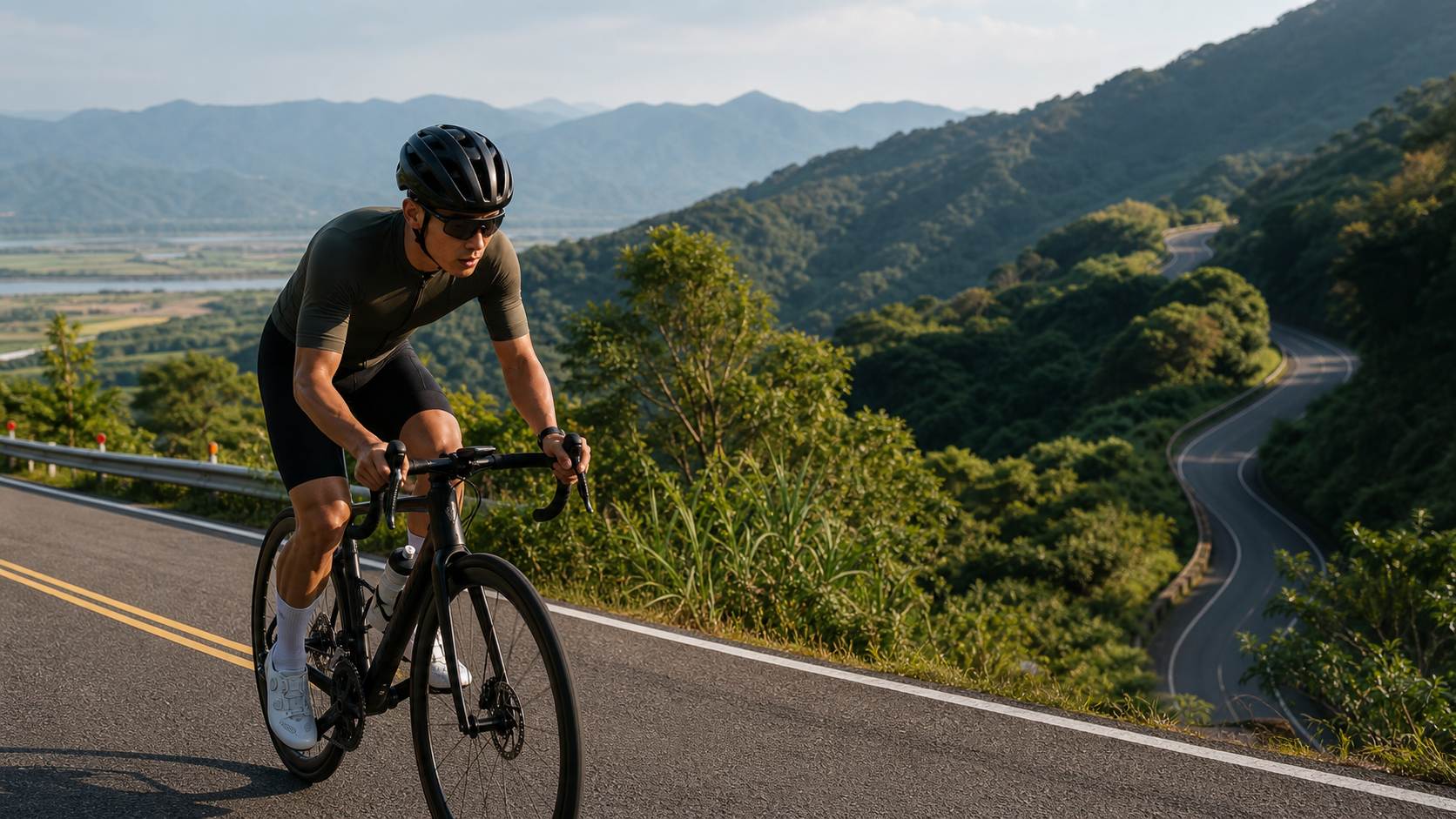
Introduction
Taiwan’s cycling routes are renowned for their varied terrain—from the flat western coastline to the astonishing gradients of Wuling, from the winding Beiyi Highway to the gentle riverside bike paths. Different terrains demand completely different power outputs, yet many riders apply the same power strategy across all terrain. Understanding the relationship between terrain and power distribution not only makes you faster, but also more efficient and less likely to blow up in the second half of a ride.
The Physics Behind Power Output
Before discussing terrain strategies, it’s essential to understand one key formula:
Power = Resistance × Speed
The main resistances a cyclist faces are:
- Aerodynamic drag: Accounts for 70–90% of resistance at high speeds on flat roads
- Gravitational component: The dominant resistance when climbing
- Rolling resistance: Present on all terrain, but relatively small (5–10%)
This physical reality dictates that different terrains require different power strategies.
Power Strategy on Flats
The Exponential Relationship of Aerodynamic Drag
On flat roads, aerodynamic drag is proportional to the cube of speed:
- Accelerating from 30 km/h to 36 km/h (+20% speed) requires approximately 73% more power
- Accelerating from 40 km/h to 48 km/h (+20% speed) requires approximately 73% more power
This means: maintaining a steady speed on the flats is more energy-efficient than surging hard and then slowing down.
Optimal Power Distribution on Flats
Principle One: Avoid “Power Spikes”
A power spike refers to a brief burst of high output. Every unnecessary acceleration on flat terrain consumes far more energy than maintaining speed requires. In time trials or long-distance rides, aim to keep power output as smooth as possible.
Principle Two: Reduce Power with a Tailwind, Maintain Power into a Headwind
In windy conditions:
- Tailwind sections: maintain a similar speed with 10–15% lower power
- Headwind sections: hold power steady or slightly higher (but no sprinting), keeping speed from collapsing
- Crosswind sections: reduce speed and power, prioritizing balance and safety
Ideal power targets on flats:
- Time trial (<60 minutes): 95–105% FTP
- Long-distance ride (>2 hours): 70–80% FTP
- Group riding (drafting): can drop to 50–65% FTP (benefit of reduced wind resistance)
Group Tactics on Flats
Riding at the back of a group can save 30–40% of your power output. Taiwan’s flat group rides (such as Taichung Houli Railway Bike Path or Chiayi Dongshi Coastal Highway) are the perfect environment to experience the benefits of group riding.
Power Strategy for Climbs
The Physics of Climbing
When climbing, the importance of aerodynamic drag drops significantly (low speed, low wind resistance), and gravitational resistance becomes the dominant factor. Power is primarily used to “fight gravity,” therefore:
- Body weight becomes critical: W/kg (power-to-weight ratio) is the most important indicator of climbing speed
- At the same power output, lighter riders climb faster
Power Management on Long Climbs
Representative long climbs in Taiwan: Wuling (2,775m elevation gain), Tataka, Beiyi Highway
Power recommendations for long climbs (climb duration >30 minutes):
| Climb Duration | Recommended Power (%FTP) | Strategy Notes |
|---|---|---|
| 30–60 minutes | 80–90% | Zone 3–4, manage lactate accumulation |
| 60–120 minutes | 72–82% | Zone 3, save energy for the second half |
| 2–4 hours | 65–75% | Zone 2–3, prioritize finishing |
| >4 hours | 60–70% | Zone 2, primarily fat metabolism |
The most common climbing power mistake: going out too hard
The early part of a climb can feel “easy,” making it tempting to output 90% or even 100% FTP. By the second half, lactate has accumulated significantly, power collapses, and the final average power ends up lower than with a steady-output strategy.
Recommendation: During the first 20% of a climb, deliberately hold power 5–10% lower than your target, then gradually increase as conditions allow.
Power Strategy on Steep Pitches
Common steep sections in Taiwan (gradient >10%): Jiufen, Badouzi, certain sections of Datun Mountain
- Speeds are low on steep pitches, aerodynamic drag nearly disappears, and all power goes into overcoming gravity
- Steep pitches actually suit brief power surges (Zone 5–6), since they cannot be sustained for long
- On the flatter sections after a steep pitch, actively recover rather than continuing to push
Seated vs. Standing Power Differences
| Comparison Item | Seated | Standing |
|---|---|---|
| Power output | Lower (-5~10%) but sustainable | Higher but not sustainable for long |
| Muscle usage | Primarily quadriceps and glutes | Adds back and arm muscles |
| Energy expenditure | More efficient | More costly |
| Best used for | Steady sections on long climbs | Attacks, summit sprints, short steep pitches |
Power Strategy for Descents
The Energy Logic of Descending
On technical descents (such as from Wuling down to Hehuan North Peak), pedaling power is largely unnecessary—gravity-converted kinetic energy is sufficient to propel you forward. In this situation, there are two strategies:
Strategy One: Free Roll
- Rest the legs, allowing muscles to recover from climbing
- Best for: when another climb follows shortly after a long climb
- Drawback: loses the opportunity to keep muscles warm
Strategy Two: Light Pedaling
- Maintain low-resistance, low-power pedaling (Zone 1, 50–80W)
- Benefits: maintains muscle blood flow and pedaling cadence, preparing for the next climb
- Best for: time trials or routes requiring sustained output later on
Short Climbs After Flats: The Pre-Acceleration Strategy
Before entering a short climb from flat terrain, you can use speed inertia:
- Actively accelerate 100–200m before the climb begins (raising to Zone 5–6)
- Convert kinetic energy into climbing momentum, reducing high power output at low speeds
- Best for: short climbs (<30 seconds)
Power Strategy Recommendations for Taiwan’s Classic Routes
| Route | Terrain Characteristics | Recommended Power Strategy |
|---|---|---|
| Wuling (from Puli) | Long climb, consistent gradient | First 1/3 Zone 3, remaining 2/3 Zone 3–4 depending on condition |
| Beiyi Highway | Mixed climbs, many corners | Climb Zone 3–4, descend Zone 1 for recovery |
| Taichung Houli Railway | Flat, open group riding | Zone 2–3, seek group draft |
| Eastern Coastal Highway | Flat with mild rollers | Zone 2 long ride, Zone 3 into headwinds to hold speed |
| Hehuan Mountain (from Cingjing) | High-altitude long climb | Zone 2–3, reduced power at altitude is normal |
Practical Advice
- Record your power distribution habits across different terrains: use the “map + power curve” overlay view in training software to see your power output on every corner and gradient, identifying where energy is wasted
- Lower power targets by 5–10% on Taiwan’s summer climbs: high heat and humidity reduce cooling efficiency, placing greater strain on the heart at the same power output—you must proactively lower your target power
- Conduct a “self-test” of power on long rides: record average power at the end of each hour, observe whether power is gradually declining, and evaluate whether your pacing is appropriate
Conclusion
Terrain is the richest training material for cycling in Taiwan. Flat roads train aerodynamic efficiency and power stability, climbs strengthen the aerobic system and power-to-weight ratio, and descents hone technique and recovery time management. Mastering power strategies for each terrain type not only makes you more efficient in races, but also turns every journey through Taiwan’s mountains and seas into a fulfilling power training session.
Related Reading
- Climbing Power Strategy: A Scientific Comparison of Steady vs. Variable Power
- Climbing Race Power Strategy: Power Distribution and Pacing on Non-Uniform Climbs
- The Physics of Climbing: Mathematical Models of Power, Gravity, and Speed
- The Correlation Between Cycling Speed and Power: Calculation Methods for Grade and Wind Correction
如果Pogačar騎西進武嶺可以多快?會破2嗎?各種情況深度推估探討 / 公路車 / CT Yeh
2 年前
大武山後門26%歡樂陡坡!JJSC南台灣單車行Day2 / 被颱風追著跑 / 公路車 / CT Yeh
2 年前
公路車 爬坡 破PR 紀錄 小技巧 分享
6 年前
全台首發!邁金P715踏板功率計!市場價格撼動者再出招 / 功率對比實測 / FAVERO ASSIOMA 可參考! / 公路車 / CT Yeh
1 年前
#公路車 #西進武嶺 配速配瓦實驗 坡度分析 四小時內攻略 建大盃 NeverStop #西進武嶺攻略
6 年前
台北闊瀨陡坡 騎旅 / 日本單車雜誌編輯車友臨時加入!/ 髮香才是最強的 / feat. 北迴歸線小隊 / 公路車 CT Yeh
6 個月前
單車 梅山36灣 坡度介紹 路段介紹 空拍 (相關遊記影片,請參考說明或我的頻道喔,歡迎訂閱)
6 年前
西進武嶺 8000名單車友數據分析 PART1 | 從新手到高手數量/瓦數/推力比/FTP推力比/功率計使用率 大解析 | 公路車 | CTYeh
5 年前