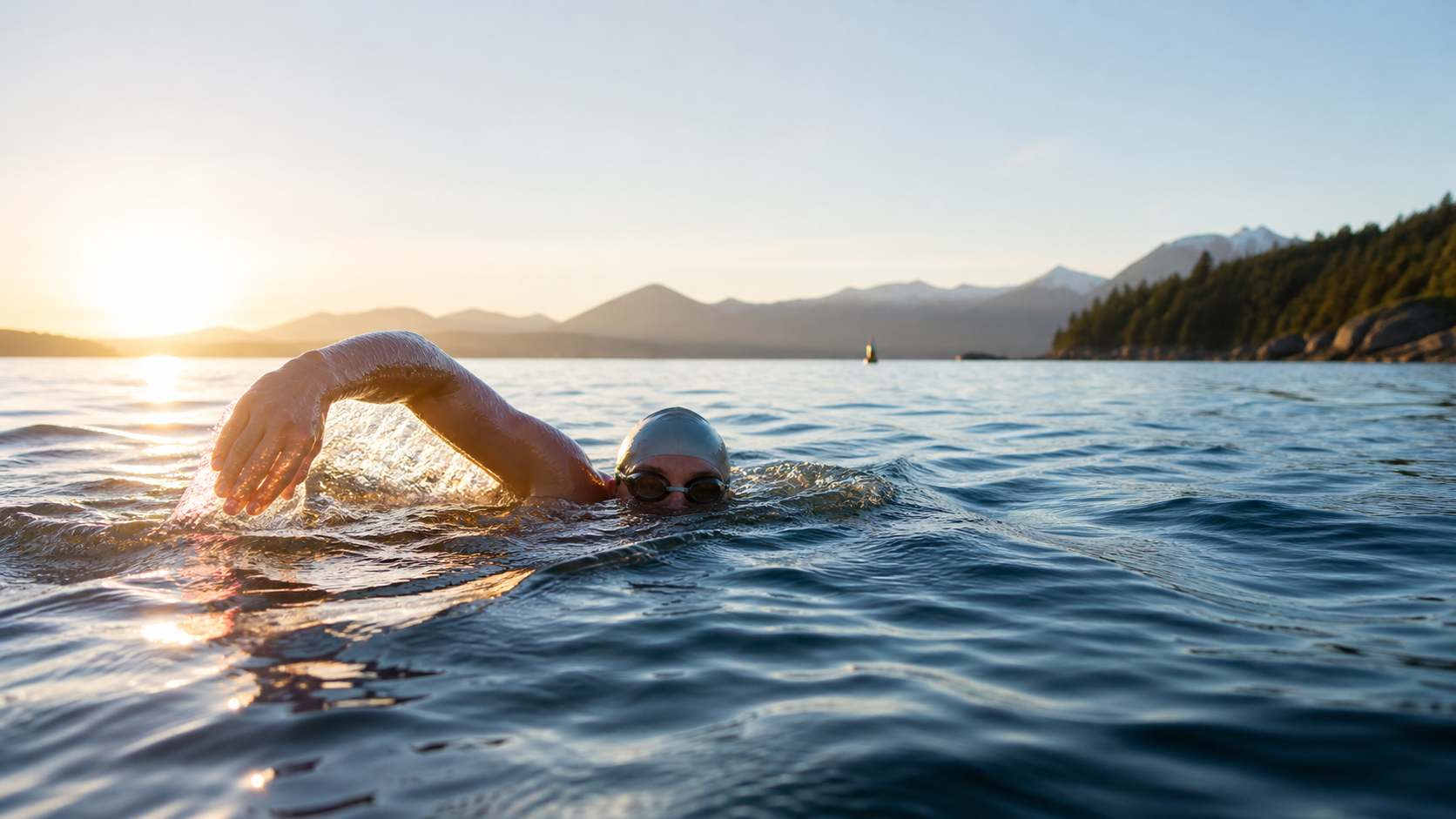
Open-Water Straight-Line Swimming Technique: How to Stay on Course Without a Black Line
Introduction
Every swimmer who transitions from the pool to open water has, after their first practice session, discovered that they swam a zigzag route. With no black line, no walls, and constant interference from waves and currents, these conditions make “straight-line swimming” the most fundamental yet hardest-to-master skill in open-water technique. According to GPS data studies from triathlon races, amateur athletes often swim 10–20% farther than the official race distance, and sometimes even more. How to shorten this extra distance is the core of this article.
1. Sighting: The Most Essential Open-Water Technique
Sighting refers to the action of briefly lifting your head to confirm your target ahead while swimming freestyle. Proper sighting involves three key elements:
- Timing: Lifting your head as your arm extends forward before your body sinks reduces added drag
- Frequency: Every 10–15 strokes in calm water; increase to every 6–8 strokes in rough conditions
- Target Selection: Prioritize buoys, tall buildings on shore, and highly visible markers
Common Mistake: Over-lifting your head causes your hips to drop, which increases drag and is clearly counterproductive. During practice, place a brightly colored bottle at the end of the pool and practice the sighting motion with “only your eyes above water.”
2. Three Methods for Staying Aligned
| Method | Best Used For | Description |
|---|---|---|
| Buoy Alignment | During races with clearly marked buoys | Confirm the position and angle of the next buoy each time you sight |
| Landmark Alignment | Alongshore swims | Pick a fixed building on shore and keep it directly in your line of sight |
| Sun/Light Alignment | Backup when visibility is low | Remember which side the sun was on at the start and keep your shadow position unchanged |
3. Underwater Awareness and Body Symmetry
Many people swim off course not because they fail to look where they’re going, but because asymmetrical strength or angle in their left and right strokes causes their body to naturally “drift.” Here are diagnostic and corrective methods:
- Closed-Eye Swimming Test: Swim 25 meters with your eyes closed in open water; the direction you drift toward reveals your weak side
- Video Analysis: Have a partner film your stroke path from underwater to check whether both entry points are symmetrical
- Kickboard Single-Arm Drills: Strengthen the efficiency of your weak-side stroke to balance the pulling power on both sides
- Core Stability Training: Land-based planks and single-leg stands to improve torso control in the water
4. Practical Advice
Pre-Race Preparation:
- Stand on shore 15 minutes before the start, scan the entire course, and identify 2–3 fixed reference points
- Note the general bearing between buoys (e.g., “the second buoy is to the right-front of the first buoy”)
- Pay attention to the sun’s position: if it is directly ahead of your swimming direction, bring polarized goggles or choose a lateral landmark on shore
Training Advice:
- Do at least one “no-black-line practice” per week: turn off the pool lights or cover the black line with a kickboard to train your sense of straight-line direction
- Join “navigation swimming” sessions at training camps to learn how to correct your course in dynamic currents
- Use a GPS watch to record every training route and objectively assess your progress
Conclusion
Straight-line swimming is not an innate talent but an instinctive response built through systematic training. From deliberately sighting during every practice to correcting stroke symmetry on land, every detail can save you precious time and energy during a race. Remember: in open water, the shortest route is always the best route.
Related Reading
CT 喇低賽) 武嶺牽車 才是王道 西進牽車四小時內秘訣 攝手位置 如何判斷 防抽筋小秘訣
7 年前
FTL 與 SYB 車隊專訪 西進武嶺 實用攻略分享! 2小時 如何練?!你不知道的眉角!新手準備武嶺必看 EP1 | 實力派女車友 | 精華版 | 公路車 | CTYeh
4 年前
CT 喇低賽) 單車 比賽總是沒照片? 攝影師的觀點大公開 姿勢就是力量! 請加速1.25倍收看
7 年前
西進武嶺 自製新版AI配速表產生器 x 賽前攻略 抱佛腳! 沒有功率計也可以產生配速表嗎?有什麼其他眉角賽前要注意的呢? | 西進武嶺 / 東進武嶺 KOM 攻略 | 公路車 | CT Yeh
4 年前
西進武嶺 免費訓練分析服務 Intervals | 練不夠還是練過頭?你哪一種類型選手?AI模型告訴你! | 備戰神器 | 公路車 訓練 | CT Yeh
4 年前
#公路車 #西進武嶺 配速配瓦實驗 坡度分析 四小時內攻略 建大盃 NeverStop #西進武嶺攻略
6 年前
備戰 戀戀197 賽前關門點分析 西濱團練 #公路車 4K高畫質
6 年前
Zwift 元宇宙單車世界 如何與全世界同步騎車運動
6 年前