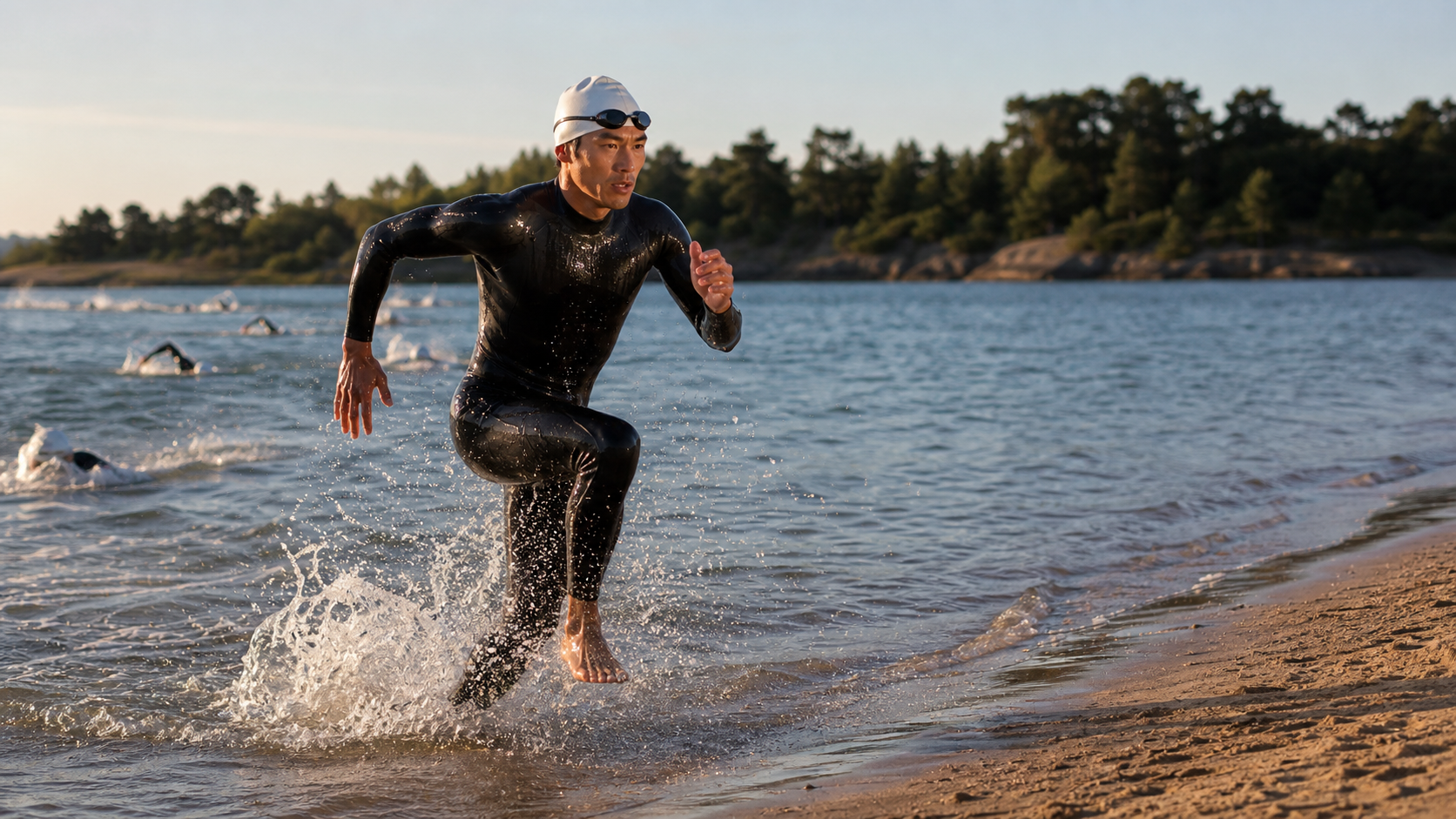
Open-Water Exit Technique: Footwork for Running onto the Beach or Shore at the Finish
Introduction
In triathlons or open-water swim events, the “exit” at the end of the swim leg is a technical element that is often overlooked yet critically important. Many athletes, after swimming 1,500 meters or even longer, feel dizzy, stumble, or even fall at the moment of exiting, losing significant time. This dizziness comes from a combination of “orthostatic hypotension” and “vestibular system imbalance”—the body suddenly shifts from a horizontal position to upright, compounded by the sudden increase in gravitational pull once buoyancy disappears, leaving the brain momentarily unable to adapt.
Understanding and practicing proper exit technique is not just about speeding up the transition—it is a matter of race safety.
1. The Three Phases of Exiting
Exiting is not a single action but a continuous three-phase process:
| Phase | Water Depth | Key Focus |
|---|---|---|
| Deep-water transition to standing | Above chest | Use the power of treading water to stand up, keep legs wide for balance |
| Shallow-water running | Knees to waist | High-knee running, arms swinging front and back |
| Beach sprint | After leaving the water | Lean forward, quickly shift into running rhythm |
2. Deep-Water Standing Technique
When the water gradually becomes shallower from chest depth to where you can touch the bottom, do not rush to stand up—the correct time to transition is when the water drops below waist level before switching to standing and running.
- Wide stance: A stance slightly wider than shoulder-width improves stability and resists wave impact
- Arm assistance: Sweep both arms outward beneath the surface, like performing a balancing motion in the water
- Fixed gaze: When standing, keep your eyes locked on a fixed point on shore to avoid vestibular imbalance
- Stay calm, don’t rush: 1–2 seconds of stabilization is worth it—far faster than fainting and falling afterward
3. High-Knee Running in Shallow Water
Running in water between knee and waist depth creates far more resistance than running on land. The following techniques can effectively reduce drag:
- High knees: Lift each knee above the water surface with every step to avoid the dragging sensation of “wading”
- Forward lean: Shift your center of gravity slightly forward so buoyancy partially helps drive forward momentum
- Short, quick strides: Take shorter steps than on land, but maintain the same cadence
- Arm swing: Swing your arms just like running on land to maintain rhythm
- Avoid taking waves head-on: When waves come from the side, angle your body slightly toward the wave direction to reduce the chance of being knocked over
4. Footwork Adjustments After Reaching the Beach
The moment you step onto the sand, many people suddenly feel heavy-footed. This is because the leg muscles have been using a kicking pattern in the water for a long time and need to be reactivated for running:
- Increase kicking intensity 20 meters before exiting: Warm up the leg muscles in preparation for running after exiting
- Remove goggles first, then the swim cap: Don’t waste time adjusting gear in shallow water
- Look up and ahead: Don’t look down at your feet; keeping your gaze level helps stabilize your center of gravity
- Accept the first 30 seconds of awkwardness: Your body needs time to adapt; don’t panic and speed up, which could lead to a fall
5. Exit Considerations for Special Terrain
- Rocky shores: Wear thick-soled swim shoes or reef-protection booties; use your hands for support when exiting and move slowly
- Docks/ramps: Grab the handrail or ladder with both hands first, then push off the wall with your feet to get out; do not jump
- Mudflats: Keep your weight on the outside of your feet to avoid sinking toes into the mud; take quick, light steps
6. Practical Advice
Training methods:
- Schedule dedicated “exit sprint” drills at the beach or lake: swim into the water, then quickly exit and run 50 meters, repeating 5–10 times
- Triathletes can practice at the pool: after finishing a set, immediately climb out of the pool to simulate the transition feeling
Before the race:
- Walk the exit area once during the pre-race warm-up to check for rocks or elevation changes on the bottom
- Know where the finish line is rather than sprinting blindly
Conclusion
Exit technique is rarely practiced specifically in training, yet in a race it can be the main factor in T1 time differences. From practicing the correct timing for standing, mastering high-knee running in shallow water, to familiarizing yourself with how to handle different terrains—every detail helps you complete this critical water-to-land transition more safely and more quickly.
Related Reading
- Open-Water Run-In Technique: The Dolphin Dive for Sprinting from the Beach into the Water
- Managing Open-Water Panic: A Self-Rescue Protocol When Panic Strikes Mid-Race
- Open-Water Start and Survival in the Washing Machine: Tactics from the Beach Sprint to Escaping the Chaos
- Open-Water Exit Technique: Timing Your Walk, Run, and Dolphin Dive
FTL 與 SYB 車隊專訪 西進武嶺 實用攻略分享! 2小時 如何練?!你不知道的眉角!新手準備武嶺必看 EP1 | 實力派女車友 | 精華版 | 公路車 | CTYeh
4 年前
白沙屯媽祖進香在家走!UREVO 坡度自調走步機 / 可連接訓練遊戲APP MyWhoosh / 邊看直播邊走起來 / CT Yeh
11 個月前
CT 喇低賽) 武嶺牽車 才是王道 西進牽車四小時內秘訣 攝手位置 如何判斷 防抽筋小秘訣
7 年前
西進武嶺 自製新版AI配速表產生器 x 賽前攻略 抱佛腳! 沒有功率計也可以產生配速表嗎?有什麼其他眉角賽前要注意的呢? | 西進武嶺 / 東進武嶺 KOM 攻略 | 公路車 | CT Yeh
4 年前
西進武嶺 免費訓練分析服務 Intervals | 練不夠還是練過頭?你哪一種類型選手?AI模型告訴你! | 備戰神器 | 公路車 訓練 | CT Yeh
4 年前
單車 梅山36灣 坡度介紹 路段介紹 空拍 (相關遊記影片,請參考說明或我的頻道喔,歡迎訂閱)
6 年前
海豚島滑沙
11 年前
#PUSHBIKE 原來這麼好玩! 小朋友 滑步車 初體驗 超可愛
6 年前