Open-Water Turn Buoy Technique: The Best Route and Speed for Staying Close to the Buoy
Introduction
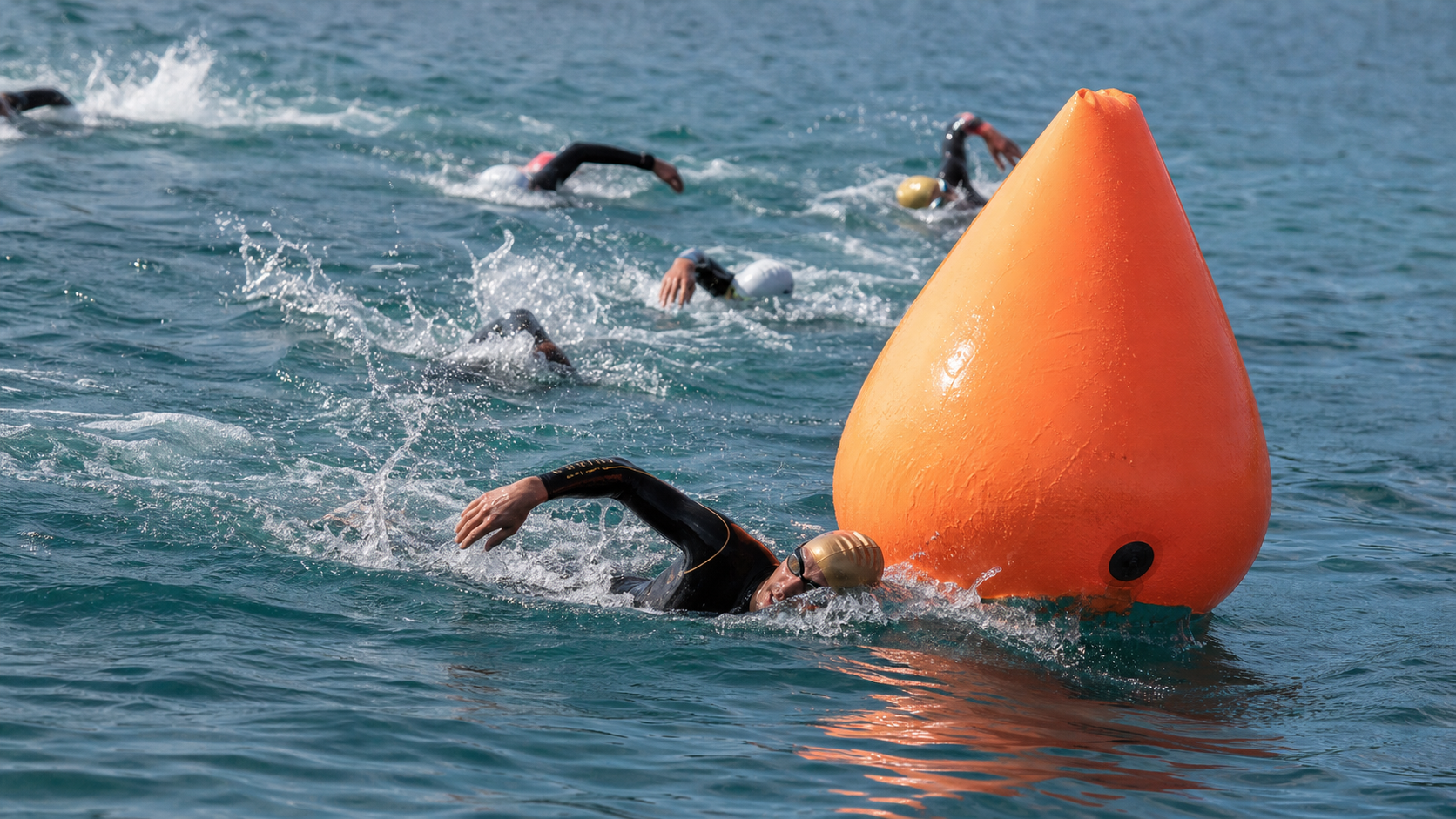
In the course design of open-water races, the turn buoy is the only reference point that allows swimmers to confirm their position in vast waters, and it is also the location where collisions, route deviations, and strategic losses are most likely to occur. Many swimmers waste 5–15 seconds at each buoy turn, and with multiple buoys throughout the race, the total loss can be substantial.
Mastering buoy turn technique is not just about turning quickly—it is a strategic ability to gain positional advantage in a fiercely competitive pack-swimming environment.
1. The Geometry of Buoy Turns
Imagine you need to round a stationary circular buoy to change direction by 90° or 180°. The shortest path is not “hugging the buoy” but rather taking a “tangent turn” geometric route:
- Tangent turn: Veer toward the inside of the buoy early and round it in an arc, similar to cutting the inside of a curve on a running track
- Hugging mistake: Swimming straight at the buoy and then turning sharply is equivalent to “taking a wide arc,” making the route longer
- Ideal radius: Begin the arc 2–3 meters from the buoy, adjusting based on race density
| Turn Type | Route Length | Crowd Pressure | Recommended Scenario |
|---|---|---|---|
| Tangent turn (outer arc) | Longer | Low | Conservative strategy when crowded |
| Tangent turn (inner arc) | Shortest | High | Leading pack, fewer swimmers |
| Straight-line sharp turn | Moderate | Medium | Not recommended; significant speed loss |
2. Strategy for Approaching the Buoy
Start preparing 50 meters out:
- Lift your head to confirm the buoy position: Confirm the exact bearing of the buoy at least 50 meters ahead
- Assess crowd density: Observe whether the area around the buoy is packed with swimmers, and decide whether to pass on the outside or inside
- Adjust your line: Veer toward your target side early to reduce the sharpness of the turn at the buoy
- Increase kicking: 15–20 meters before the turn, intensify your kick to enhance body stability and turning power
3. Technical Movements During the Turn
180° U-turn (most common):
- As you approach the buoy, begin rolling your body to the side so your head faces the turning direction
- The outside arm increases its pull arc (pulling from the shoulder backward), while the inside arm shortens its stroke length
- Increase kick tempo to maintain speed without dropping off
- Shift your gaze from the buoy to the next target direction
90° turn:
- Similar movements, but the turning arc is smaller, making it easier to maintain speed
- You can begin the body roll 4–5 meters from the buoy for a smooth transition
4. Buoy Strategy in Crowds
In large races, the area around buoys is often extremely congested. Here are some recommendations:
- Wide outside route: Although the route is slightly longer, it avoids elbows and kicks, and overall pace is actually more stable
- Wait for a gap: When the crowd is dense, slow down slightly for 1–2 strokes, then surge in once space opens ahead
- Protect your face: During the turn, extend one arm forward as a buffer to avoid direct contact with your face
- Verbal warnings: In extreme congestion, you can shout “Left side!” or “Right side!”, but race rules prohibit interfering with others
5. Speed Management
Turning is the only reasonable time to slow down during a race, but you still need to maximize efficiency:
- Do not “deliberately sprint” before the turn—saving energy for the straight-line acceleration after the turn is more effective
- Make the first 5 strokes after completing the turn more powerful than usual to quickly regain speed
- In training, time the full segment of “10 meters before the buoy + turn + 10 meters after the buoy” and continuously optimize it
6. Practical Advice
Training methods:
- Place buoys during open-water training and design courses with turns, practicing turns at least 2–3 times per week
- Practice competitive turns with training partners to simulate the crowd pressure of a race
- You can also use the pool wall to practice body roll and directional change continuity
Conclusion
Buoy turn technique combines geometric judgment, body control, and mental response—it is the segment of open-water swimming that truly tests comprehensive technical ability. By consciously practicing turn lines in every training session and building confidence for race day, you will find yourself becoming increasingly adept at the critical turning points of a race.
Related Reading
- Open-Water Turn Buoys: Turning Technique and Inside/Outside Position Strategy
- Open-Water Buoy-Rounding Technique: Inside-Line Turns and Dealing with Being Boxed In
- Route Reading in Open-Water Races: Buoy Position Judgment and Shortest-Distance Paths
- Straight-Line Swimming Technique in Open Water: Head-Lift Frequency and Timing for Buoy Orientation
CT 喇低賽) 武嶺牽車 才是王道 西進牽車四小時內秘訣 攝手位置 如何判斷 防抽筋小秘訣
7 年前
2023桃園團體繞圈賽 / 海鷗繞圈賽 | 全程空拍數據版 | 公路車 | CT Yeh
2 年前
FTL 與 SYB 車隊專訪 西進武嶺 實用攻略分享! 2小時 如何練?!你不知道的眉角!新手準備武嶺必看 EP1 | 實力派女車友 | 精華版 | 公路車 | CTYeh
4 年前
大禹嶺 到 武嶺牌樓 全程前後實況錄影 | 北進武嶺 | 東進武嶺 | KOM | 訓練台 | 坡度分析 | Taiwan KOM Last 10 km HARD | 公路車
6 年前
2025 海鷗團體繞圈賽 網路直播 超激烈裁判長視角 / EIPC 李廷威、Waypoint 等眾多高手競爭 / feat. 卡密兒主持 / 海鷗繞圈賽
9 個月前
西進武嶺 免費訓練分析服務 Intervals | 練不夠還是練過頭?你哪一種類型選手?AI模型告訴你! | 備戰神器 | 公路車 訓練 | CT Yeh
4 年前
富士山KOM 賽事篇 VLOG!/ 小野田出沒!/ 完整路段分析 / 武嶺要騎多快才能拿環?/ 台灣選手 第20回Mt.富士ヒルクライム 参加!/ 公路車 / CT Yeh
2 年前
#公路車 #西進武嶺 配速配瓦實驗 坡度分析 四小時內攻略 建大盃 NeverStop #西進武嶺攻略
6 年前