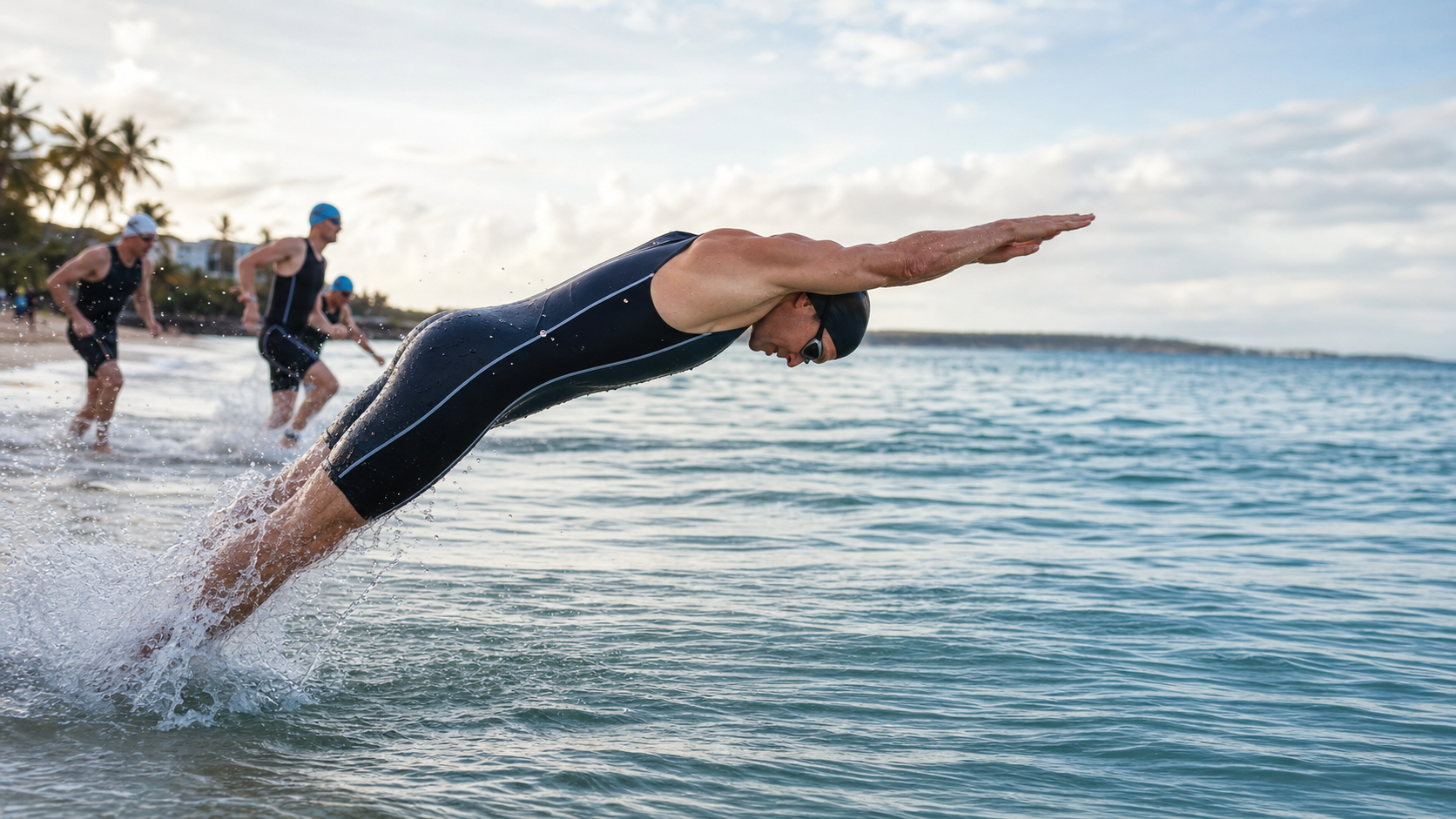
Open-Water Run-In Technique: The Dolphin Dive from the Beach into the Surf
Introduction
In the opening seconds of a major open-water race, hundreds or even thousands of athletes charge from the beach into the sea at once. Those 30–60 seconds often determine your position and mental state for the next several kilometers of swimming. Enter too slowly and you’ll get boxed in by the crowd; drop into a swim too early and your legs will churn against the shallow water with massive drag, wasting huge amounts of energy.
The “Dolphin Dive” is the key to solving this problem—it lets you move through the shallow zone in the most efficient way possible, faster than wading or running, and less tiring than swimming outright. It is the ideal bridging technique for getting into the water.
1. The Basic Principle of the Dolphin Dive
The Dolphin Dive uses the buoyancy of the water to reduce leg drag while using the momentum of your body’s downward plunge to cut through the wave face, making it more efficient than running in shallow water. Its effective depth range is:
| Water Depth | Recommended Action |
|---|---|
| Below the thighs | High-knee running |
| Thighs to waist | Dolphin dive (most effective) |
| Waist to chest | Dolphin dive or transition to swimming |
| Above the chest | Start swimming |
2. Dolphin Dive Technique Breakdown
Step 1: The Takeoff
- Enter the water at a sprint pace, and prepare when you feel the resistance increase
- Extend both arms forward, lower your head, and enter the water with your whole body in a “dive position”
- The descent angle should be about 30–45 degrees—do not plunge straight down
Step 2: Underwater Glide
- Keep your hands clasped in front of your head to maintain a streamlined position
- Let your body rise slightly with the current (using buoyancy)
- Use a dolphin kick (legs together, undulating up and down) to propel yourself forward
Step 3: Lift the Head and Rise
- When you feel the bottom with your hands or sense your body about to surface, press down with your hands to lift your upper body
- Find the bottom with your feet, plant them, stand up quickly, and continue running or launch into the next dive
Step 4: Consecutive Dolphin Dives
- One dolphin dive can propel you about 1.5–2 meters
- Keep executing them continuously within the effective depth range until the water reaches above your chest, then switch to swimming
3. Common Mistakes and Fixes
- Diving too deep: Touching the bottom wastes time—control your descent angle to around 30 degrees
- Legs spread apart: This increases water resistance—keep your legs together for the dolphin kick
- Pausing before entry: Interrupting your speed kills your forward momentum—maintain a continuous rhythm
- Dropping into a swim too early: Swimming when the water is only waist-deep creates enormous leg drag and wastes energy
- Head lifted up: Lifting your head on entry drives your body deeper—keep your head in line with your spine
4. Adjusting for Head-On Waves and Following Waves
- Entering against the waves: Complete your dive before the wave hits so it breaks over your head rather than into your face; or accelerate through during the trough between waves
- Entering with a following wave: When a wave pushes from behind, use it to accelerate, timing your dive to match the trough
- The surf zone: Get through the breaking-wave zone as quickly as possible—don’t get repeatedly pushed back in the whitewater; keep driving forward
5. The Complete Beach Sprint Sequence
The standard flow from the start line to fully entering the water:
- At the starting gun, sprint full speed toward the water
- When the water reaches below your ankles, begin high-knee running
- When the water reaches your thighs, execute your first dolphin dive
- Repeat dolphin dives until the water is above your chest
- After the final dolphin dive, transition naturally into front crawl swimming
6. Practical Advice
Training Methods:
- Before each open-water session, do 3–5 full “run-in” practice repetitions to build the movement into muscle memory
- Practice the underwater glide of the dolphin dive at the pool edge to improve your streamline quality
- Before race day, rehearse the complete start-and-run-in sequence at the race venue to familiarize yourself with the local seabed slope
Race Strategy:
- Starting position choice: first-time racers should line up on the outside of the pack to avoid the crush; confident swimmers can take the front row
- Before the start, take 3 deep breaths, relax your shoulders, and prepare for an explosive sprint
Conclusion
The dolphin dive may look simple, but it actually requires body coordination and a feel for the water. From your first clumsy entry to smooth, continuous dive transitions, that learning curve will leave you feeling confident at the start of every race. The speed and efficiency of your run-in are the first step to success in open-water competition.
Related Reading
- Open-Water Exit Technique: Timing the Walk, Run, and Dolphin Dive
- Open-Water Finish Technique: Footwork for Running onto the Beach or Shore at the Finish
- Underwater Dolphin Kick: Don’t Waste the Fastest Position
- Open-Water Start and Washing-Machine Survival: Tactics from the Beach Sprint to Escaping the Melee
海豚島滑沙
11 年前
CT 喇低賽) 武嶺牽車 才是王道 西進牽車四小時內秘訣 攝手位置 如何判斷 防抽筋小秘訣
7 年前
FTL 與 SYB 車隊專訪 西進武嶺 實用攻略分享! 2小時 如何練?!你不知道的眉角!新手準備武嶺必看 EP1 | 實力派女車友 | 精華版 | 公路車 | CTYeh
4 年前
西進武嶺 免費訓練分析服務 Intervals | 練不夠還是練過頭?你哪一種類型選手?AI模型告訴你! | 備戰神器 | 公路車 訓練 | CT Yeh
4 年前
3D 列印車褲墊 / 舒適改善? / 無痕 x 分區壓縮 / ATK & Decider系列 / JE22黑科技 / #公路車 #CTYEH
11 個月前
備戰 戀戀197 賽前關門點分析 西濱團練 #公路車 4K高畫質
6 年前
大禹嶺 到 武嶺牌樓 全程前後實況錄影 | 北進武嶺 | 東進武嶺 | KOM | 訓練台 | 坡度分析 | Taiwan KOM Last 10 km HARD | 公路車
6 年前
2025 海鷗團體繞圈賽 網路直播 超激烈裁判長視角 / EIPC 李廷威、Waypoint 等眾多高手競爭 / feat. 卡密兒主持 / 海鷗繞圈賽
9 個月前