Reading Open-Water Currents: How to Use Ocean Currents or River Flow to Save Energy
Introduction
During the 2019 Taroko swim event, some athletes clocked unexpectedly fast times off Qingshui Cliff, while others found that no matter how hard they pushed, they couldn’t get back on their intended line. What made the difference? Currents. Those who read the current direction correctly covered more than 20% extra effective distance with the same amount of effort.
Currents are the invisible third leg in open-water swimming. Learning to read and use them is one of the highest-return investments in advanced open-water technique.
1. Common Current Types in Taiwan
| Current Type | Characteristics | Common Locations in Taiwan |
|---|---|---|
| Kuroshio (branch) | Strong and steady, flowing north by east | East coast, Orchid Island |
| Taiwan Strait tidal currents | North-south, reversing with the tides | West coast, Penghu |
| Rip current | Rapid flow surging seaward | Gaps in sandbar topography along various beaches |
| River mouth currents | Vary with rainfall and tides | Dajia River, Tamsui River mouths |
2. Reading Current Direction in the Water
Observation before entering the water (most important):
- Watch the direction of drifting driftwood, foam, or floating debris on the surface
- Observe anchored boats—the direction the bow faces is the direction the current comes from
- Ask local lifeguards or experienced local swimmers
Sensing in the water:
- After swimming 50 meters in a straight line, lift your head to check whether you have drifted off your intended bearing
- Feel the resistance in your stroke—resistance drops noticeably when swimming with the current and increases when swimming against it
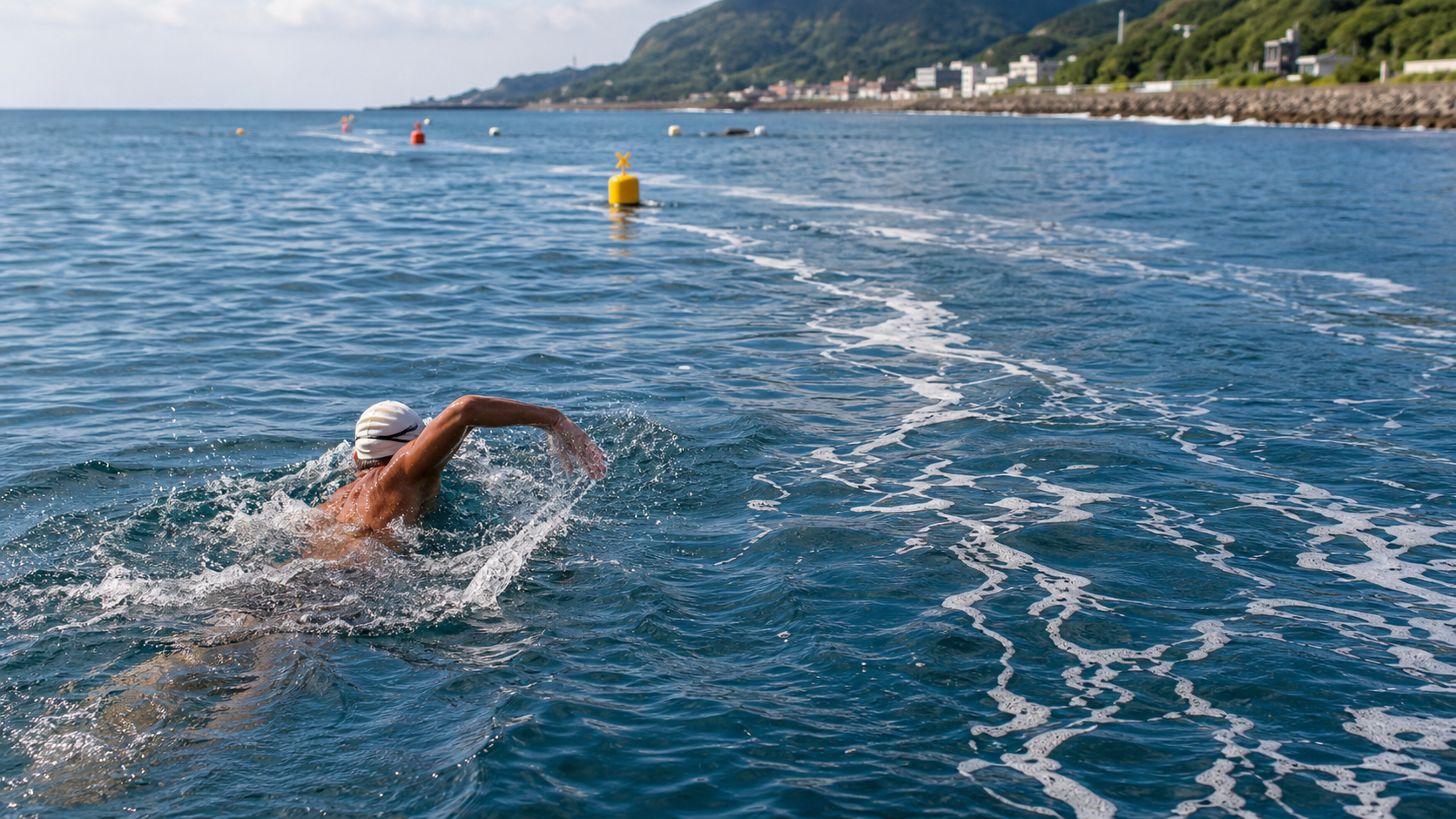
- Observe the water trail around buoys (a wake forms behind the buoy; the direction of that wake indicates the current direction)
3. Calculating Current Compensation Angle
When a current flows across your path, aiming directly at your target will actually push you off course. The correct approach is “angle compensation”—adjusting your swimming direction toward the upstream side of your target.
Simple estimation method:
- Weak current (barely noticeable): compensate 5–10 degrees
- Moderate current (clearly being carried): compensate 15–25 degrees
- Strong current (requires effort to hold your line): compensate 30–45 degrees, or consider taking a detour
Practical mantra: “Aim for the upstream side of the buoy, not the buoy itself.”
4. Strategies for Using Currents
With the current:
- Maintain standard technique; no need to push extra hard—let the current do the work
- You can moderately reduce your stroke rate to save energy for the against-current section later
- When the route allows, deliberately drift slightly in the current’s direction and let it carry you forward
Against the current:
- Shorten your stroke length and increase stroke rate—short, powerful strokes are more effective than long glides in a head current
- Keep a low body position to reduce frontal resistance from the current on your upper body
- If the head current is extremely strong, consider deviating slightly from a straight line and crossing the current zone at an angle rather than fighting it head-on
5. Identifying and Responding to Rip Currents
Rip currents are the most dangerous currents in open water and cause drowning incidents in Taiwan every year. Swimmers must learn to identify them:
- Water color difference: Rip current water is often murkier than the surrounding water and sometimes slightly darker
- Surface disturbance: The water surface in a rip current zone shows irregular texture, with foam moving seaward
- Gap in the waves: A “calm” stretch with no waves in an area that normally has waves is very likely a rip current channel
What to do if caught in a rip current:
- Do not swim straight back to shore (this is the most common mistake and wastes energy to no avail)
- Swim to the left or right of the rip current (parallel to the shoreline) to exit its range, which is usually no wider than 30–50 meters
- Once clear of the rip current, swim back to shore
6. Practical Advice
Pre-race preparation:
- Check local marine environment monitoring data 1–2 days before the race (Central Weather Administration sea forecasts, harbor bureau current data)
- Observe the water surface for at least 5 minutes before entering the water on race day to assess the day’s current conditions
- Ask the organizing committee whether current information is available—good events will explain the day’s current conditions at the athlete briefing
Conclusion
The power of currents is far greater than most people imagine. Learning to read current direction before entering the water, sensing current changes while swimming, and applying the correct angle compensation strategy will let you use your energy more intelligently than everyone else in every open-water race. Remember: swimming champions aren’t just the strongest athletes—they’re the ones who best know how to harness external forces.
Related Reading
- Reading Open-Water Currents: Ride the Flow, Survive the Head Current
- Reading Tidal and Ocean Currents: How to Use Water Flow to Save Energy
- Tides and Currents: How to Use Natural Forces to Improve Open-Water Swimming Efficiency
- Open-Water Swimming Safety Guide: Buddy System, Current Reading, and Emergency Response
CT 喇低賽) 武嶺牽車 才是王道 西進牽車四小時內秘訣 攝手位置 如何判斷 防抽筋小秘訣
7 年前
2023桃園團體繞圈賽 / 海鷗繞圈賽 | 全程空拍數據版 | 公路車 | CT Yeh
2 年前
2025 海鷗團體繞圈賽 網路直播 超激烈裁判長視角 / EIPC 李廷威、Waypoint 等眾多高手競爭 / feat. 卡密兒主持 / 海鷗繞圈賽
9 個月前
西進武嶺 免費訓練分析服務 Intervals | 練不夠還是練過頭?你哪一種類型選手?AI模型告訴你! | 備戰神器 | 公路車 訓練 | CT Yeh
4 年前
西進武嶺 自製新版AI配速表產生器 x 賽前攻略 抱佛腳! 沒有功率計也可以產生配速表嗎?有什麼其他眉角賽前要注意的呢? | 西進武嶺 / 東進武嶺 KOM 攻略 | 公路車 | CT Yeh
4 年前
備戰 戀戀197 賽前關門點分析 西濱團練 #公路車 4K高畫質
6 年前
單車 梅山36灣 坡度介紹 路段介紹 空拍 (相關遊記影片,請參考說明或我的頻道喔,歡迎訂閱)
6 年前
水金九不厭五分 10度寒流冷到不願停!feat. 卡卡 / 公路車 / CT Yeh
6 個月前