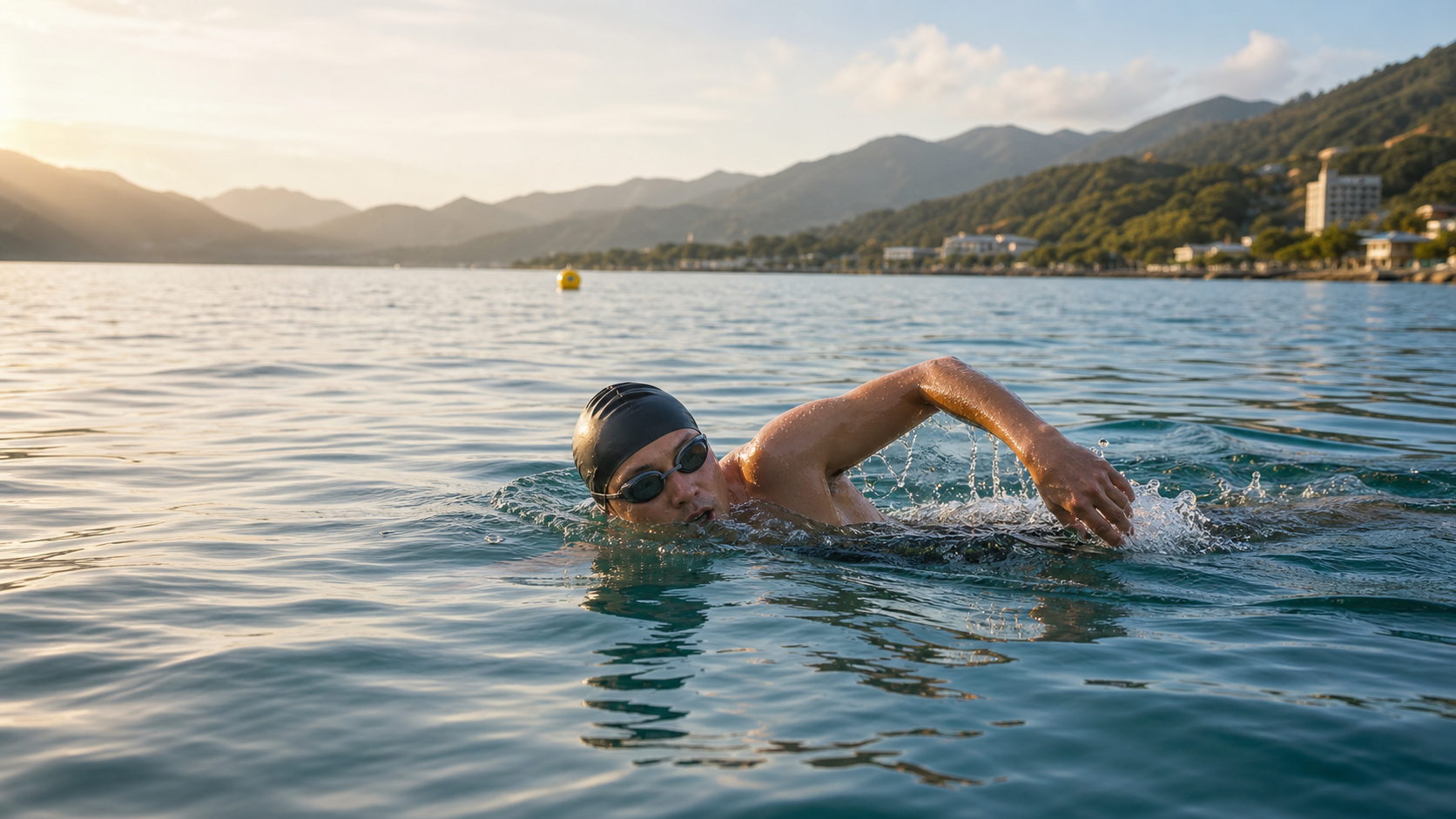
Energy Management in Open Water Swimming: Pacing and Intensity Control for Long-Distance Swims
Introduction
Taiwan hosts numerous long-distance swimming events every year, from the Sun Moon Lake万人泳渡 (3.3 km) and the Penghu circumnavigation swim to individual channel-crossing challenges, with distances ranging from a few kilometers to dozens of kilometers. Many participants prepare for these challenges with ample training volume and solid technique, yet experience severe performance drops in the latter stages of a race—not due to technical breakdown, but because of energy depletion.
Energy management in long-distance open water swimming is a science that combines physiology, strategic judgment, and self-awareness.
1. Energy Systems in Long-Distance Swimming
Swimming primarily relies on two energy systems:
| Energy System | Primary Fuel | Duration | Corresponding Intensity |
|---|---|---|---|
| Anaerobic System | Muscle glycogen (fast) | Tens of seconds to 2 minutes | Sprinting, race start |
| Aerobic System | Glycogen + Fat | Several hours | Long-distance cruising |
Long-distance swims rely almost entirely on the aerobic system. If you swim at too high an intensity too early, the anaerobic system kicks in, lactate accumulates rapidly, and fatigue sets in prematurely.
2. Pacing Principles: “Conservative Early, Accelerate Late”
Many swimmers habitually sprint at the start, swept up by the race atmosphere. This is the most common strategic mistake in long-distance swimming:
- First 30%: Swim at an intensity 5–10% below your target pace, allowing your body to fully enter an aerobic state
- Middle 50%: Maintain your target pace, at a comfortable intensity where you feel you “could still hold a conversation” (RPE 12–14)
- Final 20%: If energy permits, you can slightly increase the intensity, but avoid explosive sprinting
3. Applying Rate of Perceived Exertion (RPE)
In open water, precise timing like in a pool is impossible, making the Rate of Perceived Exertion (RPE) the most practical real-time monitoring tool:
- RPE 10–12 (Easy): Can speak normally; the early stages of a long-distance race should fall in this range
- RPE 13–15 (Moderate): Speaking requires effort; the main cruising intensity for long-distance races
- RPE 16–18 (Hard): Can only say single words; should only be used in the final stages of a race or when tackling difficult water conditions
- RPE 19–20 (Maximum): Feeling this in a long-distance open water swim indicates a pacing error
4. Nutrition Strategy
Long-distance swimming requires replenishing energy and fluids, a point that is often overlooked:
- Timing: Refuel every 45–60 minutes, with brief stops near the support boats at buoys
- Content: Energy gels (easily digestible), bananas (quick sugar and electrolytes), diluted sports drinks
- Cautions: Swallowing carries a high risk while swimming; tread water briefly or float on your back during refueling to ensure food is fully swallowed
- Pre-race nutrition: Eat a light meal containing carbohydrates 60–90 minutes before the race to avoid digestive issues
5. Using Heart Rate Monitoring
Some waterproof heart rate watches can be used while swimming, providing more objective intensity monitoring:
- Target heart rate zone: Aerobic long-distance swimming should be maintained at 65–75% of maximum heart rate
- If heart rate remains elevated: This could be due to low water temperature (cold water raises heart rate), anxiety, or pacing too fast
- Heart rate exceeding 85% of maximum: Slow down immediately; do not push through
6. Recognizing and Responding to Fatigue
- Signs of technical breakdown: No pull sensation in your stroke, legs starting to sink, increased breathing frequency
- Signs of muscular fatigue: Burning sensation in the shoulders, heavy arms
- Signs of energy depletion: Sluggish thinking, mechanical movements, no feeling of being able to “accelerate again”
Response strategies: Switch to an efficiency-first stroke mode (reduce stroke rate, lengthen distance per stroke); float on your back briefly for 30 seconds to relax your shoulders; take an energy gel to replenish quick sugar.
7. Practical Recommendations
Training plan suggestions:
- During long-distance training, deliberately complete sessions at an intensity 10% below your race target pace, without chasing speed
- Perform one “overload training” session per month: swim 20–30% farther than your target distance to accustom your body to continuing while fatigued
- Practice “fasted swimming” (swimming directly after waking up in the morning): train your body to utilize fat for fuel when glycogen is depleted
Conclusion
The outcome of a long-distance open water swim is often decided in the first 500 meters—not in terms of speed, but in terms of pacing strategy. Stay calm, accept the feeling of being “too slow” in the early stages of the race, and use scientific energy management to swim farther and longer. In open water, patience is your best weapon.
Related Reading
- Energy Refueling in Open Water: How to Eat During Long-Distance Swim Races
- Nutrition Strategies for Open Water: Energy Replenishment for Long-Distance Sea Swims
- Open Water Pacing Strategies: How to Smartly Allocate Every Kilocalorie of Energy
- Long-Distance Swim Pacing Training: Speed Management from 1500m to 5000m
西進武嶺 免費訓練分析服務 Intervals | 練不夠還是練過頭?你哪一種類型選手?AI模型告訴你! | 備戰神器 | 公路車 訓練 | CT Yeh
4 年前
西進武嶺 自製新版AI配速表產生器 x 賽前攻略 抱佛腳! 沒有功率計也可以產生配速表嗎?有什麼其他眉角賽前要注意的呢? | 西進武嶺 / 東進武嶺 KOM 攻略 | 公路車 | CT Yeh
4 年前
西進武嶺配速器 3.0更新 / NEW 免功率FTP估算! / 大數據xAI體能模型 / 如何模擬人止關前集團效應 / 配速儲存功能 / AI全台自行車賽事行事曆 / 公路車 / CT Yeh
1 年前
#公路車 #西進武嶺 配速配瓦實驗 坡度分析 四小時內攻略 建大盃 NeverStop #西進武嶺攻略
6 年前
西進武嶺各路段 前8000名 大數據分析 配速攻略/功率/心律/推力比/維持率/踏頻/踏瓦比/牽車率 大公開 | 建大盃 NeverStop 可參考 | 公路車 | CT Yeh
5 年前
2026 輪霸西濱200K 挑戰VLOG / 第一集團 / 首次參加..經驗不足、膀胱不足 /死守6H內 / AI戰鬥力顯示系統 / 公路車 / CT Yeh
4 個月前
2025 海鷗團體繞圈賽 網路直播 超激烈裁判長視角 / EIPC 李廷威、Waypoint 等眾多高手競爭 / feat. 卡密兒主持 / 海鷗繞圈賽
9 個月前
#公路車 #Vo2Max #最大攝氧量 測驗 體驗 | 心肺測試
6 年前