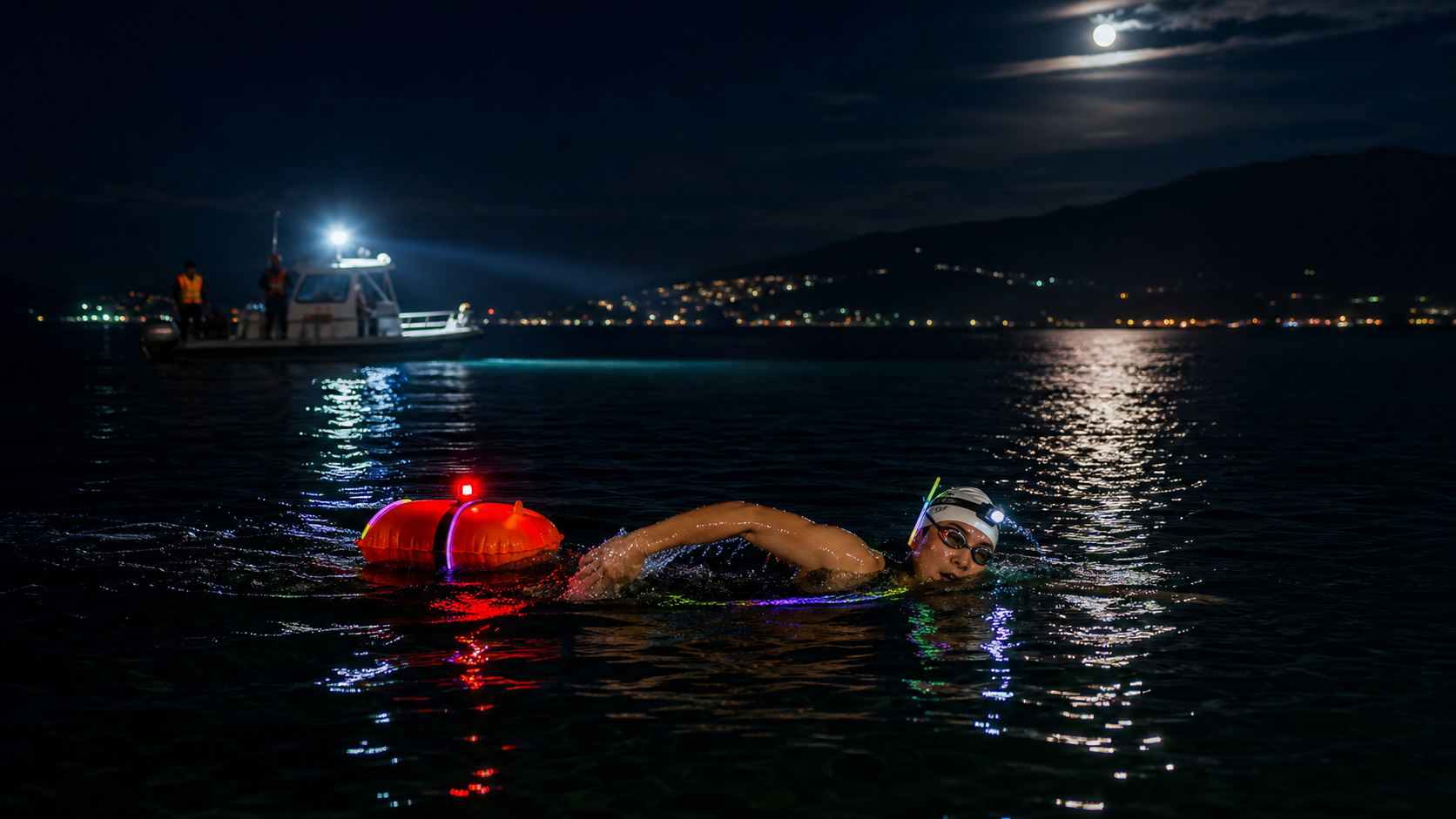
Night Swimming Techniques in Open Water: Glow Sticks, Light Signals, and Safety Guidelines
Introduction
Night swimming can occur in triathlons, long-distance open-water swimming challenges, and certain special forms of swim-crossing events. In Taiwan, summer days start early and end late, but long-distance swim crossings or overnight ultra-distance challenges may still involve nighttime swimming. For most people, swimming in dark waters at night is a greater psychological test than any technical difficulty.
This article does not encourage unprepared night swimming but rather provides a complete set of equipment, signaling, and safety guidelines for swimmers who have already decided to undertake night swimming training or events.
1. Core Challenges of Night Swimming
| Challenge | Description |
|---|---|
| Loss of direction | Unable to use visual positioning, easy to lose your bearings |
| Psychological fear | Cannot see underwater conditions, imagination triggers panic |
| Low visibility | Support boats and other swimmers have difficulty seeing you |
| Lower temperature | Night water temperatures are usually lower than daytime, increasing cramp risk |
| Light interference | Shore lights and surface reflections may confuse directional judgment |
2. Essential Night Swimming Equipment
Personal Lighting Equipment (in order of priority):
- Waterproof headlamp: LED waterproof headlamp secured to the swim cap, allowing support boats to see you while slightly illuminating the path ahead
- Glow sticks (chemical light sticks): Threaded through the swim cap and secured with rubber bands, emitting light in all directions for 6–12 hours
- Waterproof flashing light/buoy light: Attached to the body or a towed buoy, high-intensity flashing with the best long-distance visibility
- Reflective swim cap: Reflects light when illuminated by others, increasing visibility
Support boat essentials:
- Powerful spotlight (illuminating the water ahead of the swimmer)
- Positioning light (marking the boat’s location)
- VHF radio or satellite phone (emergency contact)
3. Signaling Rules
In night swimming, a fixed signaling system is more reliable than verbal communication:
| Signal | Action | Meaning |
|---|---|---|
| Waving headlamp (side to side) | Waving the headlamp in the water | I’m fine, continue |
| Raising one arm and holding still | One arm vertically upward | Need support, please approach |
| Arms crossed | Both arms crossed above the head | Emergency, rescue immediately |
| Holding a glow stick and waving it | Detach the glow stick and wave it above the water | Same as above, emergency distress |
All participants (swimmers, support boat crew, shore observers) must confirm the signaling rules before departure.
4. Direction Maintenance Techniques
Visual positioning is impossible at night, so the following alternative methods are needed:
- Follow the support boat: The most reliable method—always swim toward the support boat’s light
- Shore light markers: Set up light markers on shore in the direction of the finish beforehand as a swimming direction reference
- Compass goggles: Special goggles with a built-in compass, allowing you to confirm direction in the water
- Increase sighting frequency: At night, sight every 8–10 strokes to confirm direction, more frequently than during the day
5. Mental Preparation and Coping with Fear
The biggest enemy in night swimming is your own fear:
- Progressive night swimming training: Start with dusk swimming as the sun sets, gradually extending into fully dark conditions
- Familiar waters: Your first night swim should be in waters you know well from daytime swimming, reducing unknown variables
- Swim with a partner: Never conduct night swimming training alone—at least two people per group
- Rationalize fear: There are no “invisible dangers” underwater; the actual dangers of nighttime waters (currents, temperature) are the same as during the day
- Focus on breathing: When fear rises, place full attention on your breathing rhythm, shutting out other imaginings
6. Safety Guidelines
Basic safety regulations for night swimming in Taiwan:
- Inform others: Ensure someone on land knows your night swimming plan, including route, estimated time, and emergency contact
- Support boat accompaniment: Night swimming must have a support boat accompanying the entire time; shore observers alone are not an acceptable substitute
- No solo swimming: Solo unaccompanied swimming in open water at night is prohibited
- Weather confirmation: Only swim on nights with good visibility and stable sea conditions (wave height below 0.5 meters)
- Emergency plan: Confirm the nearest medical facility location and emergency contact numbers before departure
Conclusion
Night swimming is one of the most challenging experiences in open-water swimming. It demands that you remain calm under sensory limitations and rely on instinctive techniques built through training. With adequate equipment, clear signaling rules, and a cautious mindset, night swimming can become one of the most memorable chapters of your swimming journey. Safety always comes first—no challenge is worth the price of a life.
Related Reading
- Night Swimming Challenge Record: A Safe Night Swimming Experience with Glow Sticks and Rescue Boat Escort
- Open Water Navigation Buoy Buying Guide: Safety Float Color Regulations, Inflation Methods, and Usage Instructions
- Taiwan Night Event Safety Guidelines: Lighting, Reflective, and Traffic Control Regulations
- Night Cycling Techniques and Safety Preparation
備戰 戀戀197 賽前關門點分析 西濱團練 #公路車 4K高畫質
6 年前
單車 一日北高 ( 雙城 ) 肥宅雙人瘋狂行 紀錄片 REACTO
10 年前
FTL 與 SYB 車隊專訪 西進武嶺 實用攻略分享! 2小時 如何練?!你不知道的眉角!新手準備武嶺必看 EP1 | 實力派女車友 | 精華版 | 公路車 | CTYeh
4 年前
一日北高前的高裝檢 | 北高 360 | 挑戰11小時的裝備 | 一日雙塔 | 補給
6 年前
崇越盃「西進武嶺」挑戰! / 天堂路史詩空拍 / 秘密爬坡武器/ PGYTECH CapLock MantisPod Power 續航拍攝棒 / 廢物伙伴軍團再次出征 / 公路車 / CT Yeh
2 年前
雷達尾燈 雷不雷? 邁金L508 智慧雷達尾燈 情境考驗實測 | 同場加映 2千元等級的專業車錶 C406 Pro | 公路車 | CT Yeh
3 年前
西進武嶺 自製新版AI配速表產生器 x 賽前攻略 抱佛腳! 沒有功率計也可以產生配速表嗎?有什麼其他眉角賽前要注意的呢? | 西進武嶺 / 東進武嶺 KOM 攻略 | 公路車 | CT Yeh
4 年前
趣味單車配件:多功能智慧尾燈 / 有方向燈 可app編輯圖案!? / GRC x Lumii 聯名款 / 公路車 CT Yeh
9 個月前