Solo Swimming in Open Water: Psychological and Technical Adjustments After Losing the Main Group
Handling Solo Swimming in Open Water: Mental and Technical Adjustments After Losing the Main Group
Introduction
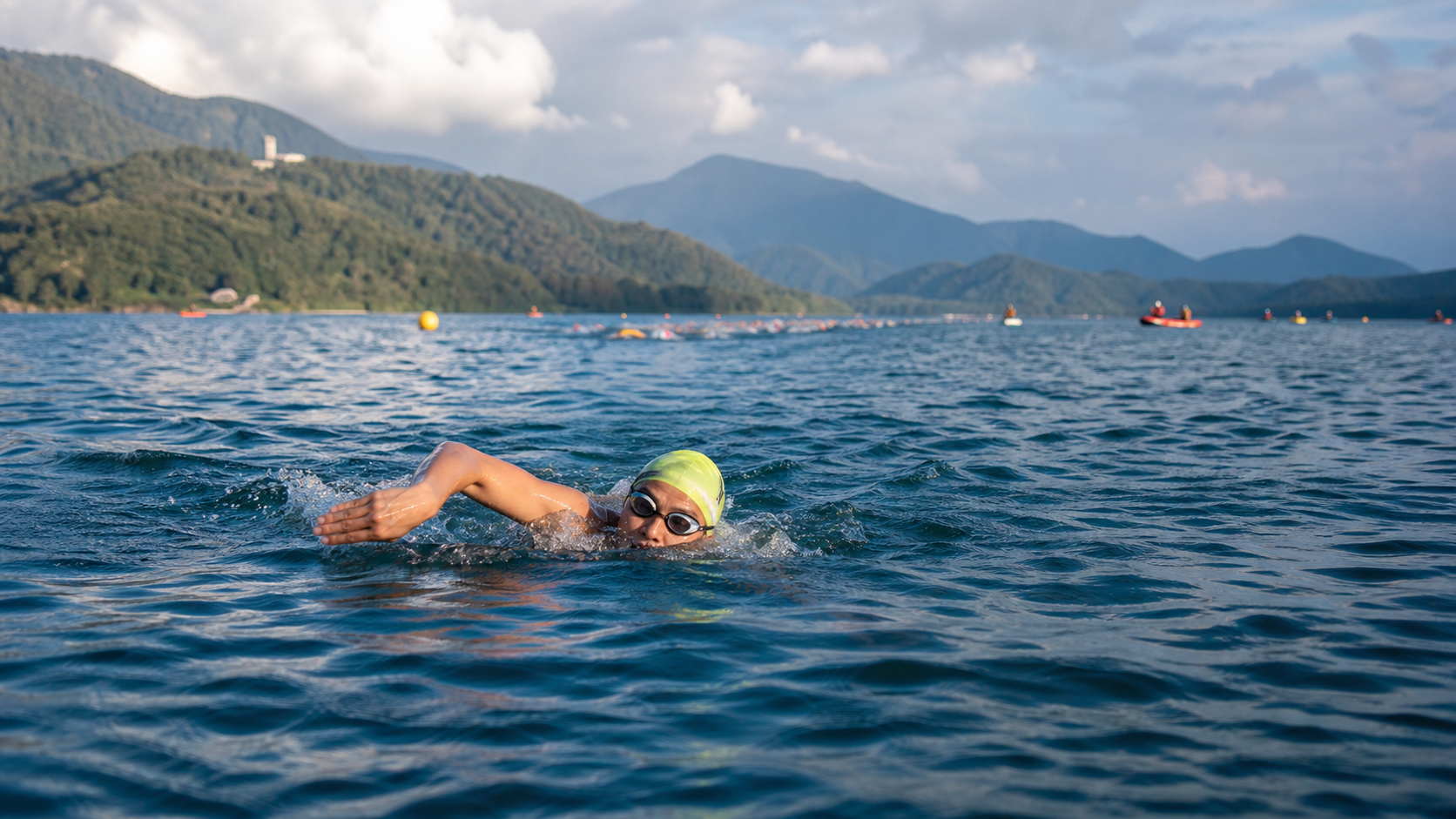
At the Sun Moon Lake mass swim, 3 minutes after the start gun, you suddenly realize the people around you are thinning out. No sign of the main group ahead, and open water behind you. You’re not sure whether you’ve pulled ahead of the pack or drifted off course entirely.
This situation—losing the main group and swimming in isolation across vast open water—is a common yet rarely trained mental challenge in open-water races. Solo swimming doesn’t necessarily mean danger, but mishandling it can trigger panic and cause swimmers with solid skills to see their performance plummet.
1. Common Causes of Solo Swimming
| Cause | Explanation |
|---|---|
| Pacing too fast | Pulling ahead of the main group into open water ahead |
| Pacing too slow | Being left behind by the main group, swimming alone at the rear |
| Directional error | Drifting off course, out of sight of the crowd |
| Skill gap | Separating from the group under specific water conditions (e.g., against a current) |
| Starting position | Starting on the outside edge, already at the group’s periphery |
2. Immediate Assessment Upon Realizing You’re Swimming Solo
The first step after realizing you’ve lost the main group is to assess quickly rather than panic immediately:
- Lift your head and scan 360 degrees: Check whether any swimmers, support boats, or buoys are nearby
- Locate the buoys: Buoys are your most reliable course reference—find the nearest one and keep swimming toward it
- Assess the distance: Estimate how far you are from the finish and whether you need to request support
- Check your physical condition: Quickly scan your energy levels and whether you have any cramps or discomfort
3. Technical Adjustments During Solo Swimming
Direction maintenance becomes even more critical:
Without a drafting group as a reference, solo swimmers must lift their heads more frequently to confirm direction:
- Increase sighting frequency to once every 8–10 strokes (roughly every 15 strokes in group swimming)
- Choose distant fixed landmarks rather than relying solely on buoys
- Pay attention to how currents affect your line and proactively compensate your angle
Adjusting energy distribution:
Without the drafting benefit, energy expenditure increases by approximately 10–15%, requiring corresponding pacing adjustments:
- Slightly reduce stroke rate while improving efficiency per stroke
- Keep breathing rhythm steady; don’t speed up breathing due to mental stress
- If more than half the distance remains, consider slowing down further to ensure you can finish
4. Mental Management of Solo Swimming
The mental challenge of solo swimming often outweighs the technical one:
Common psychological reactions:
- “Have I drifted off course?” (directional anxiety)
- “Will the people behind catch up to me?” (social comparison anxiety)
- “It’s so far and so lonely—can I even finish?” (self-doubt)
Mental coping strategies:
- Narrow your focus: Don’t think about the finish—just think “swim to the next buoy”
- Build an internal metronome: Count strokes, feel your breathing rhythm, and let repetitive motion bring a sense of stability
- Positive self-talk: “I’ve trained for this distance. I can do this.”
- Accept the solo state: Swimming solo doesn’t mean failure—world records for long-distance swims are often set in complete isolation
- Appreciate the environment: Shift your perspective—solo swimming lets you feel the stillness of the water in a way you can’t enjoy in a group
5. When to Seek Help from Support Personnel
Solo swimming doesn’t equal danger, but you should seek help immediately in the following situations:
- Completely losing your sense of direction and unable to locate any buoys
- Obvious physical distress (chest pain, extreme fatigue, severe cramping)
- Sudden deterioration of water conditions (unexpected strong currents, rapidly rising waves)
- Falling into panic and unable to calm yourself down
How to signal for help: Raise one hand and remain still, waiting for a support boat to approach.
6. Strategies for Preventing Solo Swimming
- Assess your pace before the race: Know whether your swimming speed matches the main group and choose an appropriate starting position
- Familiarize yourself with the course map: Memorize the sequence of buoy positions so you can navigate on your own even in a solo situation
- Build training partnerships: Get used to swimming with company during training to build a sense of security, while also training your ability to swim independently
Conclusion
Solo swimming is a lonely test in open-water racing, but it’s also an opportunity to understand your true swimming ability. Stripped of the group’s support, it’s just a conversation between you and the water. With solid technical preparation and strong mental resilience, solo swimming will become one of your proudest swimming memories.
Related Reading
- Handling Crowds in Open Water: Staying Calm When Hands and Feet Collide in Group Swimming
- Mental Challenges in Open Water: Overcoming Isolation and Panic to Regain Confidence in the Water
- Dealing with Open-Water Panic: A Self-Rescue Protocol for Sudden Panic During a Race
- Mental Preparation for Open Water: Overcoming Isolation and Wide-Open Vistas
備戰 戀戀197 賽前關門點分析 西濱團練 #公路車 4K高畫質
6 年前
[教學] Premiere 影片 手震 修正 教學 防抖 單眼 影像 GoPro 穩定 Video Stabilization
8 年前
戰略) Zwift Race 如何咬在第一集團 如何評估自己要開多少推力 (請開1.5倍速看)
7 年前
一日北高/長距離團騎 常見問題補充篇 / 組團或跟團的眉角 / 壯車友容易被瘦車友慢性拉爆 / 原來屁股痛可能是這個原因...? / 風場配速法 / 公路車 / CT Yeh
2 年前
FTL 與 SYB 車隊專訪 西進武嶺 實用攻略分享! 2小時 如何練?!你不知道的眉角!新手準備武嶺必看 EP1 | 實力派女車友 | 精華版 | 公路車 | CTYeh
4 年前
西進武嶺 免費訓練分析服務 Intervals | 練不夠還是練過頭?你哪一種類型選手?AI模型告訴你! | 備戰神器 | 公路車 訓練 | CT Yeh
4 年前
元宇宙運動 ! RouvyAR 虛擬實境約騎! 台灣路段開箱 帶你日月潭環潭一圈 | 團騎競賽參加教學 | 常見小問題整理 三人共享一年不用一千 | 公路車 | 訓練台 | CTYeh
5 年前
西進武嶺 自製新版AI配速表產生器 x 賽前攻略 抱佛腳! 沒有功率計也可以產生配速表嗎?有什麼其他眉角賽前要注意的呢? | 西進武嶺 / 東進武嶺 KOM 攻略 | 公路車 | CT Yeh
4 年前