The After-Work Culture of Road Running: Morning vs. Evening Run Preferences Among Taiwan's Urban Runners
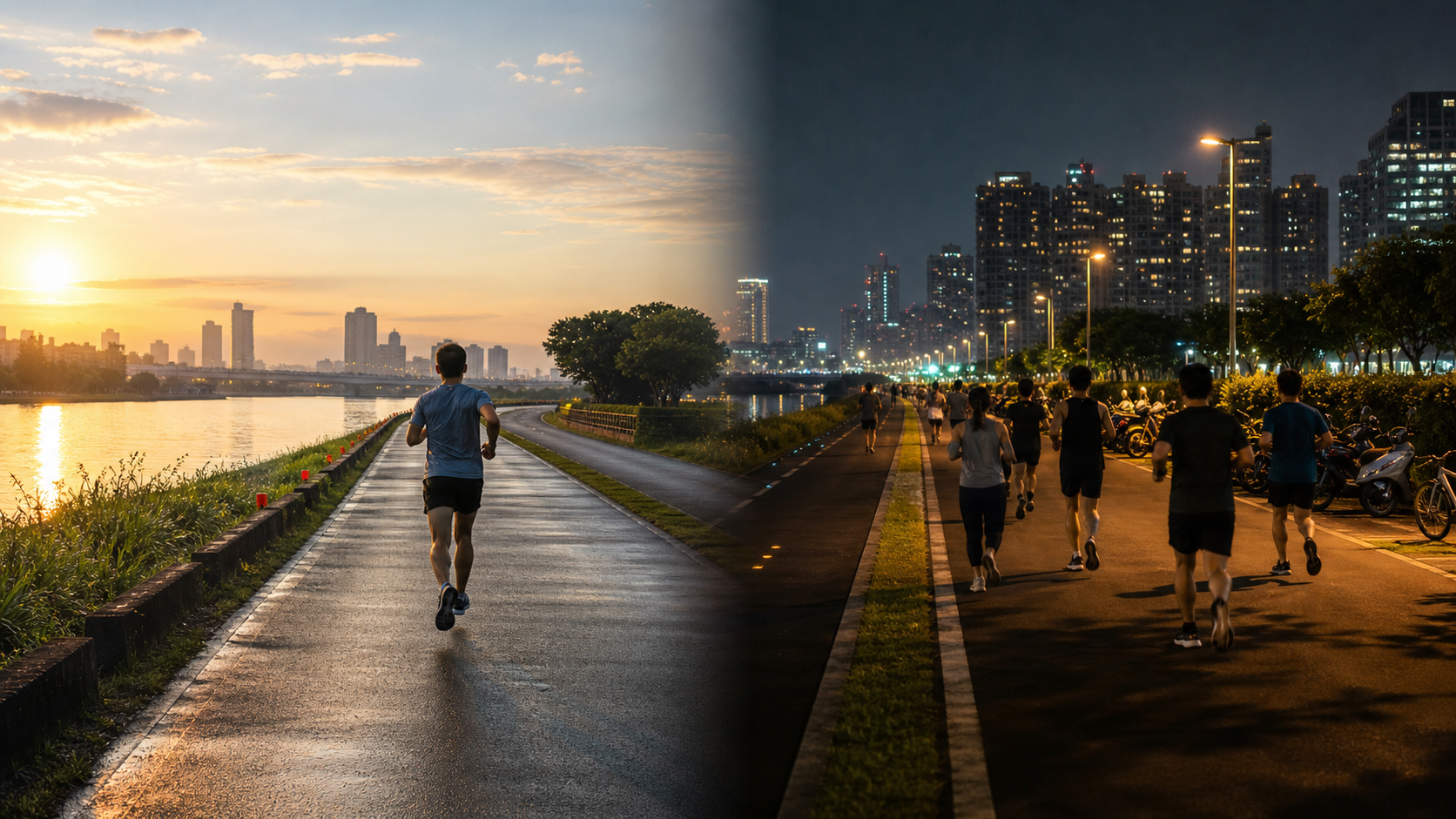
Finding time to run in the cracks of the city
A typical day for a Taiwanese office worker often looks like this: arrive at the office at 8 a.m., leave the office at 7 or 8 p.m., go home, eat dinner, shower, scroll through the phone before bed, and then fall asleep exhausted. Where does running fit in?
The answer is: either before the city wakes up, or after work. Urban runners in Taiwan mostly have only these two options, and the choice between the morning-running camp and the evening-running camp often reflects a person’s life rhythm, the nature of their work, and their definition of “me time.”
A look at the lives of the two camps
| Aspect | Morning runners | Evening runners |
|---|---|---|
| Wake-up time | 4:30–6:00 | No special early rising |
| Running window | 5:30–7:00 | 20:00–22:00 |
| Main motivation | Ensure the workout gets done, enjoy the quiet | Decompress after work, no time pressure |
| Weather impact | Less (cold in winter, manageable in summer) | More affected by post-work temperatures |
| Social nature | Usually runs solo, few groups | Strong group-run culture, more social |
| Typical occupation | Office workers with predictable hours | Irregular hours, sales/business roles |
| Summer challenge | Humid but better than midday | Taiwan’s summer nights stay hot; caution needed |
The morning runner’s philosophy: Get your own thing done first
Morning runners often share a common belief: “If I don’t run in the morning, something will inevitably come up during the day to derail the plan.”
This thinking isn’t unfounded. Overtime at work, sudden dinner plans with friends, family needing attention—for those who plan to exercise in the evening, these are all frequent plan-killers. Morning runners choose to fulfill their commitment to themselves before the world starts making demands.
Specific benefits of morning running:
- The air is relatively cleaner, especially in the Taipei Basin
- Fewer people and quieter roads, ideal for solitary thinking and entering a “flow” state
- Mental alertness tends to be better for the rest of the day after a run
- Forces a consistent daily routine, improving sleep quality
Challenges of morning running:
- From May to September in Taiwan’s summer, even early mornings can exceed 28°C
- The body isn’t fully awake yet, so the risk of injury is relatively higher and more warm-up is needed
- In winter, heading out before dawn requires mental preparation
The evening runner’s philosophy: Running as the full stop to the day
Evening runners, on the other hand, tend to view running as a “clearing mechanism”—using physical fatigue to flush out the day’s accumulated mental stress.
“Running along the riverside after work is the moment I feel closest to myself every day,” says an engineer working in the Nangang Software Park. “No matter what happened during the day, once I finish the run, it’s done.”
Specific benefits of evening running:
- Significant psychological stress relief, especially suited to high-pressure workers
- The body has been active all day, muscle temperature is higher, and injury risk is lower
- Taiwan’s cities have a special beauty at night—riverside views, city neon lights
- Strong social aspect; many evening running clubs are active at night
Challenges of evening running:
- Taiwan’s summer nights remain hot (Taipei nights in September often exceed 26°C)
- Visibility issues require reflective gear
- Overtime and last-minute invitations often disrupt plans
- May make it hard to fall asleep after exercise (varies by person)
The special challenge of running in Taiwan’s summer
Whether morning or evening running, Taiwan’s summer heat and humidity are serious concerns. A few coping strategies from Taiwanese runners:
- Lower intensity, maintain the training habit: Summer is for maintaining a base, not chasing PBs
- Force hydration: Even if you’re not thirsty, take in fluids every 15–20 minutes
- Choose light-colored, loose, moisture-wicking fabrics: Wearing black in a Taiwan summer is self-punishment
- Adjust the timing: Morning runners head out earlier (before 4:30), evening runners wait until after 9 p.m. when it’s slightly cooler
- Accept the difference between “weather runs” and “training runs”: Summer pace doesn’t mean you’re regressing
Which time slot suits you better?
There’s no standard answer to choosing morning or evening running. The following questions can help you decide:
- Is your work schedule regular? → Regular hours suit morning running
- Do you work overtime frequently? → Heavy overtime workers are better off with morning running (to avoid disruption)
- Is your sleep easily disturbed? → Those who struggle to sleep after evening runs should consider morning running
- Do you have a regular running partner or community? → Evening running clubs tend to be more active at night
- Where do you live? → In some areas, morning running offers better air quality and safety conditions
Conclusion
The debate between morning and evening running is, at its core, a dialogue between two life philosophies. One says: take care of your own business first, then face the world; the other says: after facing the world, come back to yourself.
Both are right—they just suit different people and different stages of life. What matters is that, whichever time slot you choose, you get out there and run—because on some early morning in Taipei, or on some brightly lit night, the road is waiting for you.
Related reading
- Night running culture in Taiwan: Safety and benefits of running in the evening
- Combining road running and commuting: The Taiwan practice of run commuting
- The slow-running philosophy of road running: A life outlook of not chasing speed and enjoying the process
- Road running special feature | Taipei’s office-worker-friendly morning jogging rhythm (R002)
車隊介紹) 台北 一年開團365天 車隊 Apollo Ride 晨騎 好選擇 ( 陽明山 風櫃嘴 冷水坑 平等里 聖人 關渡 大稻埕 ) 找人騎車
7 年前
Live) 備戰2019彰化經典百K 賽前攻略 (已完賽請看新影片
7 年前
2026 車錶排行榜!誰是最多車友正在使用?練家子最愛哪款?🏆 (2萬名車友數據) / 公路車 / CT Yeh
5 個月前
2019 柯P 超越北高 第一集團實錄 (11小時實錄請參考另一部影片) 一日雙城 一日北高 NeverStop Taiwan Long Distance Cycling Challenge
7 年前
單車 一日北高 ( 雙城 ) 肥宅雙人瘋狂行 紀錄片 REACTO
10 年前
2025 海鷗團體繞圈賽 網路直播 超激烈裁判長視角 / EIPC 李廷威、Waypoint 等眾多高手競爭 / feat. 卡密兒主持 / 海鷗繞圈賽
9 個月前
2020 前十五名 台灣車友還在用的車錶? 同場加映武嶺四小時內的車友都用哪些車錶,以及車錶靈異經驗分享 北高居然騎了960公里!? | 車錶送修分享 | 公路車 | CT Yeh
5 年前
JJSC南台灣單車走春三日行 DAY 1 / 強度 x 美食 x 節慶體驗 / 公路車 CT Yeh
5 個月前