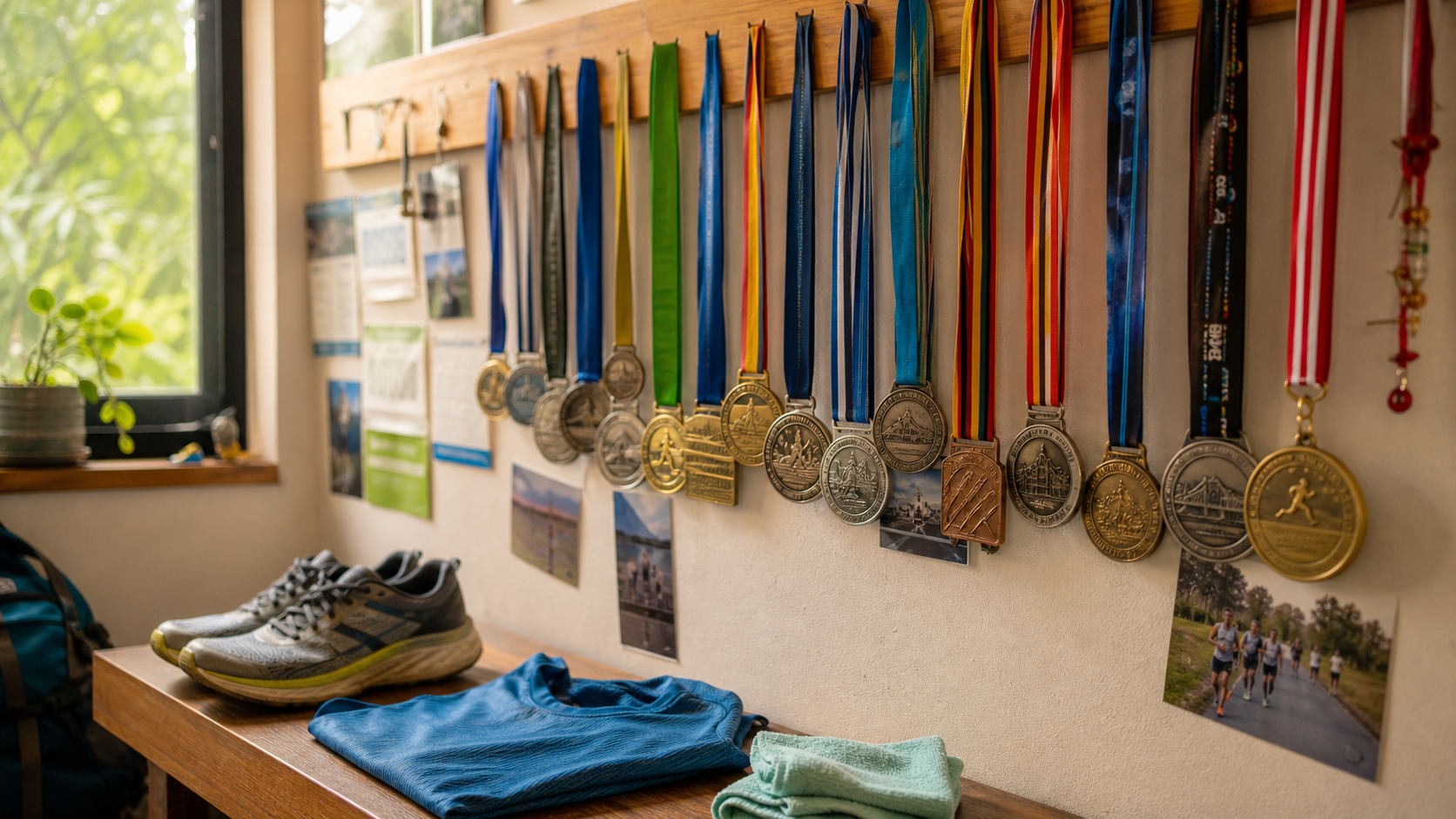
The Story That Wall Tells
Step into the home of a dedicated runner, and you’ll often find them on a wall or in a corner: pieces of metal in all shapes, colors, and weights, hung by ribbons or displayed in frames. Collectively, they’re called “finisher medals,” but in a runner’s eyes, each one is more than just metal—it’s a date, a weather condition, a pace, a moment when you told yourself, “You did it.”
Taiwan’s road race medal collection culture is a gentle ritual of remembrance. It transforms the abstract achievement of running into something tangible you can touch, giving memory a physical weight.
The Evolution of Medal Design Aesthetics in Taiwanese Road Races
Medal design for Taiwanese road race events has improved significantly over the past decade. From the standardized round metal pieces of earlier years to the creative designs that races now compete to produce, medals have become a key marketing element of an event’s brand.
| Race | Medal Features | Design Highlights |
|---|---|---|
| Taipei Marathon | Themed around Taipei landmarks | Elements such as Taipei 101, Dadaocheng, and the Keelung River |
| Tianzhong Marathon | Rural style, rice-ear theme | Changhua Tianzhong landscapes; a natural wood texture design has appeared |
| Taroko Gorge Marathon | Gorge terrain elements | Rock textures, Swallow Grotto imagery |
| Wanjinshi Marathon | Coastal scenery | Yehliu and Jinshan landscapes, often featuring glow-in-the-dark designs |
| Fubon Taipei Marathon | New design every year | Limited-edition patterns each year, collectible value |
Particularly noteworthy is that some races have begun introducing “interlocking medal” designs—runners who participate for consecutive years can piece each year’s medal together into a larger pattern. This design directly fuels runners’ motivation to return year after year.
The Display Philosophy of Medal Walls
Taiwanese runners display their medals in a wide variety of ways, reflecting different collection aesthetics:
Timeline-Style Display
Arranged in chronological order of races run, with the earliest medal in a corner and the newest in the most prominent spot. This approach best conveys the narrative of a runner’s “growth”—from the first 5K finisher medal standing alongside a full marathon medal, it reads as a personal athletic history.
Map-Style Display
Using a map of Taiwan, medals are “pinned” to the corresponding race cities. Runners who have raced across Taiwan end up with a map marked in every county and city, creating a spectacular visual effect.
Aesthetic Display
Combined with photos, race bibs, and cards bearing the race name, these are displayed together to form a complete “memorial wall.” IKEA hook systems and DIY wooden frames are common solutions.
Lightweight Portable Style
Some runners string their medals together and bring them to other races, or keep only the ones most meaningful to them (the first one, the day of a PB, a particularly difficult race), giving away or donating the rest.
The Emotional Function of Medal Collection
“The biggest role of medals is on the days I want to quit training,” said a Taichung runner who has been running for eight years. “I look at those medals on the wall, think of the story behind each one, and I can’t help but put on my running shoes.”
The power of this “object memory” has a basis in psychology. Physical objects serve as memory anchors and can evoke emotions more effectively than mere digital records—and emotion is often the key to sustaining long-term behavioral motivation.
Stories from Taiwanese Runners’ Medal Walls
-
A Taipei teacher’s 45 medals: Spent seven years running marathons across every county and city in Taiwan, then hung the medals on a map in her study. When students asked, she told the story behind each one, turning it into the most vivid geography lesson on Taiwan.
-
A couple’s twin medal walls: Both run, each collecting their own medals, hung on the left and right sides of the same wall—a visual testament to their marriage growing together.
-
A daughter’s medal frame for her father: Gathered all the medals her father had earned and mounted them in a custom display frame as a Father’s Day gift.
Medal Giving and Charity
Taiwan has a warm little tradition: passing on medals that are no longer needed or are surplus to someone in need. Some charity running events collect old medals donated by runners and pass them on to children in rural areas or underprivileged communities, letting that piece of metal continue to flow with encouraging energy.
How to Start Your Medal Collection
- Give your first medal special treatment: Whether it’s a 3K or a full marathon, the first medal deserves its own display spot
- Decide on your collection criteria: Keep everything, or only what’s meaningful? Set the rules in advance to avoid the headache of “too many” later
- Pair it with written records: Add the date, time, and a one-line note on the back of the medal or beside it to make the memory more complete
- Choose a display method that suits you: Hooks, display frames, storage boxes… pick one that brings you joy in your living space
Conclusion
The finisher medal is the most tangible ceremonial symbol of road race culture. It’s not just a souvenir—it’s a physical certificate of a person telling themselves “I can” on a certain day, on a certain road.
Years later, when the running pace slows due to age or injury, those medals on the wall still hang there, still telling the stories of all those mornings you set out, the kilometers you pushed through, and the version of yourself that kept going no matter how hard it got.
Related Reading
- Race Souvenir Collection in Road Running: Medals and Merchandise Culture at Taiwan’s Major Marathons
- Awards Ceremonies and Race Culture After Road Races: Highlights and Things to Know About Taiwanese Events
- Road Race Photography Culture: How to Capture Your Best Self on the Course
- Road Race Costume Culture: The Style Aesthetics and Personal Flair of Taiwanese Runners
小野田真的存在!日本赤城山爬坡公路賽 台灣首發團完全實錄 | 頭文字D真實賽道! | 看完東奧自行車賽後好想再去騎一次啊! | 公路車 | CT Yeh
4 年前
曜越Ciao 2000 陽明山如來光環挑戰賽 VLOG / 超過50萬大獎抽到爆 / Wilier 車主大集合 / 公路車 / CT Yeh
1 年前
台北大雁西飛 約騎挑戰 feat. Doris | 公路車 | CT Yeh
3 年前
新屋團體繞圈賽 | 眾多菁英好手賽道奔馳 | 千瓦女子軍團 | 無敵交管狂獲好評 明年你一定不能錯過 | #公路車
5 年前
TBA 北高360 逆風爆熱再送空汙 苦行挑戰賽全記錄 4K沈浸式臨空畫質| 公路車 | CT Yeh
3 年前
2026台北自行車展 一日隨意逛小紀錄 / 風櫃嘴16分國手的交流 / 踩台居然刷到季軍🥉 USD150 GET! / ! / CT Yeh
4 個月前
2023桃園團體繞圈賽 / 海鷗繞圈賽 | 全程空拍數據版 | 公路車 | CT Yeh
2 年前
日本公路最高登山賽,台灣首位YT挑戰實錄,乘鞍登山賽40週年,賽前篇完整版,請到我的YT收看 #公路車 #cycling
10 個月前