The Stress-Relieving Power of Running: How Taipei Office Workers Use Running to Digest Work Pressure
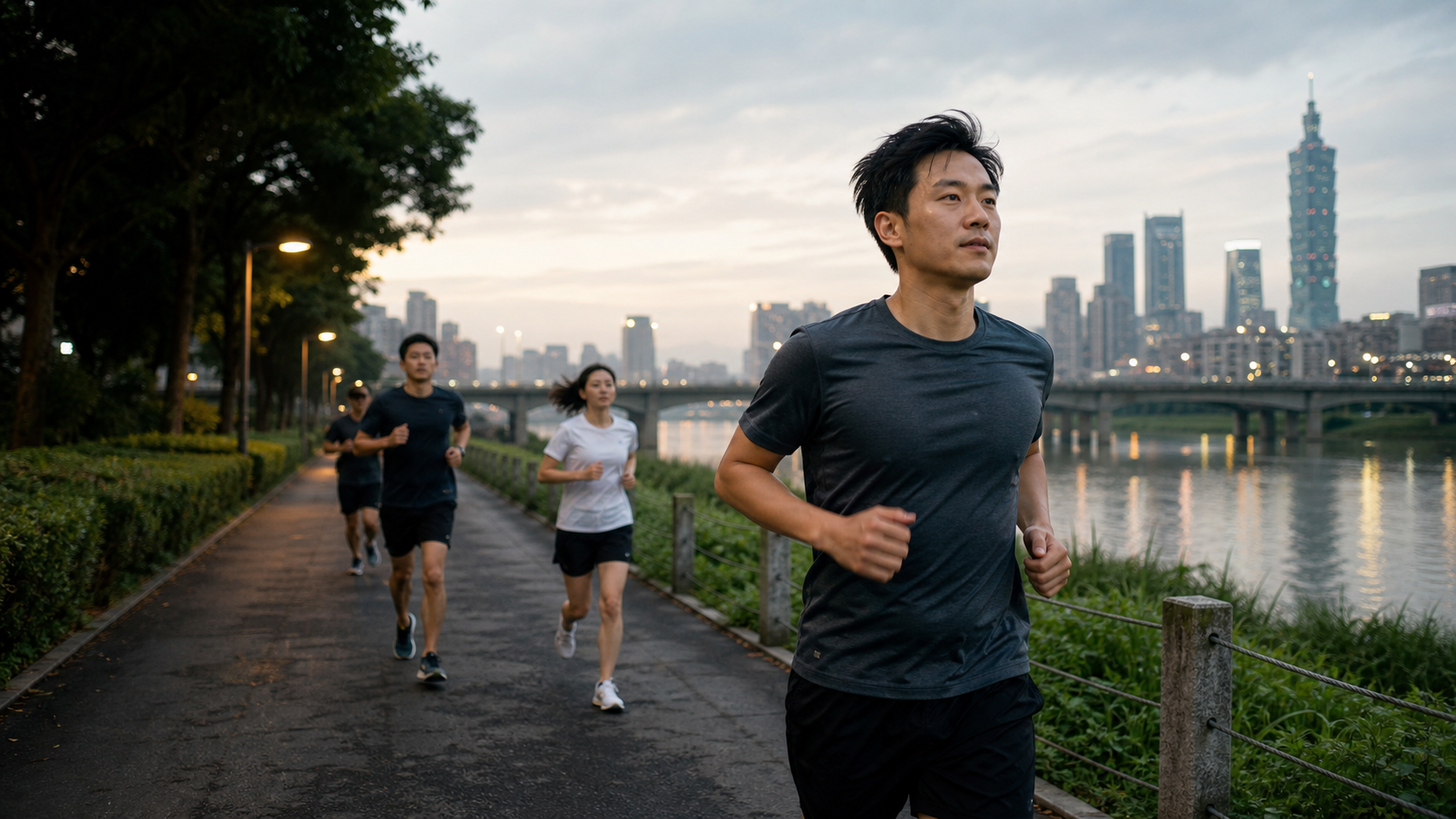
Taipei, the City of Stress
Taipei is a high-density city. Every day, more than three million people commute, work, and compete in this basin—speaking to slides in meeting rooms, scrolling through endless messages on the MRT, draining their energy into a flood of digital social interaction and office politics.
Stress is almost part of the air in Taipei. Taiwan has long ranked among the top in Asia for working hours, and the implicit norm in the work culture that “working overtime means being dedicated” leaves many people unable to truly disconnect even after clocking out. The stress that accumulates over time leaves its mark on both the body and the mind.
But more and more Taipei office workers are finding an outlet within this pressure: running.
Why Running, Not Something Else
Taipei residents have plenty of relaxation options: movies, shopping, dinner with friends, Netflix. So why has running become an increasingly popular stress outlet in recent years?
A few possible reasons:
- Immediate effects: The endorphins and serotonin released after a run can be felt within 20–30 minutes. This instant “emotional reset” is hard for other activities to replicate
- Low social cost: Running doesn’t require making plans with people, making reservations, or holding conversations. It’s especially friendly to office workers whose social battery is already drained
- Physical fatigue displaces stress: Work brings mental fatigue; running brings physical fatigue. Letting the latter “override” the former actually gives both mind and body a rest
- Taipei’s landscape cooperates: Dadaocheng, the Keelung River, Daan Forest Park, riverside bike paths—Taipei has plenty of pleasant places to run
Real Stories from Taipei Office Workers Who Run
A Tech Engineer’s Nightly Running Ritual
A software engineer working in the Neihu Science Park runs home from the office three to four times a week, at around 8 or 9 p.m. “It’s about seven kilometers. When I finish, I shower and then I can sleep. Otherwise, I bring my work brain to bed and can’t fall asleep at all.”
“Running creates a physical boundary between work and life,” he says. “My body leaves the office, but my mind is still working. After seven kilometers, though, my mind gets out too.”
An Ad Agency Creative Director’s Morning Run to Clear Her Head
A female runner who works as a creative director at an advertising agency in Taipei’s Xinyi District treats her morning run as “the time when my mind is clearest.” “I come up with my best ideas while running, and I also flush out yesterday’s bad emotions while running,” she says.
She doesn’t listen to music—she just runs and lets her thoughts drift freely. “Sometimes a proposal problem I’ve been stuck on for three weeks suddenly clicks into place during a run.”
A Nurse’s Weekend Long Run to Unwind
A nurse working at a hospital in Taipei faces a unique kind of professional stress: emotional labor. “You take care of many different patients every day. You have to comfort, explain, and control your emotions. By the time you get off work, your emotional capacity is nearly empty.”
Her solution is a weekend long run. “I run alone, I don’t talk, and I let my body take the lead. Only after the run do I become a person with emotions again.”
The Neuroscience of Running: Why It Works
Running’s stress-relieving effect isn’t just about “feeling good”—there’s a clear physiological mechanism behind it:
| Mechanism | Process | Effect |
|---|---|---|
| Endorphin release | After 20 minutes of moderate-intensity aerobic exercise | “Runner’s high,” improved mood, reduced pain perception |
| Serotonin boost | Sustained aerobic exercise stimulates tryptophan conversion | Mood stabilization, reduced anxiety, improved sleep |
| Cortisol metabolism | Exercise accelerates cortisol metabolism afterward | Lower stress hormone levels, increased relaxation |
| BDNF secretion | Aerobic exercise stimulates brain-derived neurotrophic factor | Improved hippocampal function, better emotional regulation |
| System cool-down | Core body temperature drops after exercise | Similar to the temperature drop before sleep, promoting relaxation and sleep |
Making Running a True Stress Management Tool
A few suggestions for getting real stress-relief benefits from running:
- Run at a fixed time to build a conditioned reflex: Once your body and brain get used to “this time = relaxation mode,” the stress-relief effect kicks in faster
- Don’t bring training goals into a recovery run: Recovery runs don’t chase pace or mileage—you just run
- Consistency matters more than volume: Three 30-minute runs a week are more effective than one occasional 2-hour run
- Allow yourself to think about work while running (if you want to): The rhythm of running often lets solutions surface naturally
- Don’t check your phone immediately after finishing: Let the post-run “blank period” in your brain last a few extra minutes for a more complete stress-relief effect
Taipei’s Running Landscape: Match It to Your Stress Type
- Need ambient noise to shift your mood: Night runs in Xinyi District—neon lights and crowds, let the city’s energy infect you
- Need quiet and a sense of nature: Early morning at Daan Forest Park—birdsong and tree shadows, the closest thing to a meditative run
- Need lots of movement to burn off energy: Long runs along the Keelung River loop—let your body truly tire out
- Need beautiful scenery to redirect your attention: Dusk at Dadaocheng Wharf—river light and old architecture, visual relaxation
Conclusion
The running culture among Taipei office workers isn’t about chasing results, and it isn’t fitness marketing. It’s a collective urban survival instinct that has developed on its own.
In a city where everything is defined by speed, efficiency, and competition, going out every day and moving slowly under your own power is a very gentle form of resistance. It says: my time can belong to my own body, not just to work.
That pair of running shoes is the cheapest and most effective prescription for psychological healing that Taipei office workers have.
Related Reading
- Combining Running and Commuting: The Practice of Run Commuting in Taiwan
- The Mental Health Benefits of Running: The Best Tool Against Stress
- How Running Changes Lives: Transformation Stories and Psychological Gains from Taiwanese Runners
- The After-Work Running Culture: Morning vs. Evening Run Preferences Among Taiwanese Urban Runners
2019 柯P 超越北高 第一集團實錄 (11小時實錄請參考另一部影片) 一日雙城 一日北高 NeverStop Taiwan Long Distance Cycling Challenge
7 年前
台北大雁西飛 約騎挑戰 feat. Doris | 公路車 | CT Yeh
3 年前
浪漫 #臺三線 #單車 員工旅遊 桃園到台中 老少咸宜 環台賽 路線探索
6 年前
實景訓練台) 彰化經典百K 高強度喵團 90分鐘 跟著一起練功 2019 Indoor workout Changhua Classic 100 Taiwan
7 年前
單車 一日北高 ( 雙城 ) 肥宅雙人瘋狂行 紀錄片 REACTO
10 年前
抖肩舞 台灣x日本交流版 (台灣 vs 前橋) 赤城山登山賽 coincidance
8 年前
太平山單車員工旅遊 | 這樣玩CP值最高!| 公路車
5 年前
2018 田中馬拉松 全程健跑 VR 360 環景錄影 體驗現場狂野加油氣氛! Insta 360
7 年前