Cycling Biomechanics Research: The Efficiency Debate Between Circular and Elliptical Pedaling Paths
Introduction
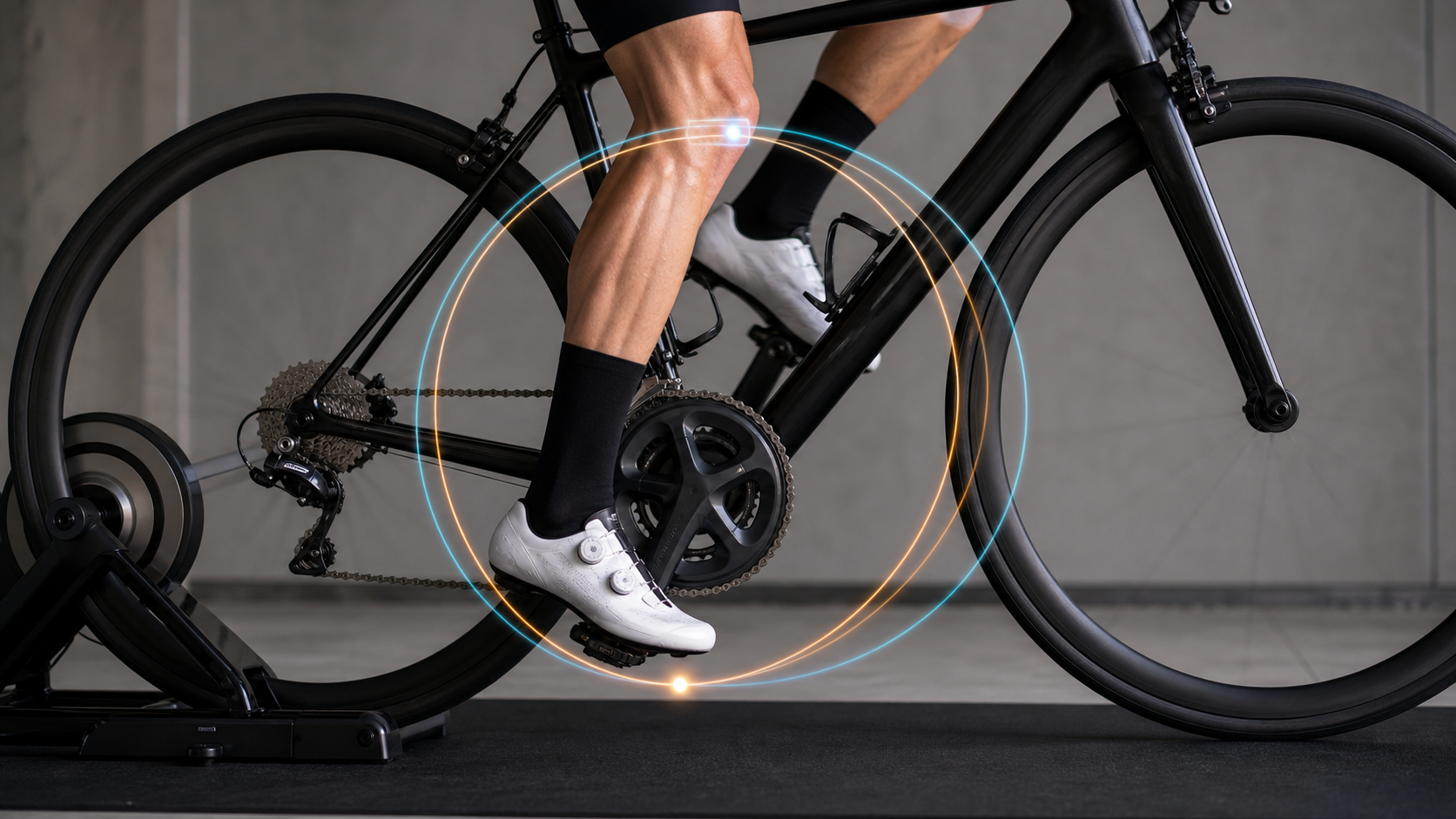
“Pedal in circles” is the most common advice cycling coaches give to beginners, meaning to apply force evenly throughout every phase of the pedaling cycle rather than only during the downstroke. However, as sports biomechanics research has deepened, a fundamental question has emerged: Which pedaling path is the human musculoskeletal system actually best suited for?
Standard crank design forces the pedal’s end to follow a perfect circular path, but some researchers have proposed that an elliptical path (indirectly altering the effective pedaling ratio through elliptical chainrings) may better match the natural force-production patterns of human muscles. This debate remains unresolved to this day, and this article will review the key research evidence.
Fundamentals of Pedaling Biomechanics
The Four Phases of the Pedaling Cycle
A complete pedaling cycle (360°) can be divided into four functional phases:
| Phase | Angular Range | Primary Muscles | Power Contribution |
|---|---|---|---|
| Power Phase | 0–90° | Quadriceps, Gluteus Maximus | Highest (~60%) |
| Bottom Transition | 90–180° | Triceps Surae | Moderate (~25%) |
| Recovery Phase | 180–270° | Hamstrings, Gluteals | Low (~15%) |
| Top Transition (Dead Center) | 270–360° | Iliopsoas | Lowest (prone to negative work) |
The Dead Center Problem
The 0° (TDC, Top Dead Center) and 180° (BDC, Bottom Dead Center) positions of the pedaling cycle are where the moment arm approaches zero, making it difficult to convert applied force into effective torque. Overcoming the dead centers is the core challenge in pedaling efficiency research.
The traditional “9–3 o’clock pedaling method” and the “scraping mud off your shoe” motion (simulating a backward pushing action) are both techniques designed to maintain effective torque near the dead centers, but research on their effectiveness remains controversial.
Research Supporting the Circular Path
Optimal Pattern Theory
The study by Coyle et al. (1991) is a key argument supporting the notion that “standard pedaling is optimal.” They found that under steady-state riding conditions:
- Well-trained athletes naturally tend toward pedaling patterns with low negative work
- Forced training toward “more circular” pedaling did not improve efficiency
- The neuromuscular system already approaches an energy-minimizing pattern in its natural state
This supports the hypothesis: Pedaling smoothness is the result of training maturity, not a technical goal that requires deliberate training.
Neural Drive Efficiency
More recent electromyography (EMG) studies show that high-level athletes exhibit more precise muscle activation timing and greater inter-muscular coordination. This explains why elite riders pedal more efficiently than amateurs—but this is a result of training adaptation and has relatively little to do with the geometric shape of the pedaling path.
Research Supporting the Elliptical Path
The Indirect Effect of Elliptical Chainrings
Elliptical chainrings (such as Rotor Q-Ring, Osymetric) do not change the geometric path of the cranks; instead, they adjust crank angular velocity at different phases of the pedaling cycle by altering the effective chainring size:
- Power Phase (drive zone): Effective tooth count increases (approximately +2–4T), allowing the rider to output higher torque
- Dead Center Zone: Effective tooth count decreases (approximately -2–4T), allowing the crank to pass through the dead centers faster, reducing time spent in negative work
In effect, this makes the rider “feel” an elliptical-like window of effective power output.
Divergent Research Findings
| Study | Subjects | Elliptical Chainring Effect | Method |
|---|---|---|---|
| Leong et al. (2017) | 12 trained riders | No significant difference | Time trial simulation |
| Strutzenberger et al. (2014) | 8 amateur riders | Altered muscle activation patterns | EMG |
| Hintzy et al. (2016) | Professional riders | Slight increase in maximal sprint power | Track testing |
| Cordova et al. (2014) | 15 riders | Improved altitude response? | Hypoxic environment |
Main reasons for divergent findings: inconsistent training levels among subjects, insufficient adaptation periods (elliptical chainrings typically require a 4–8 week adaptation period), and differences in testing conditions.
The Importance of Individual Differences
The consensus of recent research is gradually pointing toward: the “optimal form” of pedaling path exhibits significant individual variation, influenced by the following factors:
- Thigh length and height ratio: Riders with longer thighs face greater difficulty in the dead center zone and may benefit more from elliptical chainrings
- Slow-twitch fiber ratio: Riders with a predominance of fast-twitch fibers (RR-type ACTN3) respond differently to chainring shape compared to slow-twitch-dominant riders
- Training experience: Beginners have more room to improve their pedaling technique, while veterans adapt more slowly to changes in pedaling style
Practical Recommendations
- Beginners should prioritize “pedaling in circles” technique: Use the pedaling balance metrics on indoor smart trainers (such as Wahoo/Garmin left-right balance) to first build fundamental pedaling coordination
- Experienced riders may try elliptical chainrings: Allow at least 6 weeks of adequate adaptation, and compare power/heart rate ratios within the same intensity zones
- Don’t blindly commit to a single solution: Individual variation in pedaling path optimization is large; “what suits you best is the best” applies particularly well in this domain
- Use a power meter for quantitative evaluation: Subjective feelings are unreliable; use a 20-minute power test before and after a 6-week period to objectively assess the effect of any pedaling style change
Conclusion
The circular vs. elliptical pedaling path debate reflects a core challenge in sports science: group-level research findings do not necessarily apply to every individual. Future research directions may focus on how to use individual biomechanical assessments to find the optimal pedaling optimization strategy for each rider, rather than pursuing a single “best pedaling formula” that applies to everyone.
Related Reading
- Cycling Pedaling Biomechanics: Coordination of the Knee, Ankle, and Hip Joints
- Quantifying Cycling Pedal Smoothness: Research on New Power Meter Analysis Metrics
- Pedal Smoothness: Dead Centers, Pulling Up, and 360° Power Output Techniques
- Left-Right Symmetry of Pedaling Force Vectors: Research on Asymmetry Quantification Using Power Meter Data
高雄綠園道鐵路自行車道 / 外地人能輕鬆駕馭 還是整路崩潰? / 2025 全線開通 春節實地探索一次!(附GPS連結)/ 公路車 / CT Yeh
1 年前
一日北高常見問題大集合 | 攻略 | 路線 | 訓練 | 補給 | 自行車 單車 | 一日雙城 | 雙塔 | TWB北高360 | 屁股痛
6 年前
Unaas X50 全碳纖幅條輪 數據實測對比PK | Lun Hyper 的高階版 | 板輪爬坡也可以很厲害? ! 武嶺2小時大師一起親測! CP值超高 | 公路車 | CT Yeh
4 年前
大家都在開箱的...單車用藍芽對講耳機真的有幫助嗎? SENA BiKom 20 長距離旅遊 & 海鷗繞圈賽 實際體驗心得 / 公路車 / CT Yeh
9 個月前
碟煞公路車 銑面器 !? 原來銑完差這麼多! 降低蹭碟機率! | TIME 公路車 保養小記錄 | CT Yeh
3 年前
#公路車 #Fitting 靠人工智慧APP 幫你調整單車
6 年前
2026 車錶排行榜!誰是最多車友正在使用?練家子最愛哪款?🏆 (2萬名車友數據) / 公路車 / CT Yeh
5 個月前
Nepest NOVA 碳條輪組:輕量、空力、舒適一次滿足!/ 公路車 / CT Yeh
7 個月前