Cycling Heat Acclimatization Training: Scientific Research on Core Temperature Tolerance in Hot Environments
Introduction
At the 2021 Tokyo Olympics, temperatures exceeding 35°C caused multiple athletes to suffer heat exhaustion symptoms. Yet in the same environment, athletes from tropical countries or those who had completed heat adaptation training displayed markedly different competitive abilities. This is not merely a difference in mental toughness—it is the result of deep physiological adaptation.
Heat Acclimatization / Heat Acclimation refers to the adaptive changes in physiological systems triggered by repeated exposure to hot environments, enabling the body to dissipate heat more efficiently and maintain core temperature stability. Recent research has further revealed that these adaptations can also enhance aerobic performance in cooler environments—a finding that has established heat training as another important physiological enhancement tool alongside altitude training.
The Physiological Mechanisms of Heat Adaptation
Core Temperature Regulation System
The primary challenge the human body faces during exercise in high heat is heat accumulation: metabolic heat production (typically exceeding 70–75% of total exercise energy) must be dissipated through evaporative cooling (sweating), convection, and radiation—otherwise core temperature (Tc) will rise rapidly.
A core temperature exceeding 40°C marks the critical threshold for heat exhaustion, while 41–42°C enters the life-threatening range of heat stroke. The core goal of heat adaptation is precisely to enhance the body’s buffering capacity before reaching this temperature boundary.
Physiological Changes Induced by Heat Adaptation
| Adaptation Parameter | Direction of Change | Timeline | Mechanism |
|---|---|---|---|
| Sweat Onset Temperature | Decrease of 0.3–0.5°C | 5–7 days | Heat shock protein induction |
| Maximum sweat rate | Increase of 10–20% | 7–14 days | Sweat gland sensitization |
| Plasma Volume | Increase of 5–12% | 3–5 days | Aldosterone and ADH response |
| Heart rate (same intensity) | Decrease of 5–10 bpm | 5–10 days | Blood volume expansion |
| Core temperature (same intensity) | Decrease of 0.3–0.5°C | 7–14 days | Integration of multiple mechanisms |
| Skin blood flow | Increase | 5–10 days | Enhanced vasodilation capacity |
The Special Value of Plasma Volume Expansion
Plasma Volume Expansion (PVE) triggered by heat adaptation is the most practically significant adaptation because:
- With increased plasma volume, more oxygen can be delivered to muscles at the same cardiac output
- The PVE effect persists for 1–3 weeks after returning to a cooler environment
- This explains why heat training can enhance aerobic performance in cool conditions, similar to the blood-boosting effects of altitude training
Designing an Effective Heat Training Protocol
Comparison of Training Protocol Options
Heat adaptation protocols commonly found in the literature can be categorized into three types:
| Protocol Type | Environment | Duration | Intensity | Research Findings |
|---|---|---|---|---|
| Active heat exposure | 35–40°C, 40–60% RH | 60–90 min/day | Moderate intensity | Best |
| Passive heat immersion | Hot water bath at 40°C | 30–40 min/day | Resting state | Good (does not consume training time) |
| Mixed protocol | Post-training heat immersion | Training + 30 min immersion | Moderate-to-high intensity + passive | Best overall |
Practical Heat Training Procedure
The standard heat adaptation protocol recommended by research (based on the work of Garrett et al.):
- Total duration: 10–14 days
- Daily exposure time: 60–90 minutes
- Environmental temperature: 35–42°C (room temperature or high-temperature cycling clothing)
- Training intensity: 40–60% VO₂max (moderate aerobic intensity—not pursuing training effect, focusing on heat exposure)
- Fluid replacement: 800–1200 mL per hour, containing electrolytes (particularly sodium: 500–1000 mg/L)
Home-Based Heat Adaptation Protocol
For athletes unable to train in a controlled environment:
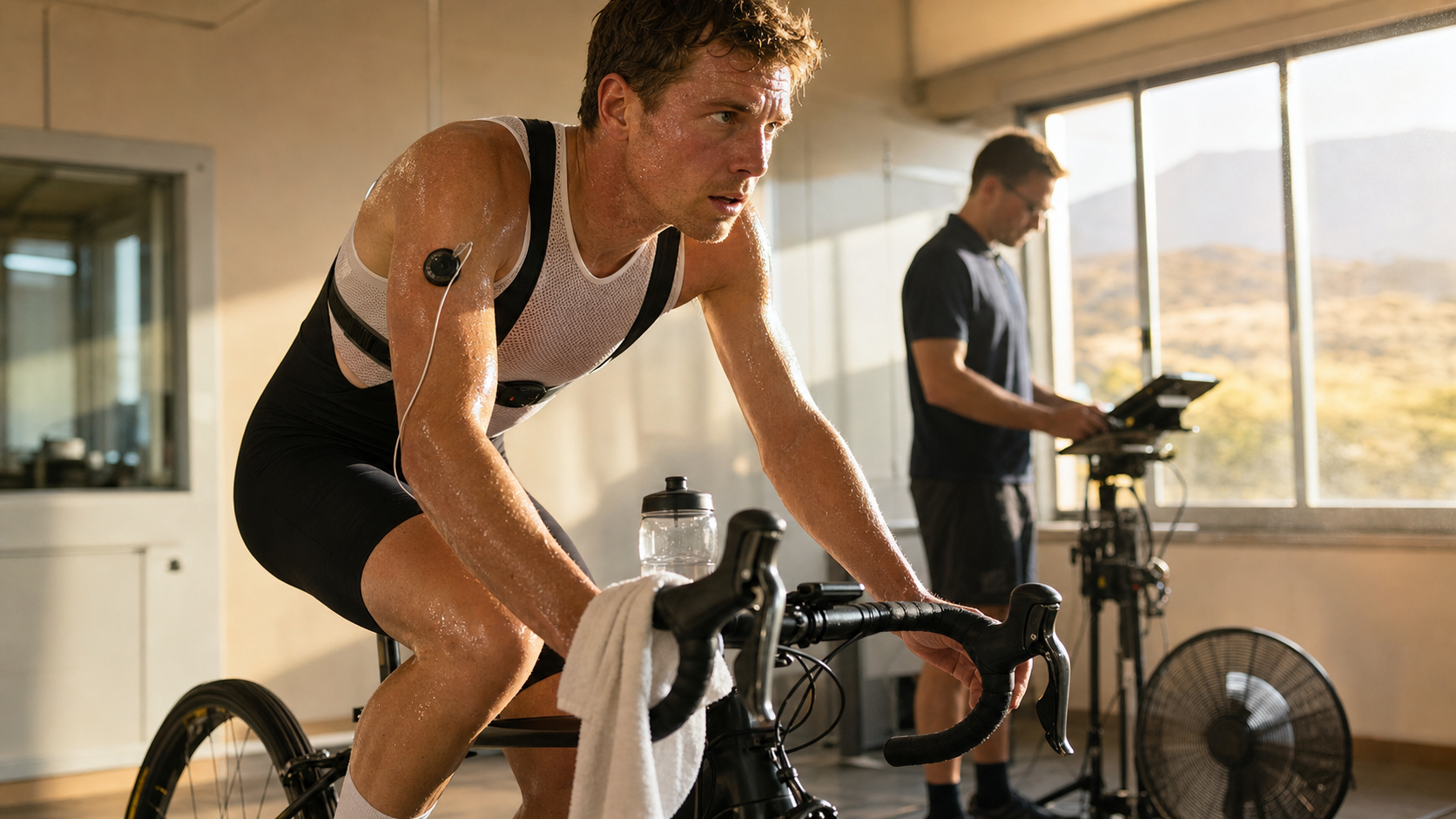
- Indoor cycling with air conditioning off: Ride on a trainer in a stuffy indoor space during summer, wearing multiple layers to increase heat load
- Post-training hot water bath: Immediately after training, soak in a 40°C hot bath for 30–40 minutes; research shows this can produce adaptation effects similar to active heat training (based on the work of Zurawlew et al., 2016)
- Sauna training: Perform 2–3 rounds of sauna after each training session (80–90°C, 8–12 minutes per round)
Quantified Benefits of Heat Adaptation on Race Performance
- Time trial performance in hot conditions (>30°C): improvement of 5–8%
- Time trial performance in cool conditions: improvement of 1–3% (primarily through the PVE mechanism)
- VO₂max improvement: 3–5%
- Reduced risk of heat illness: significantly reduced (difficult to quantify but consistent across studies)
Practical Recommendations
- 14–21 days before race day is the optimal heat training window; avoid intense heat adaptation during race week
- Sodium supplementation is critical: sweat sodium losses increase during heat training; failure to replenish may lead to hyponatremia
- Monitor cardiac drift: whether heart rate gradually decreases at the same intensity is the best indicator of ongoing heat adaptation
- Be aware of adaptation decay: heat adaptation effects gradually diminish approximately 14–28 days after cessation of heat exposure; maintenance is needed before race day
- Large individual variability: older athletes (>50 years) adapt more slowly and require a longer adaptation period
Conclusion
Heat adaptation training is a scientifically well-validated performance enhancement tool, and compared to altitude training, it offers greater accessibility and lower cost. Whether the goal is to cope with hot-weather racing or to enhance overall aerobic capacity through plasma volume expansion, a well-designed heat training protocol can deliver measurable competitive advantages for cyclists.
Related Reading
- Summer Race Preparation: Complete Heat Adaptation Training Protocol and Scientific Execution Guide
- Heat Adaptation Training: Physiological Strategies to Improve Summer Cycling Performance in Taiwan
- Heat Adaptation Training: Performance Enhancement Strategies for Taiwan’s Hot Summer Environment
- Cycling Heat Adaptation Training: Coping Strategies for Taiwan’s Summer High Temperatures
#公路車 #Fitting 靠人工智慧APP 幫你調整單車
6 年前
單車AI教練!全新 ChatGPT4o 幫你分析訓練成果!排武嶺課表,分析騎車姿勢! 太神了! / 公路車 / CT Yeh / feat. 緯緯
2 年前
水金九不厭五分 10度寒流冷到不願停!feat. 卡卡 / 公路車 / CT Yeh
6 個月前
3D 列印車褲墊 / 舒適改善? / 無痕 x 分區壓縮 / ATK & Decider系列 / JE22黑科技 / #公路車 #CTYEH
11 個月前
GoPro Hero 10 畫質好但 他是個吃電怪物 過熱只是小CASE 單車錄影實測 ! 耗電 災情 過熱實測 購買前請三思 OSMO Action 2了 !? | CT Yeh
4 年前
CT暗黑廚房) 車友必備 宇宙無敵鮮蚵湯 幫助訓練恢復 天然食補 好市多 超肥鮮蚵 破PR
7 年前
實景訓練台) 彰化經典百K 高強度喵團 90分鐘 跟著一起練功 2019 Indoor workout Changhua Classic 100 Taiwan
7 年前
西進武嶺 免費訓練分析服務 Intervals | 練不夠還是練過頭?你哪一種類型選手?AI模型告訴你! | 備戰神器 | 公路車 訓練 | CT Yeh
4 年前