Introduction
Bicycle chainrings have been circular in design almost since their inception, but the question of “whether circular is truly optimal” has never ceased to be challenged by engineers and sports scientists. The concept of non-circular chainrings saw commercial products as early as the 1980s, but it was the launch of the Rotor Q-Ring and Osymetric systems in the 2000s, followed by attention from professional riders (such as Bradley Wiggins winning the 2012 Tour de France on Osymetric), that truly sparked widespread research interest.
The core theory behind oval chainrings is this: by altering the effective gear ratio at different phases of the pedal stroke, muscles work longer in their strongest force-producing positions and pass through the dead centers (Top/Bottom Dead Center) more quickly, thereby improving overall pedaling efficiency. But does scientific research actually support this theory?
The Mechanical Principles of Oval Chainrings
Periodic Variation of Effective Crank Arm Length
The core mechanism of an oval chainring is to cause the effective chainring size to vary periodically throughout the pedal stroke:
| Pedaling Phase | Round Chainring | Oval Chainring (Rotor Q-Ring Example) |
|---|---|---|
| Power phase (0–90°) | Fixed (e.g., 52T) | Increases to approximately 54T |
| Bottom transition (90–180°) | Fixed (52T) | Returns to 52T |
| Upstroke phase (180–270°) | Fixed (52T) | Decreases to approximately 50T |
| Top transition (270–360°) | Fixed (52T) | Returns to 52T |
This design increases the effective chainring size (greater leverage) during the power phase and decreases it in the dead zone (faster crank rotation, shortening time spent at the dead centers).
Ovality and Orientation Settings
Oval designs differ between brands:
- Rotor Q-Ring: Ovality of approximately 10–11%, with adjustable OCP 1–5 orientation (phase offset of the long axis relative to the crank arm), suitable for different pedaling styles
- Osymetric: Ovality of approximately 16%, fixed orientation, the most non-circular design on the market
- SRAM oval chainrings (Mountain): Optimized for off-road riding, with ovality of approximately 10%
Electromyography (EMG) Research Analysis
Changes in Activation Patterns of Major Muscle Groups
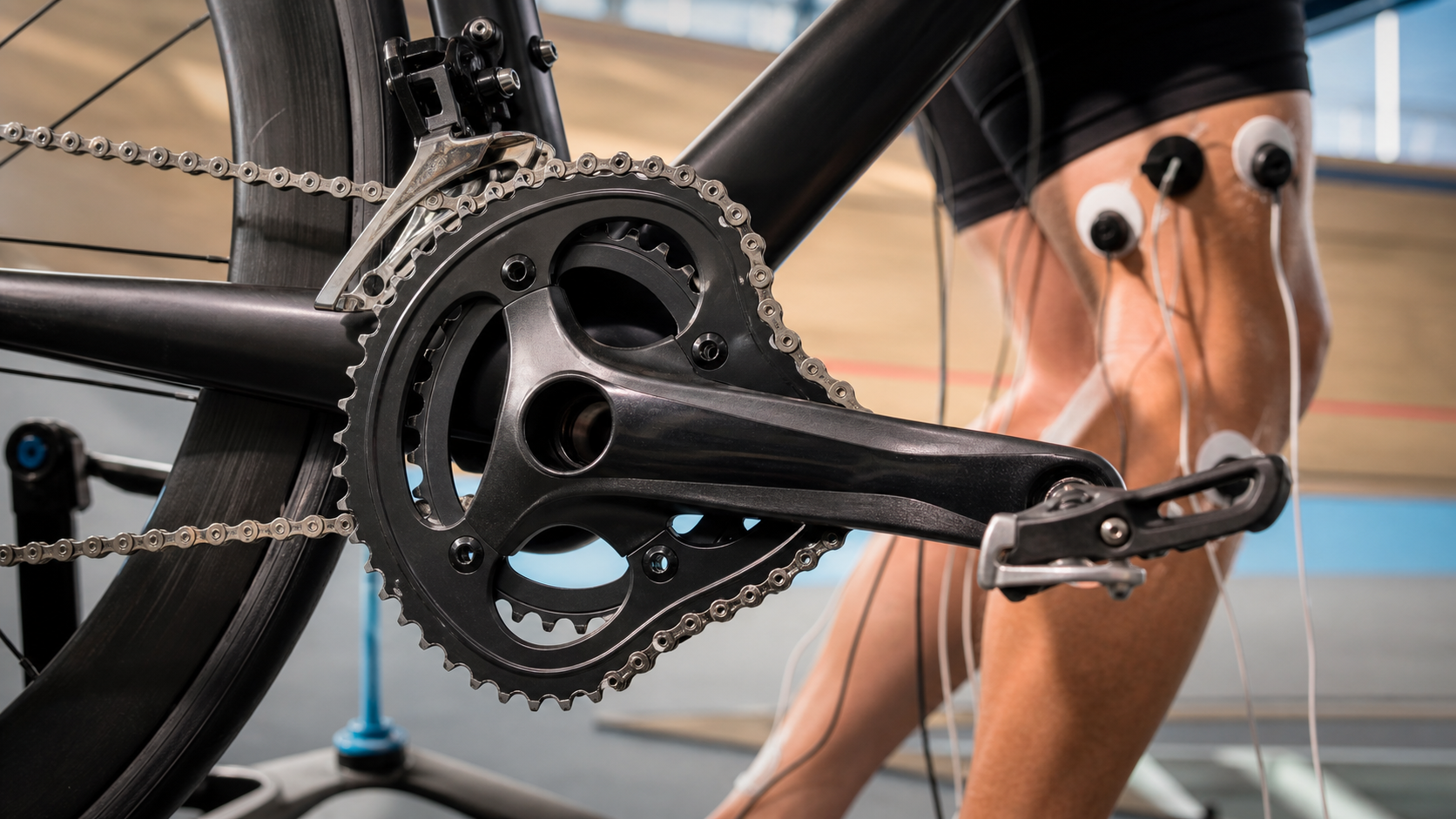
Strutzenberger et al. (2014) conducted an EMG study on 8 amateur riders, comparing muscle activation differences between Osymetric and round chainrings:
- Quadriceps (Vastus Lateralis): With oval chainrings, peak activation timing shifted approximately 5–8° earlier into the power phase of the pedal stroke, consistent with the design goal of extending the maximum torque window
- Hamstrings (Bicep Femoris): No significant change in activation patterns
- Calves (Gastrocnemius): Activation decreased with oval chainrings, possibly due to reduced buffering demands on the calf muscles from faster bottom transition
- Iliopsoas: Activation decreased in the top dead center zone, consistent with the expected effect of shortening time at the dead center
Research on Muscle Fatigue Indicators
Research by Lloyd et al. showed that after prolonged use of oval chainrings:
- The rate of decline in the quadriceps’ median power frequency (MPF) was slower compared to using round chainrings, suggesting a potentially reduced rate of muscle fatigue
- This is consistent with the theory that “oval chainrings allow muscles to work longer at optimal force-producing angles”
- However, the sample size was small, and conclusions should be interpreted with caution
Systematic Review of Competition Performance Research
Condition-Dependent Effects
Synthesizing multiple studies, the effects of oval chainrings show clear condition dependence:
| Condition | Oval Chainring Advantage | Hypothesized Reason |
|---|---|---|
| Maximal sprint power test | Some studies show +1–3% | Extended maximum torque window |
| 1-hour time trial | Most studies show no significant difference | Effects balanced after full adaptation |
| Testing after prolonged fatigue | Some studies show positive effects | Delayed quadriceps fatigue |
| Cyclocross/Mountain biking | More positive reports | More intermittent high-power output |
| With adequate adaptation period | More pronounced effects | Neuromuscular adaptation complete |
The Critical Importance of the Adaptation Period
This is the most frequently overlooked variable in oval chainring research. Most studies use an adaptation period of less than 4 weeks, while riders who actually use oval chainrings commonly report needing 6–12 weeks to fully adapt to the new neuromuscular coordination pattern. An insufficient adaptation period may bias research results toward showing no effect.
Rider Types Who May Benefit from Oval Chainrings
Based on existing research and practical feedback, the following types of riders may benefit more:
- Riders with pronounced dead spots: If a power meter shows poor pedaling smoothness (Balance), oval chainrings may help improve it
- Cyclocross and mountain bike riders: Riding styles requiring frequent climbing and intermittent bursts benefit more from the periodic effective gear ratio variation of oval chainrings
- Riders who prefer high cadence: Oval chainrings feel smoother at high cadence (>95 rpm), with some riders reporting more continuous power delivery
- Riders with a history of knee problems: Some reports suggest oval chainrings can reduce peak knee joint loading, but more research is needed to confirm
Practical Recommendations
- Orientation settings matter: The OCP setting on Rotor Q-Rings should be adjusted based on individual maximum knee flexion angle; it is recommended to have a Bike Fitter assist with the setup
- Do not switch during peak season: The adaptation period for oval chainrings will temporarily reduce training quality; introduce them during the base phase
- Maintain the original gear ratio conversion: After switching to an oval chainring, the actual average gear ratio is the same as a round chainring, so no rear derailleur adjustment is needed
- Objective evaluation method: Compare using a 20-minute power test before and after a 6-week period; if there is no improvement, consider returning to round chainrings
Conclusion
Research on muscle force analysis of oval chainrings provides theoretical support, but the actual performance benefits vary from person to person. They are not a universal efficiency-boosting tool, but for riders with specific pedaling patterns and riding disciplines, they may indeed deliver genuine muscle fatigue-delaying effects after adequate adaptation. Science is gradually clarifying the answer to “who is suited for oval chainrings,” and individualized assessment is the correct approach to application.
Related Reading
- Bicycle Biomechanics Research: The Efficiency Debate Between Circular and Oval Pedaling Paths
- The Specific Impact of Core Training on Cycling Efficiency: Scientific Research and Practical Exercises
- The Influence of Bicycle Q-Factor on Knee Valgus Moment: Individualized Fitting Research
- Quantifying Pedaling Smoothness: Research on New Power Meter Analysis Metrics
再一組! 全碳幅條 碟煞/無內胎輪組 開箱! 到底好騎嗎? UNAAS X40 | 公路車 | CT Yeh
4 年前
鉅齒紋輪組!? ControlTech MEG-T50 EVO 碳纖維幅條輪組/ 功率對比實驗 / 公路車 / CT Yeh
2 年前
單車胎壓觀察到的有趣現象,SRAM Quarq TyreWiz 2.0 無內胎胎壓計 / 裝了有哪些幫助? / Tubeless / 公路車 / CT Yeh
1 年前
Unaas X50 全碳纖幅條輪 數據實測對比PK | Lun Hyper 的高階版 | 板輪爬坡也可以很厲害? ! 武嶺2小時大師一起親測! CP值超高 | 公路車 | CT Yeh
4 年前
SONY FDR-X3000 兩年 單車 錄影 使用心得 AS300
7 年前
公路車 BB培林大升級! / 備戰海鷗繞圈賽 Canyon Aerod & TIME 一起改 / MIT大廠 CEMA對鎖式陶瓷培林BB & 導輪 / 公路車 / CT Yeh
2 年前
來都來了!改好改滿 / CS大導輪 + BB 可以省幾瓦? / 同場加映 TIME XPRO卡踏 / #公路車 #ceramicspeed / CT Yeh
1 年前
Vision Metron RS 37碳幅條輪組 (非SL)官網沒有的 低調開箱 / 這重量太銷魂了 / 公路車 / CT Yeh
6 個月前