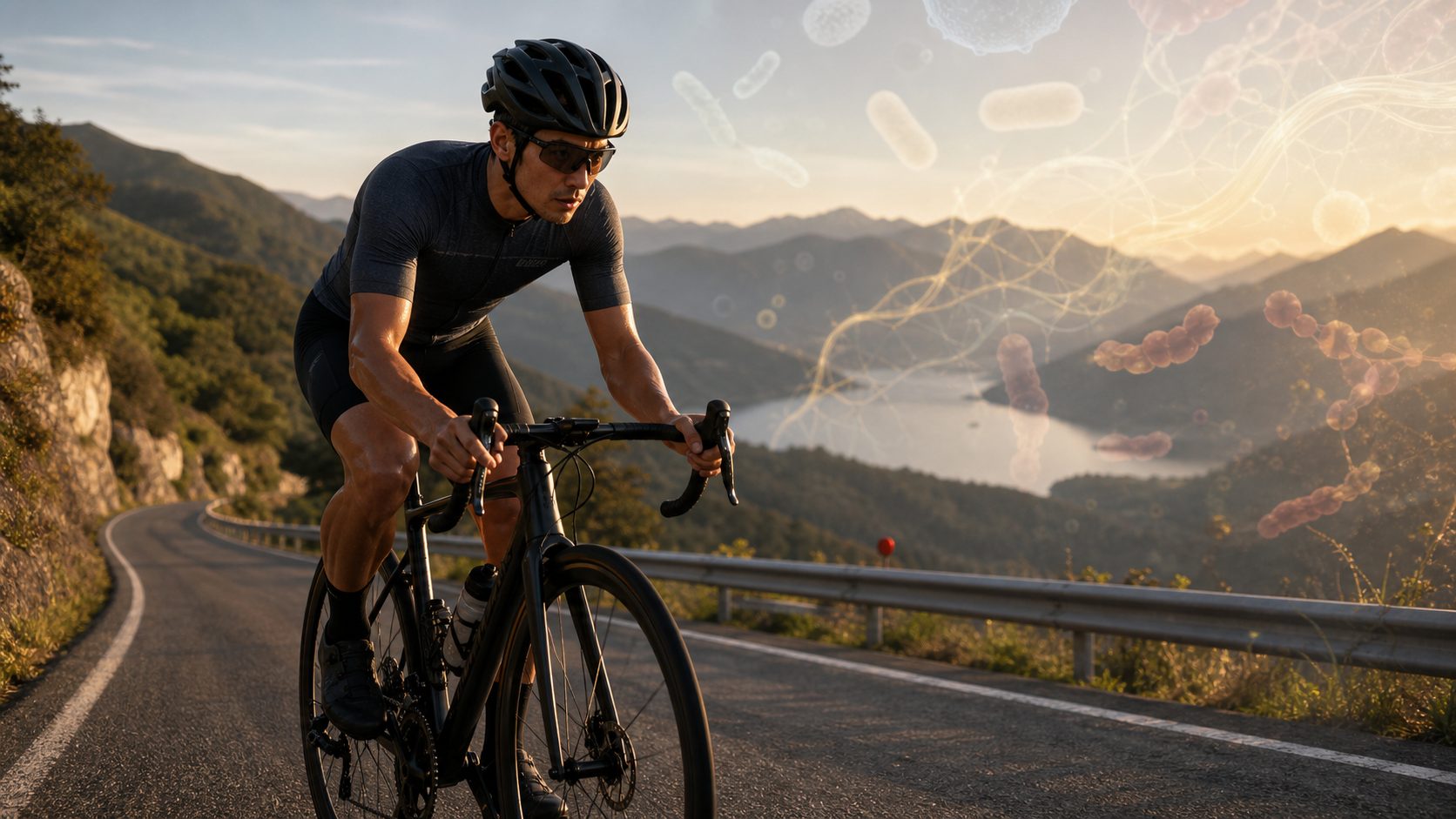
Introduction
The human gut is home to over 100 trillion microorganisms, with a total gene count roughly 150 times that of the human genome. This “second genome” is known as the gut microbiota, and it has profound effects on the immune system, metabolic function, and even mental health. In recent years, sports science research has begun to focus on a new question: Does endurance training alter the gut microbiota, and does this change affect athletic performance?
For cyclists, gut issues are themselves a major factor influencing performance—according to statistics, approximately 30–50% of endurance athletes experience gastrointestinal discomfort (nausea, diarrhea, abdominal cramps) during competition. Understanding the bidirectional relationship between the gut microbiota and training may be the next frontier in optimizing athletic performance.
The Impact of Endurance Training on Gut Microbiota
Characteristics of Athletes’ Gut Microbiota
A landmark study by Clarke et al. (2014) published in the journal Gut compared the gut microbiota of professional rugby players, moderately active adults, and sedentary adults:
- Athletes had significantly higher microbial diversity (Alpha Diversity) than both control groups
- Higher proportions of specific beneficial genera (such as Akkermansia and Bifidobacterium)
- Greater abundance of genera associated with short-chain fatty acid (SCFA) production
Further research on cyclists (research direction by Mitchell et al., 2019) found:
- Amateur riders cycling > 10 hours per week had significantly better gut microbiota diversity than those cycling < 3 hours per week
- The abundance of Ruminococcaceae family bacteria (involved in fiber breakdown and SCFA production) was positively correlated with VO₂max
Differential Effects of Exercise Intensity
| Training Intensity | Primary Effects on Gut Microbiota |
|---|---|
| Light aerobic (< 60% VO₂max) | Positive: increases beneficial microbial diversity |
| Moderate intensity (60–75% VO₂max) | Positive: promotes proliferation of SCFA-producing bacteria |
| High intensity (> 85% VO₂max) | Mixed: short-term increase in intestinal permeability, microbiota improves after recovery |
| Overtraining (prolonged high volume) | Negative: decreased microbial diversity, increased pro-inflammatory genera |
The “Leaky Gut” Issue in High-Intensity Training
During high-intensity riding, blood is redistributed to working muscles, and intestinal blood flow can decrease by 60–70%. This causes transient ischemia of the intestinal mucosa, leading to a phenomenon known as “increased intestinal permeability (Leaky Gut)”:
- Toxins such as bacterial lipopolysaccharides (LPS) may leak into the bloodstream
- Triggers a systemic low-grade inflammatory response
- Directly linked to the nausea and diarrhea symptoms experienced after races
Short-Chain Fatty Acids (SCFA) and Athletic Performance
The Key Metabolic Role of SCFAs
Short-chain fatty acids (primarily acetate, propionate, and butyrate) are metabolic products of gut bacteria fermenting dietary fiber. Their importance for athletes includes:
- Butyrate: The primary energy source for intestinal mucosal epithelial cells, maintaining intestinal barrier integrity
- Propionate: Converted in the liver into a substrate for gluconeogenesis, indirectly supporting blood glucose stability during exercise
- Acetate: A potential energy source for cardiac and skeletal muscle
Research on Microbiota and SCFA Production
Recent metagenomic studies (analyzing microbiota through DNA sequencing) show:
- Veillonella atypica (a lactate-converting bacterium) can convert lactate produced during exercise into propionate, theoretically forming a positive feedback loop of energy reuse
- A 2019 study in Nature Medicine found that Boston Marathon runners had significantly increased gut Veillonella abundance after the race
- However, the applicability of these findings to cyclists still requires further research
The Bidirectional Relationship Between Gut Health and Training
Endurance training → Improved gut microbiota → Better energy metabolism → Better training adaptation → Continuous positive cycle
     ↑                                                      |
     └──────────────── Increased SCFA production ──────────────────────┘
But there is also a risk of a negative cycle:
Overtraining → Increased intestinal permeability → Inflammatory response → Reduced recovery capacity → Decreased training tolerance
Dietary Strategies and Their Microbiota Effects
| Dietary Strategy | Effects on Riders’ Microbiota |
|---|---|
| High dietary fiber diet (> 25g/day) | Significantly increases microbial diversity |
| Mediterranean diet | Increases beneficial bacteria such as Lactobacillus |
| High-sugar refined diet | Decreases microbial diversity, increases pro-inflammatory bacteria |
| Probiotic supplementation (specific strains) | May reduce in-race gastrointestinal discomfort by 30–40% |
| High-fat diet before high-intensity events | Known negative impact on gut microbiota |
Practical Recommendations
- Dietary diversity during the season: During training periods, focus on a variety of fruits, vegetables, and whole grains to maintain a foundation of gut microbiota diversity
- Probiotic supplementation strategy: Research supports supplementing with probiotics containing Lactobacillus rhamnosus for 4–8 weeks before long-distance events, which may reduce gastrointestinal discomfort
- Gut protection after high-intensity training: Consuming polyphenol-rich foods (berries, dark chocolate) after high-intensity sessions may help reduce intestinal inflammatory responses
- Avoid trying new foods before races: Maintain a familiar dietary pattern for 48 hours before competition to reduce microbiota fluctuations
- Monitor the relationship between training load and gastrointestinal symptoms: If gut issues occur frequently, it may be a warning sign of overtraining
Conclusion
Gut microbiota research has opened a new door for cycling sports science. From microbial diversity to the metabolic recycling of short-chain fatty acids, the gut is no longer just a digestive organ but an important component of the athletic performance system. As microbiome technologies (Microbiomics) become more accessible, personalized “gut microbiota optimization diet plans” may become a standard part of elite cyclists’ preparation protocols in the future.
Related Reading
- Gut Microbiota and Cycling Performance: How the Microbiome Affects Your Endurance
- Microbiome and Exercise: New Research on Gut Microbiota and Endurance Performance
- Gut Health in Swimmers: The Impact of Probiotics and Gut Microbes on Immunity
- Gut Microbiota and Endurance Performance: How the Microbiome Affects Energy, Inflammation, and Recovery
靠單車減肥35公斤 心得分享與整理
7 年前
公路車 BB培林大升級! / 備戰海鷗繞圈賽 Canyon Aerod & TIME 一起改 / MIT大廠 CEMA對鎖式陶瓷培林BB & 導輪 / 公路車 / CT Yeh
2 年前
一日北高常見問題大集合 | 攻略 | 路線 | 訓練 | 補給 | 自行車 單車 | 一日雙城 | 雙塔 | TWB北高360 | 屁股痛
6 年前
2025 自行車錶排行榜 兩萬車友大數據 / Garmin Bryton 排名會大洗牌嗎? / 全新的碼表前身分析 /公路車 / CT Yeh
1 年前
一日北高/長距離團騎 常見問題補充篇 / 組團或跟團的眉角 / 壯車友容易被瘦車友慢性拉爆 / 原來屁股痛可能是這個原因...? / 風場配速法 / 公路車 / CT Yeh
2 年前
約騎爆笑地獄梗 大腸怎麼了🤣 #公路車 #cycling
3 年前
鉅齒紋輪組!? ControlTech MEG-T50 EVO 碳纖維幅條輪組/ 功率對比實驗 / 公路車 / CT Yeh
2 年前
大家都在開箱的...單車用藍芽對講耳機真的有幫助嗎? SENA BiKom 20 長距離旅遊 & 海鷗繞圈賽 實際體驗心得 / 公路車 / CT Yeh
9 個月前