Introduction
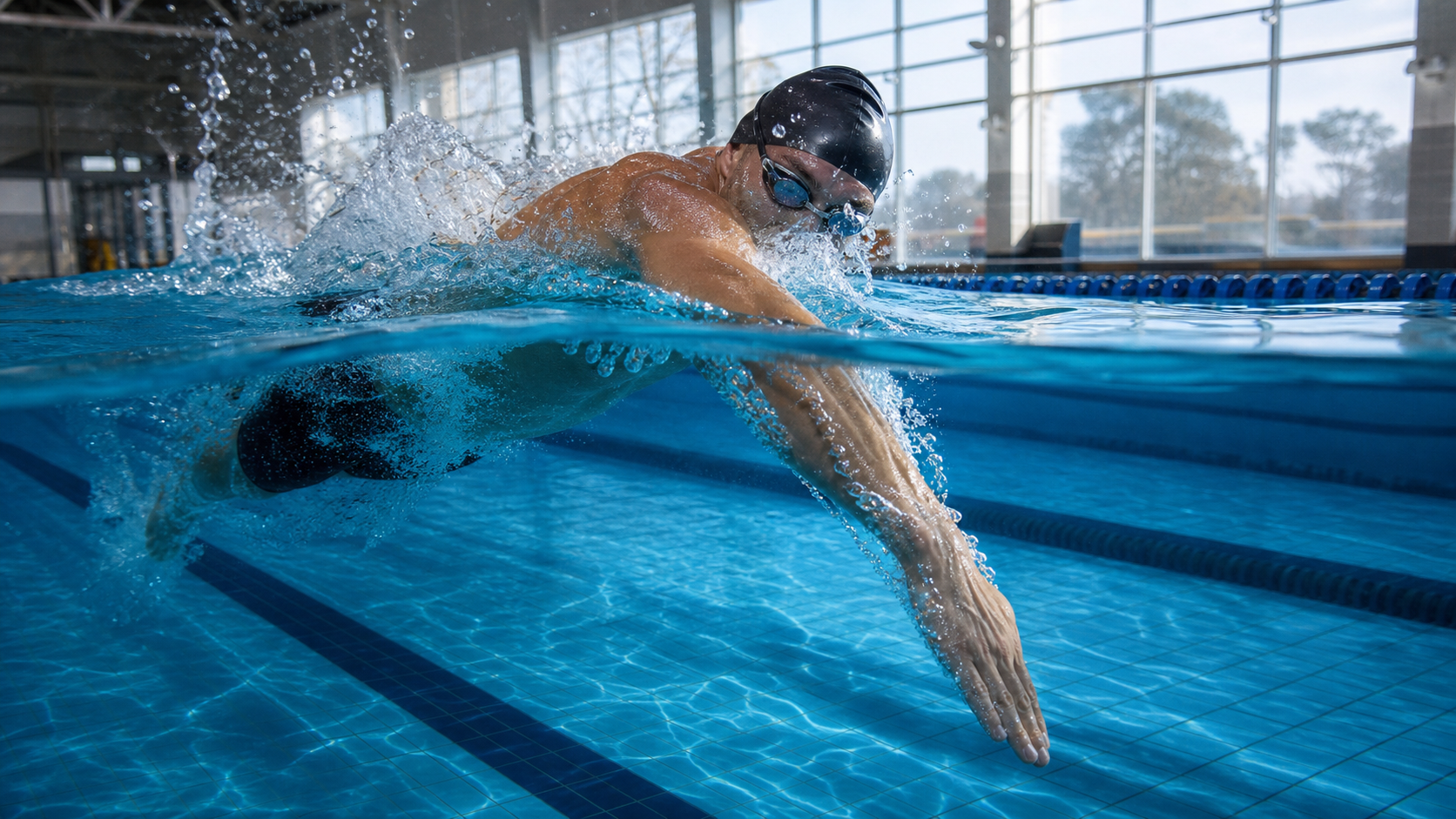
In swimming technique discussions, the freestyle hand entry angle is a long-standing topic of debate. Coaches hold two distinctly different views: one camp advocates that a “thumb-first” entry reduces water resistance and initiates better shoulder rotation; the other argues that this position can easily lead to shoulder impingement syndrome and recommends switching to a “fingertip-first, roughly neutral palm” entry. This article examines the core arguments of this debate from three perspectives: biomechanics, sports injury research, and the experiences of actual swimmers.
Technical Explanation of the Two Entry Methods
Thumb-First Entry (Pronated Entry)
Thumb-first entry means that as the hand enters the water, the thumb side cuts in first, with the palm in a pronated position. Proponents believe this allows the arm to glide naturally into a high-elbow position after entry, facilitating the subsequent high-elbow catch.
Arguments supporting thumb-first entry:
- The hand’s contact surface area upon entry is smaller, resulting in lower initial water resistance
- It drives scapular protraction, helping to increase stroke length
- Some elite swimmers (such as the early Michael Phelps) did use this technique in competition
Neutral Entry (Thumb Slightly Higher)
Modern mainstream coaches tend to teach a “neutral palm, thumb slightly higher than the little finger” entry. The hand enters the water in the direction of the index to middle finger, with the entire arm in a more relaxed, externally rotated position.
Arguments supporting neutral entry:
- Reduces the risk of subacromial space impingement (Impingement Syndrome)
- The glide path after entry is smoother, requiring no additional shoulder adjustment
- Easier for most recreational swimmers to learn and maintain
Biomechanical Analysis
| Comparison Item | Thumb-First Entry | Neutral Entry |
|---|---|---|
| Entry water resistance | Lower (smaller cutting surface) | Slightly higher (wider palm surface) |
| Shoulder rotational torque | Higher, requires stronger rotator cuff muscles | Moderate, more energy-efficient |
| Injury risk | Higher (especially the rotator cuff) | Lower |
| Glide efficiency | Requires technical compensation | More direct path |
| Learning difficulty | High (requires combined high-elbow drills) | Moderate |
Common Errors and Injury Mechanisms
When using thumb-first entry, the following errors are most likely to occur:
- Excessive pronation: Over-rotation of the hand causes the elbow to drop below the wrist, disrupting the catch path after entry
- Crossing the midline: Thumb-first entry makes it easy for the hand to drift toward the body’s midline, causing a crossover stroke and increasing side-to-side body sway
- Shoulder impingement: Under long-term high-intensity training, pronated entry places additional stress on the rotator cuff muscles
Taiwanese swimming coach Wu Jian-Hui points out that among the recreational swimmers he coaches, roughly 30% of shoulder discomfort is directly related to improper entry angles, particularly among middle-aged and older swimmers with reduced shoulder joint mobility.
Practical Recommendations
For beginners:
- Prioritize learning the neutral entry position; establish a stable entry habit before fine-tuning details
- Use underwater cameras or phone recordings to confirm the entry point is directly in front of the shoulder (to avoid crossing the midline)
For advanced swimmers:
- If you have no shoulder discomfort, you may try a slightly thumb-down entry (not extreme pronation) to see if it improves catch initiation
- It is recommended to incorporate resistance band training for rotator cuff strengthening to reduce injury risk
For swimmers with shoulder issues:
- Strongly recommended to switch to a neutral or thumb-slightly-higher entry
- Reduce weekly swimming frequency and follow a physical therapist’s advice for shoulder rehabilitation
Conclusion
There is no absolute answer to the thumb-first entry controversy; the technical choice must account for individual shoulder joint mobility, training volume, and skill level. For most recreational swimmers, neutral entry is safer and easier to master; for technically proficient swimmers without shoulder problems, a moderate thumb-down entry may help improve catch efficiency. Regardless of the method chosen, avoiding midline crossover and maintaining the correct relative position of the wrist and elbow are the fundamental keys to improving freestyle efficiency.
Related Reading
- Complete Analysis of Freestyle Entry Angles: Choosing Between Thumb-First and Flat-Palm Entry
- Optimizing the Freestyle Hand Entry Point: Common Crossover Errors and Corrections
- Freestyle Stroke Entry Angle: Propulsion Differences Between 45-Degree and Vertical Entry
- Backstroke Stroke Entry Angle Errors: Preventing and Correcting Shoulder Impact Injuries
CT 喇低賽) 武嶺牽車 才是王道 西進牽車四小時內秘訣 攝手位置 如何判斷 防抽筋小秘訣
7 年前
[教學] Premiere 影片 手震 修正 教學 防抖 單眼 影像 GoPro 穩定 Video Stabilization
8 年前
如何把 GoPro 影片 翻轉 批次 轉正?
6 年前
2024崇越盃西進武嶺/360VR昆陽坡定點直播/請用手指滑動畫面切視角/Panox /CT Yeh
2 年前
西進武嶺 自製新版AI配速表產生器 x 賽前攻略 抱佛腳! 沒有功率計也可以產生配速表嗎?有什麼其他眉角賽前要注意的呢? | 西進武嶺 / 東進武嶺 KOM 攻略 | 公路車 | CT Yeh
4 年前
Insta 360 One 超級防手震技術實測
7 年前
兔子自己洗澡 姿勢超可愛的 Rabbit Wash Itself
13 年前
類空拍神器 Feiyu Pocket 2s (有優惠連結)三軸穩定 運動攝影機 開箱!比GoPro 還強的滑順視角!三小時長時間錄影 行車記錄器 | 環花東365實測 | 公路車 CT Yeh
4 年前