Freestyle Stroke Rhythm: Application Scenarios and Training Strategies for 2-Beat, 4-Beat, and 6-Beat Kicking
Introduction
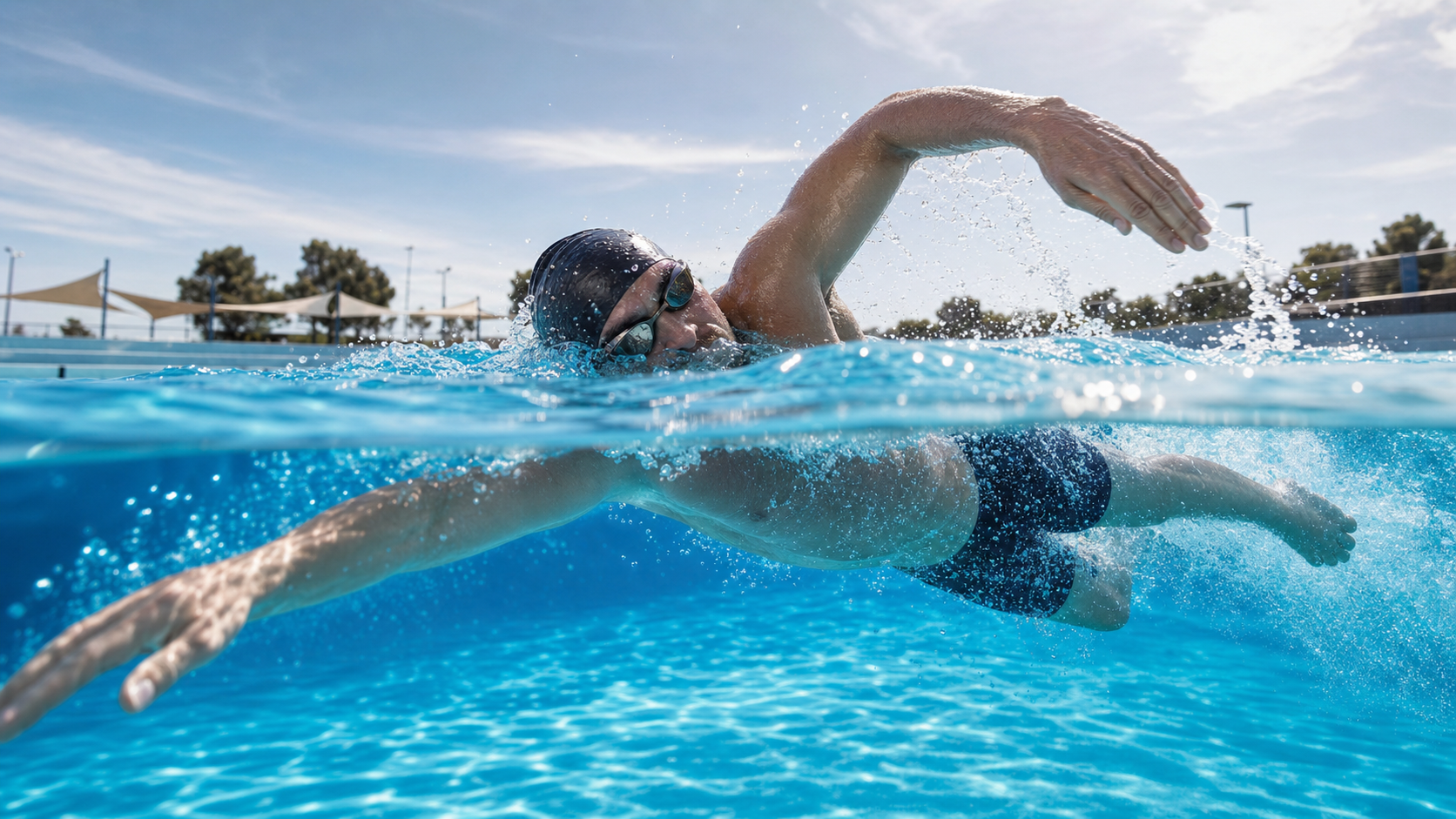
In freestyle swimming, the kick is not only a source of propulsion but also plays a key role in stabilizing body rotation and maintaining a streamlined position. However, not every situation calls for maximal kicking. Depending on race distance, individual fitness levels, and technical goals, swimmers can choose between 2-beat, 4-beat, or 6-beat kick rhythms. This choice directly affects energy distribution and swimming efficiency, making it well worth understanding in depth.
Defining the Three Kick Rhythms
A “beat” refers to the number of kicks the legs perform during one complete arm stroke cycle (one stroke with each arm).
- 2-beat kick: 2 kicks per stroke cycle (left kick paired with right arm pull, right kick paired with left arm pull)
- 4-beat kick: 4 kicks per stroke cycle, falling between the 2-beat and 6-beat
- 6-beat kick: 6 kicks per stroke cycle, the fastest rhythm with the strongest propulsion
Technical Comparison of the Three Kick Styles
| Comparison Item | 2-Beat Kick | 4-Beat Kick | 6-Beat Kick |
|---|---|---|---|
| Leg energy expenditure | Low | Medium | High |
| Propulsion contribution | ~10% | ~15% | ~20–25% |
| Body stabilization effect | Basic | Good | Excellent |
| Suitable distance | Long distance (1500m+) | Middle distance (400–800m) | Short distance (100–200m) |
| Cardiorespiratory load | Low | Medium | High |
| Learning difficulty | Low | Medium | Medium-high |
In-Depth Analysis of Each Kick Rhythm
2-Beat Kick: An Energy Management Tool for Long Distances
The biggest advantage of the 2-beat kick is a significant reduction in oxygen consumption by the legs. Research shows that high-intensity kicking (6-beat) can consume about 15% of the body’s total oxygen, which is a considerable waste for long-distance swimmers—especially triathletes, who still have to bike and run after the swim.
The movement logic of the 2-beat kick is “counter-stabilization”: as the left hand enters the water, the right leg kicks downward, maintaining balance through the cross-body rotational torque. The legs function more for “stabilization” than “propulsion.”
Best suited for:
- Triathletes
- Marathon swimming participants
- Swimmers with weaker leg strength
4-Beat Kick: A Flexible Choice for Transition Periods
The 4-beat kick is not a fixed “standard technique” but rather a transitional state many swimmers naturally shift through between 2-beat and 6-beat, or a deliberate choice for middle-distance races. Its rhythm sits between the two, offering better body rotation stability than the 2-beat while consuming less energy than the 6-beat.
Some swim coaches advise against deliberately training the 4-beat kick, because the rhythm is harder to master and tends to naturally drift toward 2-beat or 6-beat when fatigued.
6-Beat Kick: The Standard for Sprint Swimmers
The 6-beat kick provides the highest body stability and greatest propulsion, making it the mainstream choice in short-distance competitive swimming. The continuous, rapid kicking minimizes lateral body sway, allowing arm pull power to be converted more directly into forward speed.
However, the 6-beat kick places high demands on the cardiorespiratory system and requires strong core muscles and hip flexors (Iliopsoas) to maintain quality throughout. If kicking power is insufficient, the 6-beat can actually cause the legs to sink, increasing drag.
Best suited for:
- 50–200m competitive swimmers
- Swimmers with ample leg strength and good ankle flexibility
Ankle Flexibility: The Hidden Key to Kicking Efficiency
Regardless of which kick rhythm you choose, ankle flexibility is a critical factor in kicking efficiency. Swimmers with limited ankle dorsiflexion (pulling the toes toward the shin) will see limited propulsion gains even with a 6-beat kick.
Here is a suggested test: sit on the floor with legs extended straight, and see if your toes can naturally point forward (plantar flexion) beyond 150 degrees. If not, you need to strengthen ankle flexibility training.
Training Recommendations
Improving 2-beat rhythm:
- Swim with paddles, keeping the legs to minimal kicking amplitude, and feel the diagonal coordination between arms and legs
- Use a counting method: count “one” when the left hand enters the water, “two” when the right hand enters, to ensure a steady rhythm
Building leg endurance for the 6-beat kick:
- Do isolated kicking drills (with a kickboard), 100m per set, focusing on relaxing the ankles
- Progressively increase kicking intensity to avoid over-fatiguing the hip flexors
Mixed-rhythm training (advanced):
- Practice using a 2-beat kick during steady-paced segments and switching to a 6-beat kick during sprint segments in long-distance swimming
- This “variable kicking” technique requires considerable feel-based training but is highly beneficial for race tactics
Conclusion
There is no absolute right or wrong in choosing a kick rhythm—the key lies in matching it to race goals and individual fitness levels. It is recommended that every swimmer take the time to test all three rhythms, understand their speed and energy expenditure under each, and gradually adjust through a long-term training plan. Technical refinement is always a process of “getting to know your own body.”
Related Reading
- Freestyle Kicking Technique: Strategies for Choosing Between 6-Beat, 4-Beat, and 2-Beat
- Freestyle Kick Rhythm: Which Distances and Body Types Suit 2-Beat, 4-Beat, and 6-Beat
- Freestyle Kicking Efficiency: Speed vs. Endurance Trade-offs Between 6-Beat and 2-Beat Kicks
- Freestyle Kick Rhythm Fully Explained: The Logic Behind Choosing 2-Beat, 4-Beat, and 6-Beat
CT 喇低賽) 武嶺牽車 才是王道 西進牽車四小時內秘訣 攝手位置 如何判斷 防抽筋小秘訣
7 年前
西進武嶺 免費訓練分析服務 Intervals | 練不夠還是練過頭?你哪一種類型選手?AI模型告訴你! | 備戰神器 | 公路車 訓練 | CT Yeh
4 年前
類空拍神器 Feiyu Pocket 2s (有優惠連結)三軸穩定 運動攝影機 開箱!比GoPro 還強的滑順視角!三小時長時間錄影 行車記錄器 | 環花東365實測 | 公路車 CT Yeh
4 年前
多機位拍片神器 DJI Action 2 拍出速度張力感 | 類空拍機視角 4陣列麥克風超強降風噪 實測! | 公路車 | CT Yeh
3 年前
Live) 備戰2019彰化經典百K 賽前攻略 (已完賽請看新影片
7 年前
2024桃園團體自由車邀請賽!4K環台賽等級拍攝 全賽事精華!/ 集團大摔車 / 60隊菁英好手衝線 / 公路車 CT Yeh
1 年前
抖肩舞 台灣x日本交流版 (台灣 vs 前橋) 赤城山登山賽 coincidance
8 年前
教學) 如何做出專業 慢動作 影片 Slow Motion 120fps GoPro 7 ActionCam AX700 A99II
7 年前