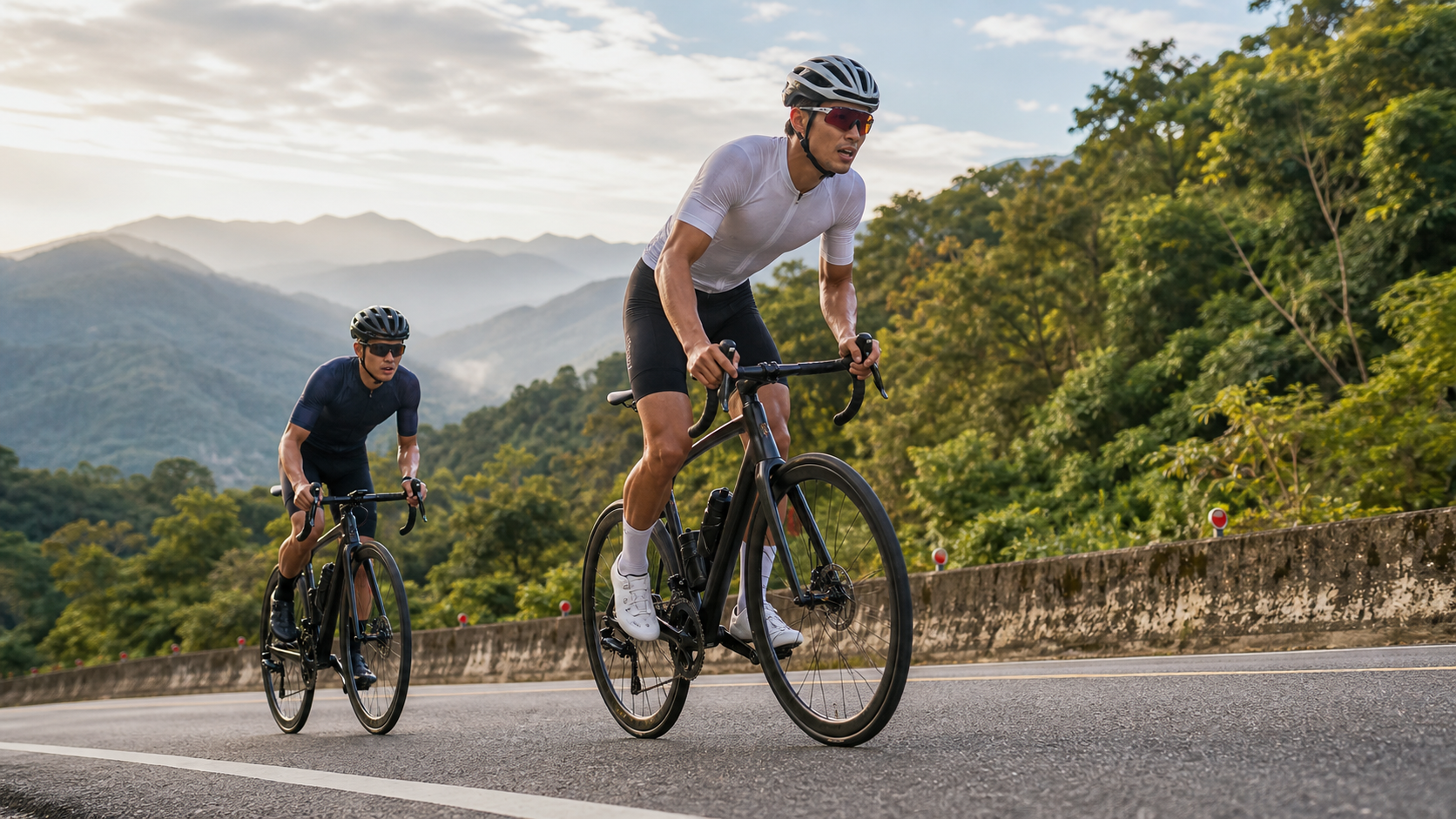
Seated Climbing vs. Standing Climbing: How to Decide When to Get Out of the Saddle
Introduction
Getting out of the saddle to climb is a technique every rider uses, yet it is also one of the most frequently misused. Many cyclists habitually stand up as soon as the road steepens, unaware that this action increases energy expenditure by roughly 5–12%. Conversely, staying seated the entire way is not optimal either—standing up at the right moments allows different muscle groups to take over and rest, helping you push through the toughest sections of a climb.
Physiological Characteristics of Seated Climbing
Seated climbing is the fundamental posture for long climbs. Sitting on the saddle distributes your body weight evenly, allowing the glutes to contribute greater force during the pedal stroke. Research shows that gluteus maximus activation is about 15–20% higher when seated compared to standing, and since the glutes are among the largest muscles in the body with excellent aerobic endurance, they are well-suited for sustained output over long durations.
Key advantages of seated climbing:
- Higher energy efficiency; at the same power output, heart rate is roughly 5–8 bpm lower.
- Longer sustainable duration, suitable for climbs lasting over 30 minutes.
- Helps maintain a steady pace and consistent breathing rhythm.
Physiological Characteristics of Standing Climbing
Standing (out-of-saddle) climbing recruits more upper-body muscles (latissimus dorsi, trapezius, arms) to assist with force application, allowing the rider to “walk” the pedals by leveraging body weight, producing higher power output over short periods.
Research shows that during standing climbing:
- Average power can increase by 10–20% (depending on body weight and technique).
- Heart rate rises concurrently by 8–15 bpm.
- Quadriceps load increases, with greater involvement from the gastrocnemius and biceps femoris as well.
| Characteristic | Seated Climbing | Standing Climbing |
|---|---|---|
| Energy efficiency | High | Low (approximately 8–12% more expenditure) |
| Sustainable duration | Long (over 30 minutes) | Short (recommended 30–90 seconds per bout) |
| Peak power | Moderate | High |
| Heart rate impact | Stable | Noticeably elevated |
| Primary muscle groups | Glutes dominant | Quadriceps dominant |
| Suitable gradient | Any gradient | Steep climbs (>10%) or sprints |
When Should You Get Out of the Saddle?
Use the following four criteria to make standing climbing a precise tactical tool:
1. Sudden Increase in Gradient
When the gradient jumps from 7% to 12–15%, staying seated will cause your cadence to plummet (below 55 rpm). Standing up at this point lets you use your body weight to push down and restore pedal rhythm.
2. Muscles “Seizing Up”
After 15–20 minutes of seated riding on a long climb, your quadriceps or glutes will begin to feel the heavy sensation of “lactic acid buildup.” Standing for 30–60 seconds at this point changes the muscle recruitment pattern, effectively giving those muscles a “relief break.”
3. Critical Sprint Points
In the final 500 meters of a race or on steep sections after a corner, standing up while accelerating is standard tactics.
4. “Waking Up” When Heart Rate Is Too Low
Some riders are overly conservative at the start of a long climb, keeping their heart rate in a low zone. Standing for a short 20–30 second burst can quickly elevate heart rate into the target zone, activating a better aerobic energy state.
Technical Key Points for Standing Climbing
An incorrect standing posture is not only wasteful of energy but can also harm your knees and back:
- Slight forward lean: Keep your center of gravity directly above the pedals; do not lean back.
- Relaxed arms: Use the handlebars for stability, but avoid pulling excessively, which causes upper-body sway.
- Bike rhythm: The bike will naturally rock side to side when standing, which is normal, but the sway should be controlled.
- Shift down one gear: Shift to an easier gear before standing to prevent a sudden drop in cadence and “mashing” the pedals.
- Don’t hold your breath: Many riders briefly hold their breath when changing position; make a conscious effort to maintain your breathing rhythm.
Situations Where Standing Is Not Recommended
- Early in a climb (first 5–10 minutes): Muscles are not yet fully warmed up, and standing too early risks straining the front of the thighs.
- Heart rate already in Zone 4–5 (>165 bpm): Adding the extra demand of standing may push you quickly into anaerobic territory and cause you to “blow up.”
- Gentle gradients below 6%: Seated climbing is entirely sufficient; standing only wastes energy.
Training Recommendations
- Standing intervals: On a trainer or gentle slope, stand for 30–60 seconds every 5 minutes to get your muscles accustomed to switching modes.
- Seated-standing combined pacing workout: During a 20-minute Tempo ride, stand for 1 minute every 4 minutes to simulate pace management on long climbs.
- Time comparisons: Record your time on the same climb riding fully seated versus using appropriate seated-standing rotation to find your optimal strategy.
Conclusion
Seated and standing climbing are not an either-or choice but complementary tools. The secret of top climbers lies in precisely judging when to switch, executing the standing position with proper technique, and unleashing its peak-power advantage at the most critical moments while conserving energy in the seated position the rest of the time. With more practice and more comparison, you too can find your own optimal rhythm.
Related Reading
- Seated-Standing Transitions on Climbs: When Standing to Pedal Is Most Efficient
- Switching Between Seated and Standing on Climbs: When to Stand and Pedal Most Effectively
- Climbing Pedal Technique: Power Output Comparison Between Seated and Standing
- Seated vs. Standing on Climbs: When Is It Most Efficient to Switch
一日北高/長距離團騎 常見問題補充篇 / 組團或跟團的眉角 / 壯車友容易被瘦車友慢性拉爆 / 原來屁股痛可能是這個原因...? / 風場配速法 / 公路車 / CT Yeh
2 年前
一日北高常見問題大集合 | 攻略 | 路線 | 訓練 | 補給 | 自行車 單車 | 一日雙城 | 雙塔 | TWB北高360 | 屁股痛
6 年前
CT 喇低賽) 武嶺牽車 才是王道 西進牽車四小時內秘訣 攝手位置 如何判斷 防抽筋小秘訣
7 年前
單車 一日北高 ( 雙城 ) 肥宅雙人瘋狂行 紀錄片 REACTO
10 年前
靠單車減肥35公斤 心得分享與整理
7 年前
白沙屯媽祖進香在家走!UREVO 坡度自調走步機 / 可連接訓練遊戲APP MyWhoosh / 邊看直播邊走起來 / CT Yeh
11 個月前
訓練台體驗) 2019台北自行車展 三大家 訓練台體驗 Tacx Neo Flux 2 Xepdo Apx Wahoo Kickr
7 年前
滑雪新手們慘摔學習全紀錄(請開字幕),滑雪好好玩 | Snowboard + Ski | 岩原 スキー場 | 滑雪APP使用 | GoPro Max
6 年前