Introduction
Backstroke is the only competitive swimming stroke performed face-up, which eliminates breathing issues but introduces entirely new technical challenges: limited visibility, difficulty with orientation, and a tendency for the upper body to sit too high on the water, creating high drag. Mastering the S-shaped pull path and kicking rhythm coordination in backstroke is a major technical leap from recreational to competitive swimming.
Backstroke Streamlining and Hand Entry Position
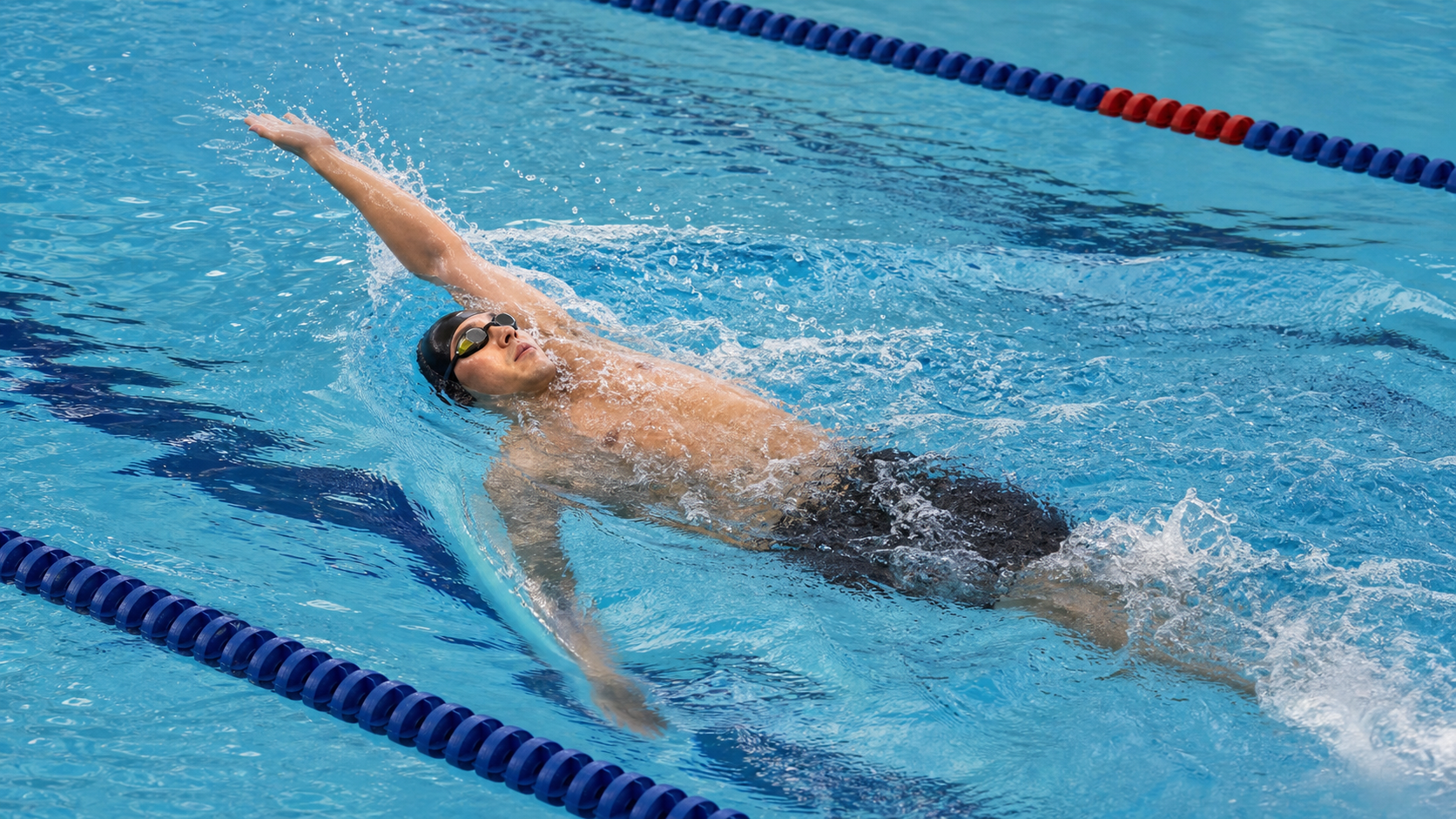
Propulsive efficiency in backstroke is determined from the entry position onward. The ideal hand entry point is on the extension of the shoulder line (directly above the shoulder), with the thumb pointing downward and the pinky side entering the water first. If the hand crosses the midline of the head on entry, the body will undergo unnecessary lateral rotation; if the entry point is too close to the head, the pull stroke length is shortened.
Key Points for Hand Entry:
- Enter with the arm extended, elbow slightly bent (to avoid splashing)
- After entry, the hand immediately drives downward into the catch position
- The time the entire arm spends entering the water should be short, avoiding lingering at the surface
The Mechanics of the S-Shaped Pull Path
The backstroke pull path is not a straight line but an S-shaped (or “propeller-shaped”) trajectory. This path is designed to continuously find “still water,” ensuring the palm is always pressing against fresh water rather than pushing through already-disturbed turbulence.
The Three Phases of the S-Shape:
- Catch Phase: After entry, the hand moves outward and downward (the elbow begins to bend), establishing the propulsive surface
- Pull Phase: The hand pushes inward and upward, with the path passing directly beneath the waist
- Push Phase: The hand rotates outward and downward, finally completing the “keyhole” shape
Technical Points for Each Phase of the Backstroke Pull
| Phase | Hand Position | Elbow Angle | Primary Muscles Used |
|---|---|---|---|
| Entry Glide | Directly above shoulder line | Slightly bent | Serratus anterior (extension) |
| Catch | Outward and downward | Gradually bending to 90 degrees | Infraspinatus, latissimus dorsi activation |
| Main Pull | Directly beneath the waist | Approximately 90 degrees | Latissimus dorsi, pectoralis major dominate |
| Push | Beside the thigh | Gradually straightening | Triceps complete the motion |
| Exit and Recovery | Thumb exits first | Straight | Shoulder rotation drives the motion |
Coordination of Kicking Rhythm and Body Rotation
The standard backstroke uses a 6-beat kick, meaning for each complete arm stroke cycle (one pull with each arm), the legs kick 6 times. This rhythm follows the same principle as the freestyle 6-beat kick, aiming to maintain body balance and propulsive continuity.
Specifics of the Backstroke Kick:
- The kick emphasizes the “up-kick” (as opposed to the freestyle down-kick), with the top of the foot providing the main propulsion during the upward motion
- The knees should remain relatively stable, with the movement originating primarily from the hips and ankles
- Ankle flexibility equally affects kicking efficiency
The logic of coordinating body rotation (45–50 degrees) with the arm pull in backstroke is: as the right arm enters the water, the body rotates to the right, pre-stretching the right latissimus dorsi; as the left arm begins its pull, the body rotates from right to left, adding rotational momentum to the propulsion. This principle is nearly identical to freestyle.
Common Backstroke Technical Errors
Error 1: Hand Entry Across the Midline
The most common error, causing a “snake-like” weaving of the body and significantly increasing drag. It is necessary to strengthen proprioception of the entry position along the shoulder line.
Error 2: Dropping Hips
When the core is not engaged in backstroke, the hips sink below the water surface, greatly increasing forward resistance. Keep the core tight to maintain the body as close to the surface as possible.
Error 3: Excessive Head Tilt Backward
Tilting the head too far back causes the chest to float up and the legs to sink, forming a “V-shaped” body position. The head should maintain a slight chin tuck, with the ears just at the water surface level.
Error 4: Shoulders Rising Too Far Out of the Water During the Pull
Some swimmers lift the entire shoulder out of the water during the arm recovery phase, adding extra impact upon re-entry. The recovering arm should exit and re-enter the water in a smooth arc.
Backstroke-Specific Direction Control
Directional awareness is a major challenge for beginners in backstroke. The following methods help maintain a straight swimming line:
- Use ceiling lights or markers as reference points
- Ensure symmetrical hand entry points for both arms (each directly above the shoulder line)
- Keep both feet on the body’s midline during the kick (avoiding the legs drifting to one side)
Training Recommendations
Single-Arm Backstroke Drill:
Keep one hand resting on the abdomen while the other arm completes the full sequence of entry → S-shaped pull → exit. This helps precisely feel the pull path on one side.
Backstroke Kick with Kickboard:
Hold a kickboard with both hands placed on the thighs, performing only the kicking motion, focusing on feeling the kick rhythm and maintaining body streamline.
Backstroke Flags Training:
Use the pool’s 5-meter flags (backstroke turn flags) to practice counting strokes from the flags to the wall, building distance awareness and turn timing.
Conclusion
Refining backstroke technique is a comprehensive training process that requires simultaneous attention to what happens “above the water” (arm recovery trajectory, line of sight) and “below the water” (S-shaped pull, kick rhythm). Using video analysis and isolated drill work can greatly accelerate technical improvement. For swimmers aiming for balanced development across all four competitive strokes, investing in backstroke technique is absolutely worthwhile.
Related Reading
- Backstroke Technique Improvement: Optimizing Body Roll and Arm Entry Angle
- Key Technical Points for Backstroke: Rotation Axis and Pull Efficiency Guide
- Backstroke Pull Path: Modern Techniques of S-Shaped Pull vs. Straight-Arm Pull
- Backstroke Pull Rhythm and Shoulder Rotation: The Overlooked Efficiency Code
CT 喇低賽) 武嶺牽車 才是王道 西進牽車四小時內秘訣 攝手位置 如何判斷 防抽筋小秘訣
7 年前
西進武嶺 自製新版AI配速表產生器 x 賽前攻略 抱佛腳! 沒有功率計也可以產生配速表嗎?有什麼其他眉角賽前要注意的呢? | 西進武嶺 / 東進武嶺 KOM 攻略 | 公路車 | CT Yeh
4 年前
[教學] Premiere 影片 手震 修正 教學 防抖 單眼 影像 GoPro 穩定 Video Stabilization
8 年前
#公路車 #西進武嶺 配速配瓦實驗 坡度分析 四小時內攻略 建大盃 NeverStop #西進武嶺攻略
6 年前
如何把 GoPro 影片 翻轉 批次 轉正?
6 年前
FTL 與 SYB 車隊專訪 西進武嶺 實用攻略分享! 2小時 如何練?!你不知道的眉角!新手準備武嶺必看 EP1 | 實力派女車友 | 精華版 | 公路車 | CTYeh
4 年前
Insta 360 One 超級防手震技術實測
7 年前
一起升級!海鷗盃LSD團練...JJSC Zone2招待 騎到手抖 / 公路車 / CT Yeh
2 天前