Swimming Stroke Transition Technique: Coordination Training for Rotating Through All Four Strokes
Introduction
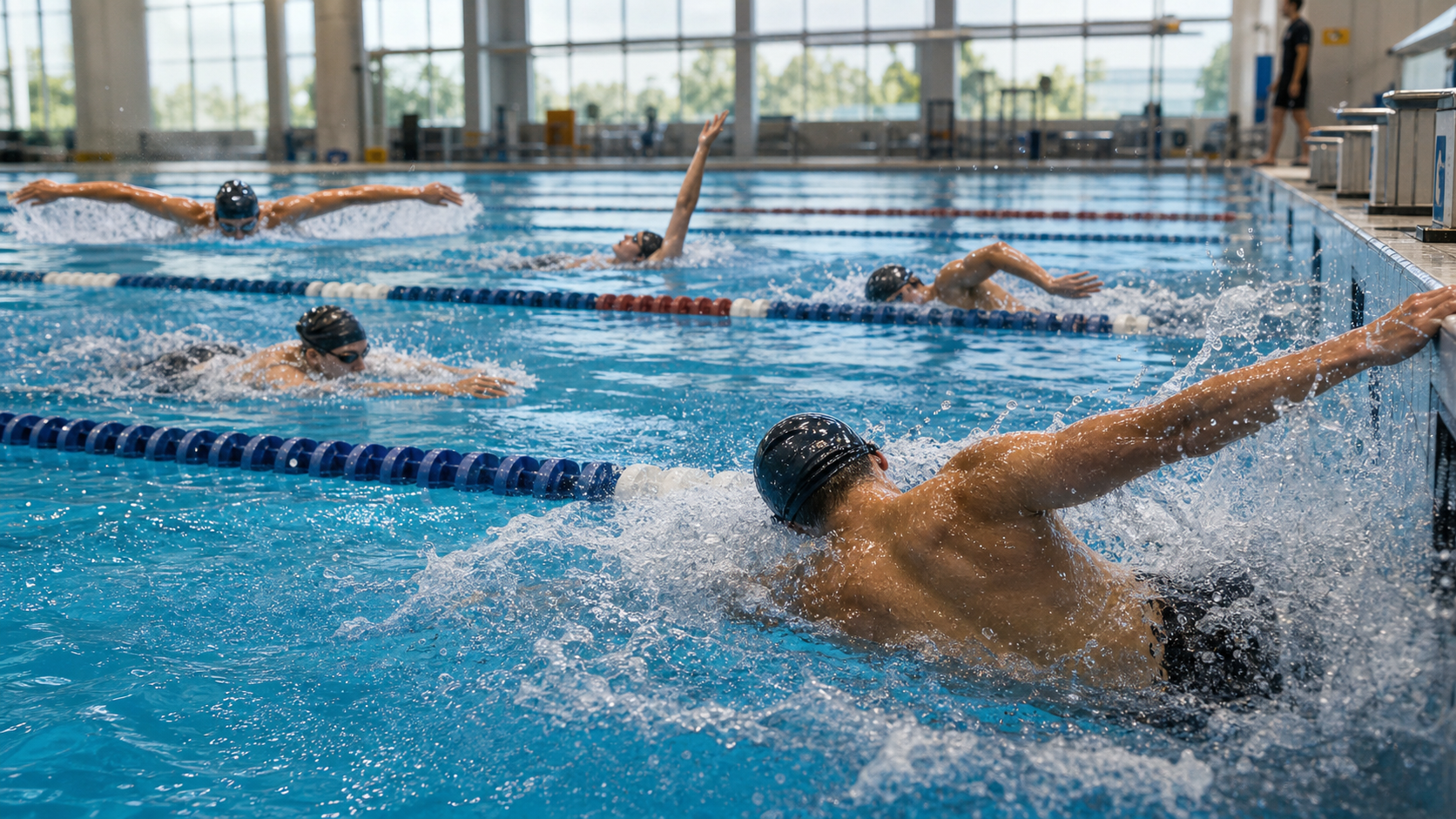
The Individual Medley (IM) requires swimmers to complete butterfly, backstroke, breaststroke, and freestyle in sequence, making it the event with the most comprehensive demands on swimming technique. Even if each stroke’s individual technique is solid, the “transition rhythm” between strokes is often the bottleneck limiting overall performance. This article focuses on coordinated training strategies for swimming all four strokes in rotation, helping swimmers build smooth stroke-switching ability.
The Challenges of Four-Stroke Transitions
The difficulty of stroke transitions is not only technical but also a matter of nervous system adaptation:
- Breathing rhythm reset: The butterfly’s large gulping breaths, the backstroke’s unrestricted breathing, the breaststroke’s head-up breaths, and the freestyle’s side-turning breaths—each stroke has a completely different breathing pattern
- Body position adjustment: Switching from the backstroke’s supine position to the breaststroke’s prone position requires the body to quickly re-establish proper posture after the turn
- Muscle group switching: Each stroke uses different primary muscle groups, requiring rapid activation of the correct muscle combinations during transitions
- Rhythm rebuilding: Each stroke has a different movement frequency and tempo, requiring quick adaptation
Comparison of Technical Characteristics Across the Four Strokes
| Stroke | Primary Propulsion Source | Breathing Method | Body Position | Rhythm Characteristics |
|---|---|---|---|---|
| Butterfly | Upper-body dominant + dolphin kick | Head up, forward | Prone undulation | High intensity, explosive |
| Backstroke | Upper-body dominant + 6-beat kick | Unrestricted breathing | Supine rotation | Steady and continuous |
| Breaststroke | Lower-body dominant (60–70%) | Head up, forward | Prone undulation | Glide-and-kick rhythm |
| Freestyle | Upper-body dominant + flutter kick | Side-turning breath | Prone rotation | Flexible and adjustable |
Key Technical Points for Stroke Transitions
Butterfly → Backstroke Transition
This is the most difficult transition of the four strokes, requiring a flip from the prone to the supine position.
Technical points:
- On the final butterfly stroke, rotate the body 180 degrees to touch the wall
- After touching the wall, push off quickly and use an underwater dolphin kick start
- After surfacing, immediately settle into the backstroke rhythm—don’t let the body “float” too long during the transition phase
Common problems:
- Choosing the wrong direction to roll (competition rules: may roll to either side)
- Head position not adjusted after the roll, with the head tilting too far forward
Backstroke → Breaststroke Transition
The transition from backstroke to breaststroke requires the swimmer to quickly flip to the prone position after touching the wall on the back.
Technical points:
- After the final backstroke arm entry, you may stop stroking and let momentum carry you toward the wall
- After touching the wall, perform a “barrel roll” to flip over and push off
- After pushing off, use an underwater breaststroke leg kick start
Breaststroke → Freestyle Transition
The final transition is relatively easier, as both breaststroke and freestyle are in the prone position, requiring only an adjustment of arm and leg rhythm.
Technical points:
- After the final breaststroke stroke, touch the wall and turn—the turn should be clean and crisp
- After the freestyle start, the pace can gradually increase in preparation for the overall sprint
Four-Stroke Coordinated Training Methods
Method 1: “1+1+1+1” Short-Course Circuit
Swim 25 meters of each stroke—butterfly → backstroke → breaststroke → freestyle—complete one full round, then rest. Repeat for 4–6 sets. This method gives each stroke equal practice volume while training transition fluidity.
Method 2: Reverse-Order Medley
Practice in the order of freestyle → breaststroke → backstroke → butterfly, allowing you to work on the technically demanding butterfly while energy levels are higher.
Method 3: Two-Stroke Specialized Transitions
Select only two strokes to alternate (for example, butterfly → backstroke back and forth), focusing on conquering a specific transition rhythm. This is more targeted than practicing all four at once.
Method 4: “Mental Rehearsal” Training
Before entering the water, mentally rehearse the movement details of each stroke transition (especially the wall-touch and flip sequence), which helps produce more automated movements in the water.
Practical Training Recommendations
- Schedule at least one four-stroke medley training session per week, even if the distance for each stroke is very short
- Focus extra practice on the weakest stroke-transition combinations; there’s no need to complete all four strokes every time
- Use underwater video to record turn movements—turn technique can affect medley performance by 5–10%
- When training the medley, maintain the technical quality of each stroke; don’t sacrifice correct form just to “hurry into the next stroke”
Conclusion
Coordinated training for swimming all four strokes in rotation is the best way to improve overall swimming versatility. It not only strengthens technical diversity but also helps the body adapt to rapid switching between different muscle groups and rhythms. Even if you don’t compete in the medley, regularly practicing four-stroke transitions can help uncover technical weaknesses in each stroke, making it a highly effective self-diagnostic training method.
Related Reading
- Medley Swimming Training: A Weekly Schedule for Practicing All Four Strokes
- Swimming Technique Video Analysis: Using Your Phone to Identify Technical Flaws—Advanced Applications
- Race Strategy for the Medley: Stroke Order and Pacing Distribution
- Medley Swimming Training: Energy Allocation and Technical Challenges for 25m of Each Stroke
[教學] Premiere 影片 手震 修正 教學 防抖 單眼 影像 GoPro 穩定 Video Stabilization
8 年前
西進武嶺 免費訓練分析服務 Intervals | 練不夠還是練過頭?你哪一種類型選手?AI模型告訴你! | 備戰神器 | 公路車 訓練 | CT Yeh
4 年前
如何把 GoPro 影片 翻轉 批次 轉正?
6 年前
西進武嶺 自製新版AI配速表產生器 x 賽前攻略 抱佛腳! 沒有功率計也可以產生配速表嗎?有什麼其他眉角賽前要注意的呢? | 西進武嶺 / 東進武嶺 KOM 攻略 | 公路車 | CT Yeh
4 年前
單車AI教練!全新 ChatGPT4o 幫你分析訓練成果!排武嶺課表,分析騎車姿勢! 太神了! / 公路車 / CT Yeh / feat. 緯緯
2 年前
白沙屯媽祖進香在家走!UREVO 坡度自調走步機 / 可連接訓練遊戲APP MyWhoosh / 邊看直播邊走起來 / CT Yeh
11 個月前
教學) 如何做出專業 慢動作 影片 Slow Motion 120fps GoPro 7 ActionCam AX700 A99II
7 年前
CT 喇低賽) 武嶺牽車 才是王道 西進牽車四小時內秘訣 攝手位置 如何判斷 防抽筋小秘訣
7 年前