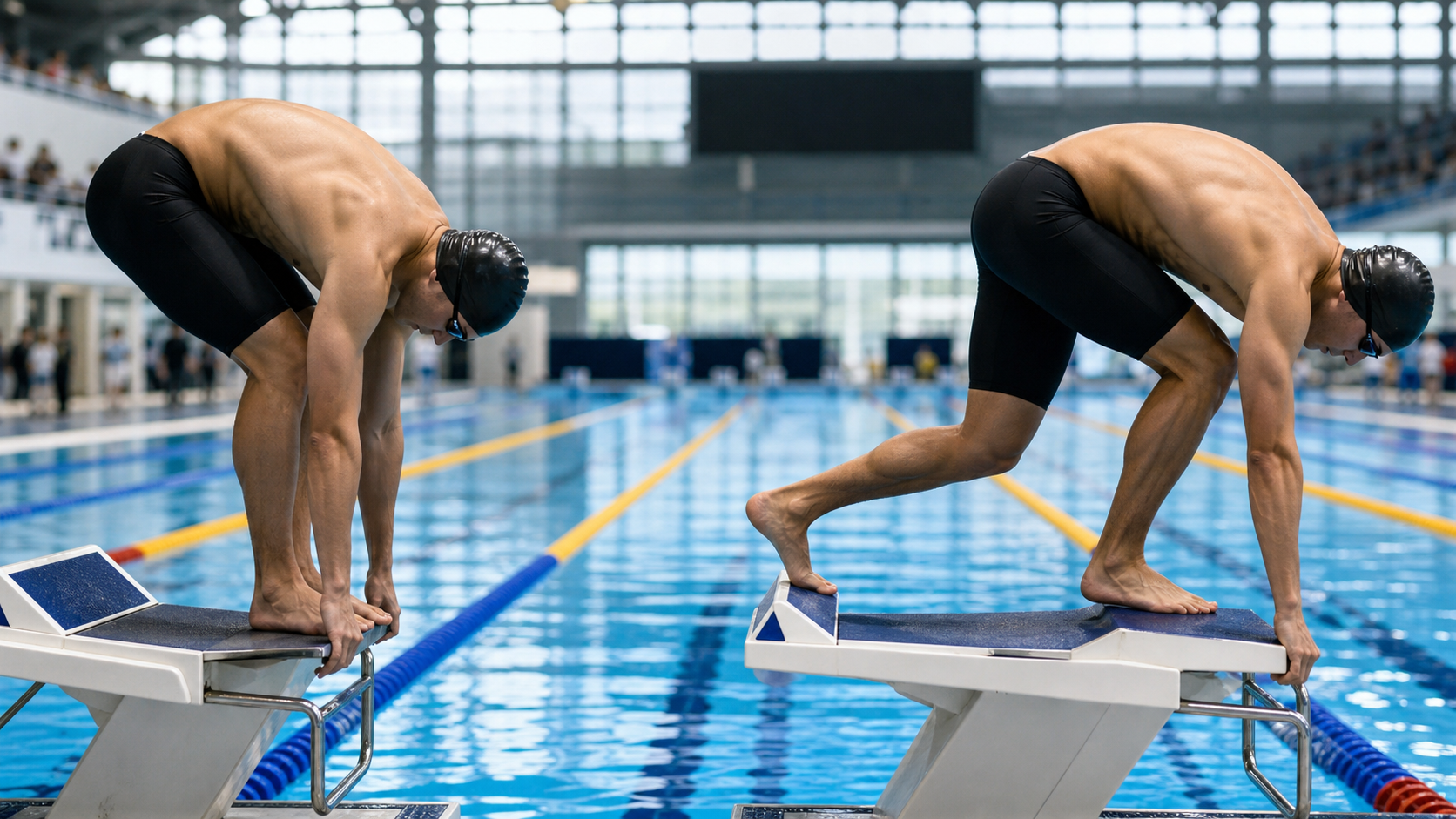
Introduction
In competitive swimming, the quality of the start can directly affect the final result. In the 50m freestyle, differences in starting technique can create a time gap of 0.3–0.5 seconds, which at the world-class competitive level is enough to decide medal outcomes. Currently, two main starting methods are used in competitive swimming: the Grab Start and the Track Start, each with its own advantages and disadvantages.
Basic Introduction to the Two Starting Methods
Grab Start
The grab start is the traditional starting method. The swimmer stands on the starting block with both feet side by side (shoulder-width or slightly narrower), grabs the front edge of the block with both hands, and leans the body forward. Upon hearing the starting signal, both legs extend simultaneously and the body launches forward.
Technical characteristics:
- Both legs generate force simultaneously, concentrating explosive power
- Greater forward lean of the body helps enter the water sooner
- A traditional technique that many swimmers are familiar with
Track Start
The track start (also known as the athletic-style start) is the mainstream choice in modern competitive swimming, especially in sprint events. The swimmer places one foot at the front edge of the block and the other toward the rear (similar to a running starting position), shifting the center of gravity backward. Upon hearing the signal, the front foot pushes off the block and the rear foot follows with force.
Technical characteristics:
- After shifting the center of gravity backward, the counter-pull creates more explosive power off the block
- Requires higher coordination between upper and lower limbs
- Suitable for swimmers with fast reaction times and strong lower-body explosive power
Detailed Comparison of the Two Starting Methods
| Comparison Item | Grab Start | Track Start |
|---|---|---|
| Reaction time off the block | Slightly slower (higher stability) | Slightly faster (better force accumulation) |
| Flight distance | Moderate (approx. 3.0–3.5m) | Longer (approx. 3.3–4.0m) |
| Entry angle | Steeper (approx. 30–35 degrees) | Flatter (approx. 20–30 degrees) |
| Underwater glide distance | Shorter | Longer |
| Technical difficulty | Low | Medium-high |
| Lower-body explosive power requirement | Medium | High |
| Suitable distances | All distances | Best for sprint events (50–100m) |
Complete Technical Flow of the Start
Regardless of the starting method, the complete start process consists of five phases:
1. Setup
Lean the body forward with the center of gravity over the front of the feet (grab start) or over the front foot (track start), engage the core, and control breathing.
2. Reaction
The moment the starting signal sounds, the legs activate. Reaction time typically ranges between 0.6–0.8 seconds and requires extensive practice to shorten.
3. Flight
After pushing off the block, the body flies toward the water in a streamlined position, arms extended forward, chin tucked into the chest, and the back slightly arched.
4. Entry
The hands and head enter the water first, with an entry angle of approximately 20–35 degrees (the smaller the angle, the less splash and the smoother the underwater glide). At the moment of entry, the body must be fully streamlined with the legs pressed together.
5. Underwater Glide and Breakout
After entry, use underwater dolphin kicks or frog kicks to extend the glide, then surface when speed drops close to swimming speed and begin stroking.
The Importance of Entry Angle
The entry angle has a significant impact on start efficiency. If the entry angle is too large (too steep), energy is largely consumed by the impact of entering the water; if the entry angle is too small (too flat), it can cause “slapping” and abdominal impact.
Ideal entry angles:
- Short-distance sprint (50m): approximately 20–25 degrees, maximizing underwater glide distance
- Middle-to-long distance (100m+): approximately 30–35 degrees, surfacing quickly to begin stroking
Training Recommendations
Basic training for practicing starts:
- Repeatedly practice the push-off motion on the starting block (without entering the water) to feel the pushing force and flight posture
- Use “underwater-only” training: after starting, perform only underwater movements without timing the swim, focusing on improving glide posture
Shortening reaction time:
- Practice reacting to sound signals, using a phone stopwatch with a partner to test reaction time
- Improving reaction time requires hundreds of repetitions before results become visible
Correcting entry angle:
- Have a partner record from the side to observe the angle between the body and the water surface at entry
- If the entry angle is too large, try extending the arms more flat during the flight phase (reducing the degree of back arching)
The Specifics of Backstroke Starts
The backstroke start requires taking off from the water and is the only starting method performed in the water. Key technical points include: the feet push off the wall at a position 20–40 cm below the water surface, the body launches in an arc (rather than flat) after takeoff, and immediately after entry, transition into underwater dolphin kicks.
Conclusion
Although starting technique occupies only a small portion of the entire race, it has a significant impact on psychological momentum and rhythm establishment. It is recommended that every swimmer who trains seriously incorporate start practice as a fixed part of their daily routine, performing 5–10 start repetitions before each training session. Over time, noticeable improvements are guaranteed.
Related Reading
CT 喇低賽) 武嶺牽車 才是王道 西進牽車四小時內秘訣 攝手位置 如何判斷 防抽筋小秘訣
7 年前
Live) 備戰2019彰化經典百K 賽前攻略 (已完賽請看新影片
7 年前
戰略) Zwift Race 如何咬在第一集團 如何評估自己要開多少推力 (請開1.5倍速看)
7 年前
滑雪新手們慘摔學習全紀錄(請開字幕),滑雪好好玩 | Snowboard + Ski | 岩原 スキー場 | 滑雪APP使用 | GoPro Max
6 年前
Zwift跨國線上追逐賽 第二站 台灣 TTR vs. 日本 JETT 第二場 (台灣追日本) | 數百位國內外公路車高手,同場較勁 | 多視角賽事直播
4 年前
多機位拍片神器 DJI Action 2 拍出速度張力感 | 類空拍機視角 4陣列麥克風超強降風噪 實測! | 公路車 | CT Yeh
3 年前
首發 Garmin Edge 850 車錶 深入開箱!? / 公路車 / CT Yeh
10 個月前
戀戀197 競賽組 | 50頁投影片心得報告 | 賽後檢討 攻略 #公路車
6 年前