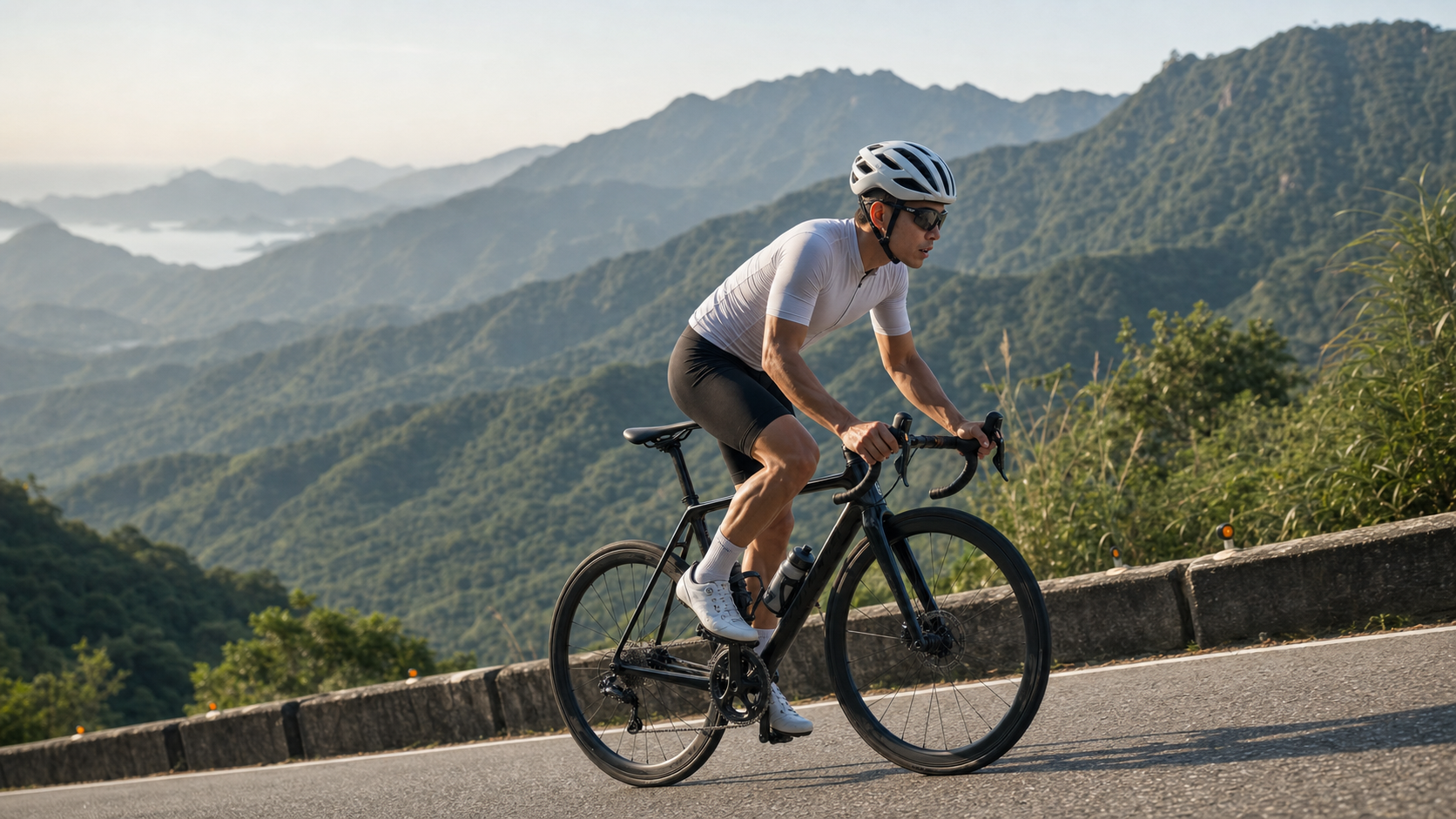
Optimizing Climbing Position: Techniques for Shifting Weight Forward and Core Stability
Introduction
Many cyclists spend a fortune upgrading to lightweight components while overlooking the free “upgrade” that comes from optimizing their position. A proper climbing posture not only boosts pedaling efficiency but also significantly delays fatigue and reduces the risk of injury. This article breaks down the core elements of climbing posture from a biomechanical perspective, with a particular focus on weight management and core stability.
How Your Center of Gravity Shifts When Climbing
Compared to riding on flat ground, the front of the bike is lifted when climbing, naturally creating a rearward-tilting moment. Without proactive adjustment, your center of gravity will sit behind the saddle, leading to:
- A floating front wheel (especially on gradients > 10%)
- Reduced glute activation efficiency (when weight shifts back, the glutes cannot engage effectively)
- Body weight failing to translate into pedaling force
The correct approach: proactively shift your weight forward, keeping your center of gravity directly above or slightly ahead of the pedals.
Specific Techniques for Shifting Weight Forward
Upper Body Adjustments
- Lean slightly forward: Keep your spine in its natural curve and tilt your upper body forward about 5–10 degrees (relative to flat-road position).
- Hand position: Hold the tops or the hook section of the drops, depending on comfort. For most of a climb, riding on the tops allows your back to relax and your chest to open up.
- Arms slightly bent, not locked: Keep your arms elastic to act as shock absorbers for your upper body—do not fully lock out your elbows.
Saddle and Seated Position Adjustments
- Sit on the front third of the saddle: When climbing, actively move your hips toward the front edge of the saddle so the angle between your thighs and the ground is closer to that of flat riding, which helps the glutes and quadriceps work together.
- Keep your pelvis stable: Your pelvis should not rock noticeably side to side—rocking indicates weak core strength or imbalanced pedaling.
- Knees aligned with your toes: Avoid knees tracking outward or inward, as this accelerates knee wear under the high loads of climbing.
The Role of the Core Muscles in Climbing
The core is not just the abs—it includes deep stabilizing muscles such as the transversus abdominis, multifidus, and quadratus lumborum. During a climb, the core’s primary functions are:
| Core Muscle Function | Impact on Climbing | Consequences of Weakness |
|---|---|---|
| Stabilizing the pelvis | Allows pedaling force to transfer effectively | Pelvic rocking, wasted energy |
| Maintaining a neutral spine | Reduces back fatigue | Lower back pain, premature fatigue |
| Connecting upper and lower body | Force transfer during out-of-saddle pedaling | Poor standing efficiency, excessive arm strain |
| Balancing left-right pedaling | Even power output | Uneven leg strength, unstable cadence |
The core is not meant to “brace” but to actively engage in the pedaling process from the correct position. Think of the core as the “bridge” connecting your legs and arms—the more solid the bridge, the more efficient the power transfer.
Practical Drills for Core Activation
Off-Bike Training
- Dead Bug: Lie on your back with your lower back pressed into the floor, alternately extending opposite arm and leg while keeping your lower back down. Do 3 sets × 10 reps to effectively train deep core stability.
- Plank: Basic plank for 30–60 seconds, plus side planks for 20–30 seconds per side to strengthen the transversus abdominis and quadratus lumborum.
- Glute Bridge: Lie on your back with knees bent, lift your hips until your knees, hips, and shoulders form a straight line, strengthening the glutes and lumbar stabilizers.
On-Bike Core Activation Cues
- While climbing, silently repeat “pull your navel inward” to help activate the transversus abdominis.
- Imagine your ribs pressing downward without flaring outward to maintain thoracic stability.
- Feel both sit bones pressing evenly into the saddle, without favoring one side.
Common Climbing Posture Mistakes
- Excessive head droop: Staring at the front wheel instead of ahead causes excessive tension in the back of the neck and prevents you from reading the road. Keep your gaze 5–10 meters ahead.
- Shrugged shoulders: When tense or fatigued, the shoulders naturally creep upward, greatly increasing neck and shoulder fatigue. Consciously drop your shoulders once every 10–15 minutes.
- Stiff ankles: Locking the ankles completely during a climb reduces the smooth arc of the pedal stroke. Keep a slight dynamic flexibility in the ankles, pressing the heel gently down at the bottom of the stroke.
- Pulling too hard on the bars: Forcefully pulling upward on the handlebar causes excessive arm and shoulder fatigue and makes the bike sway front to back. Pulling on the bars is for stability, not for extra power.
Training Recommendations
- Do 10–15 minutes of core training 2–3 times per week, scheduled after climbing training days (not before, to avoid compromising riding performance).
- Film yourself climbing: Have a friend film you from the side while you climb, then compare against the posture points in this article to identify what needs correcting.
- Ride with deliberate posture: For the first 10 minutes of every climb, consciously execute all the posture cues so that correct form gradually becomes muscle memory.
Conclusion
Posture optimization is a zero-cost performance upgrade. A proper climbing position not only makes you faster but also allows you to ride longer and more comfortably. It’s recommended to re-evaluate your climbing posture every few months—especially since form tends to deteriorate most in the late stages of fatigue, which is precisely when maintaining efficiency matters most.
Related Reading
- Descending Technique After a Climb: Transitioning Weight Shift and Brake Timing
- MTB Climbing: Switching Between Seated and Standing Positions and Mastering Pedal Rhythm
- Advanced Climbing Technique: When to Switch Seated/Standing, Cadence and Breathing Coordination, and Gear Change Timing
- The Complete Guide to Road Bike Climbing Technique: Conquer Every Mountain with Ease
#公路車 #Fitting 靠人工智慧APP 幫你調整單車
6 年前
[教學] Premiere 影片 手震 修正 教學 防抖 單眼 影像 GoPro 穩定 Video Stabilization
8 年前
一日北高/長距離團騎 常見問題補充篇 / 組團或跟團的眉角 / 壯車友容易被瘦車友慢性拉爆 / 原來屁股痛可能是這個原因...? / 風場配速法 / 公路車 / CT Yeh
2 年前
西進武嶺 自製新版AI配速表產生器 x 賽前攻略 抱佛腳! 沒有功率計也可以產生配速表嗎?有什麼其他眉角賽前要注意的呢? | 西進武嶺 / 東進武嶺 KOM 攻略 | 公路車 | CT Yeh
4 年前
公路車 爬坡 破PR 紀錄 小技巧 分享
6 年前
CT 喇低賽) 武嶺牽車 才是王道 西進牽車四小時內秘訣 攝手位置 如何判斷 防抽筋小秘訣
7 年前
Insta 360 One 超級防手震技術實測
7 年前
單車 梅山36灣 坡度介紹 路段介紹 空拍 (相關遊記影片,請參考說明或我的頻道喔,歡迎訂閱)
6 年前