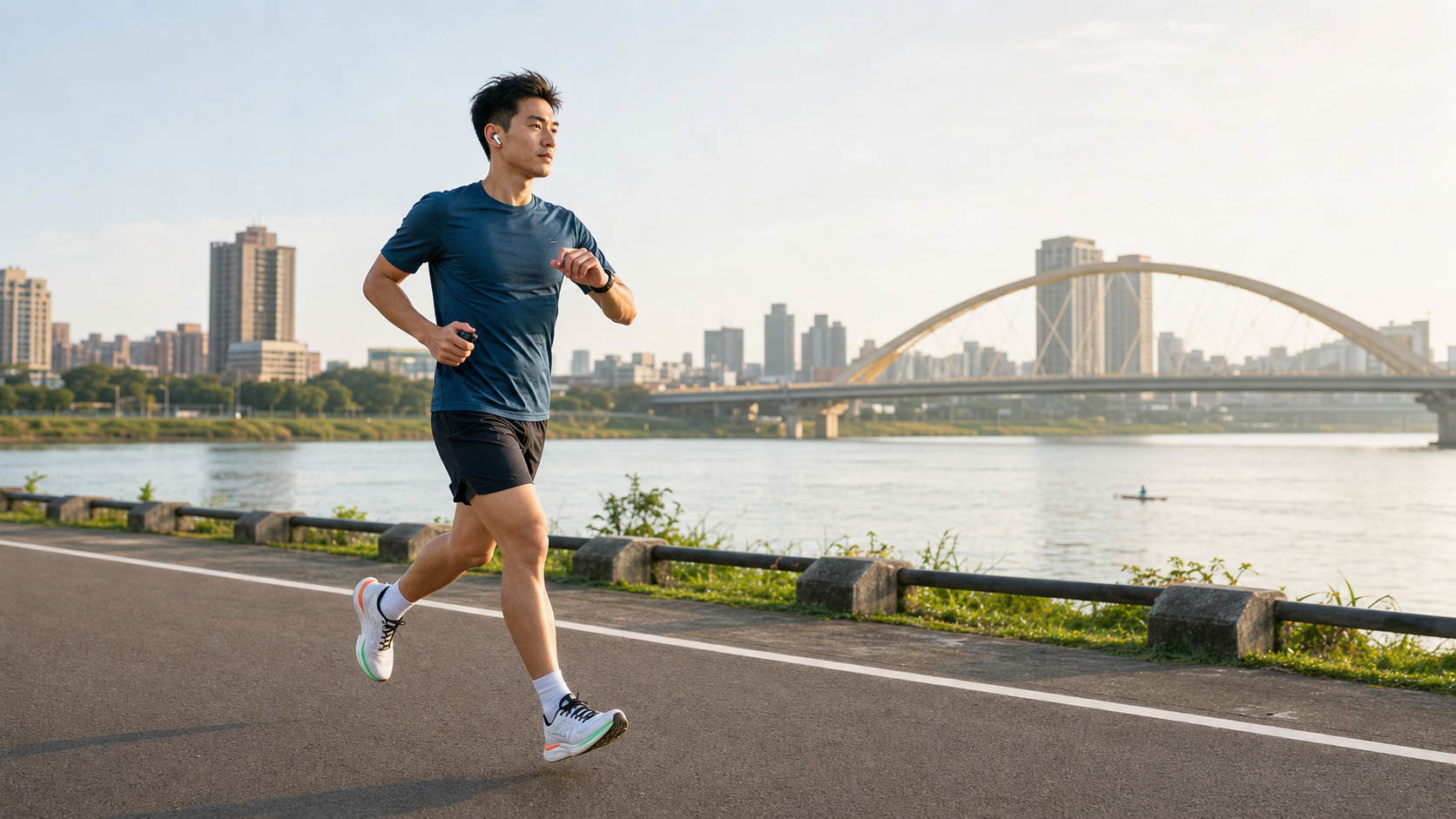
180spm Cadence: Myth or Science?
The number “180 steps per minute (spm)” for running cadence was first proposed by Coach Jack Daniels during his study of elite runners at the 1984 Los Angeles Olympics. He observed that nearly all top distance runners maintained a cadence above 180 spm. Since then, this number has become the widely circulated “golden cadence” target in the running community.
But does it apply to everyone?
Research shows:
- The natural cadence of general runners typically falls between 155–170 spm
- Increasing cadence by 10% (about 10–15 steps/min) can significantly improve running efficiency and reduce injury risk
- Cadence targets vary by individual: a tall runner at 185cm may have an optimal cadence of 170–175, while a runner at 160cm might be 180–185
Why Is a Higher Cadence More Efficient?
The biomechanical changes brought by increased cadence include:
- Shorter stride length, with the foot landing closer to the center of mass: reduces over-striding and lowers braking force
- Shorter ground contact time: less contact time with the ground per step, reducing ground impact forces by approximately 15–30%
- Increased knee flexion angle: more natural shock absorption, lowering the risk of knee injuries
- Improved hip extension angle: stronger posterior push-off, enhancing propulsion efficiency
Experimental research (Chumanov et al., 2012) showed that a 10% increase in cadence reduced patellofemoral joint (front of knee) loading by 16% and gluteus medius loading by 9%.
How to Measure Your Own Cadence?
Method 1: Manual Counting
Run for 30 seconds, count only the times your right (or left) foot lands, then multiply by 4 to get your spm.
Method 2: GPS Watch
Running watches from brands like Garmin, Suunto, and COROS all feature cadence monitoring, displaying real-time spm directly.
Method 3: Running Apps
Nike Run Club and Strava (paid version) both provide cadence data.
Metronome Training Method: Gradually Increasing Cadence
Forcing yourself straight to 180 spm often causes physical discomfort. The correct approach is progressive improvement.
Tool Recommendations
- Metronome Apps: Metronome Beats, Pro Metronome (free downloads)
- Music Beats: Choose music with BPM matching your target cadence (search for “180 BPM running playlist” on Spotify)
- Watch Vibration: Some Garmin watches can set a cadence target and alert you via vibration
Progressive Improvement Plan (6 Weeks)
| Week | Target Cadence | Training Method | Duration |
|---|---|---|---|
| Week 1 | Current +2–3 spm | Turn on metronome during easy runs | 10 minutes per session |
| Week 2 | Current +4–5 spm | Easy runs, metronome for 20 minutes | 20 minutes |
| Week 3 | Current +6–8 spm | Entire easy run + 1 Fartlek session | Entire run |
| Week 4 | Current +8–10 spm | All intensity workouts | Entire session |
| Weeks 5–6 | Maintain target cadence | Consolidate, remove metronome dependence | Entire session |
Important Note: Your speed will temporarily drop in the early stages of increasing cadence—this is normal. Your body needs 3–6 weeks to adapt to the new neuromuscular pattern.
Five Supplementary Cadence Training Drills
In addition to running with a metronome, the following supplementary drills can accelerate cadence improvement:
- High-Cadence Marching in Place: Stand still and take quick, small steps at 180 spm to feel the target rhythm, 30–60 seconds per set, 5 sets
- Short Hill Sprints: Uphill running forces a shorter stride and higher cadence, 100m × 8 sets
- Butt Kicks: Actively kick your heels toward your glutes to increase leg turnover speed, 20–30m × 4 sets
- High Knees: While moving forward, drive your knees up quickly to strengthen hip flexor power, 20–30m × 4 sets
- Ankling Drills: Bounce forward using only your ankles without engaging the knees, training quick ground-contact reflexes, 20m × 3 sets
Common Questions About Increasing Cadence
Q: My speed hasn’t improved after increasing cadence—is that normal?
Completely normal. The purpose of increasing cadence in the early stages is not to go faster, but to improve technical efficiency. As your body adapts, your speed at the same heart rate will naturally increase.
Q: Is a higher cadence always better?
No. Increasing cadence should be paired with a reasonable stride length. The goal is to maintain a high cadence in a naturally relaxed state, not to deliberately step frantically. Excessively high cadence (above 200 spm) often comes with an overly short stride, and efficiency actually declines.
Q: Do I need to maintain 180 spm during easy jogs?
During easy jogs, your cadence can be slightly lower (170–175 spm), but you should avoid dropping below 165 spm. The key is to avoid a long-stride, over-striding running style regardless of speed.
Conclusion
Cadence is the most easily improvable yet most often overlooked running technique metric. Compared to outcome metrics like pace and heart rate, cadence is a “process metric” you can actively control. Next time you run, open a metronome app, set it 5 spm higher than your current cadence, and feel that lighter, quicker ground-contact running sensation—that is the starting point of efficiency gains.
Related Reading
- Cadence Optimization: Why Is 180spm the Ideal Target?
- Is 180spm Cadence the Gold Standard? The Scientific Debate on Running Cadence and Stride Length
- The Science of Road Running Cadence: The 180spm Myth and Your Optimal Cadence
- Running Cadence Improvement Training: An 8-Week Adaptation Plan from 165spm to 180spm
西進武嶺 免費訓練分析服務 Intervals | 練不夠還是練過頭?你哪一種類型選手?AI模型告訴你! | 備戰神器 | 公路車 訓練 | CT Yeh
4 年前
#公路車 #Fitting 靠人工智慧APP 幫你調整單車
6 年前
白沙屯媽祖進香在家走!UREVO 坡度自調走步機 / 可連接訓練遊戲APP MyWhoosh / 邊看直播邊走起來 / CT Yeh
11 個月前
實景訓練台) 彰化經典百K 高強度喵團 90分鐘 跟著一起練功 2019 Indoor workout Changhua Classic 100 Taiwan
7 年前
Live) 備戰2019彰化經典百K 賽前攻略 (已完賽請看新影片
7 年前
[教學] Premiere 影片 手震 修正 教學 防抖 單眼 影像 GoPro 穩定 Video Stabilization
8 年前
教學) 如何做出專業 慢動作 影片 Slow Motion 120fps GoPro 7 ActionCam AX700 A99II
7 年前
大家都在開箱的...單車用藍芽對講耳機真的有幫助嗎? SENA BiKom 20 長距離旅遊 & 海鷗繞圈賽 實際體驗心得 / 公路車 / CT Yeh
9 個月前