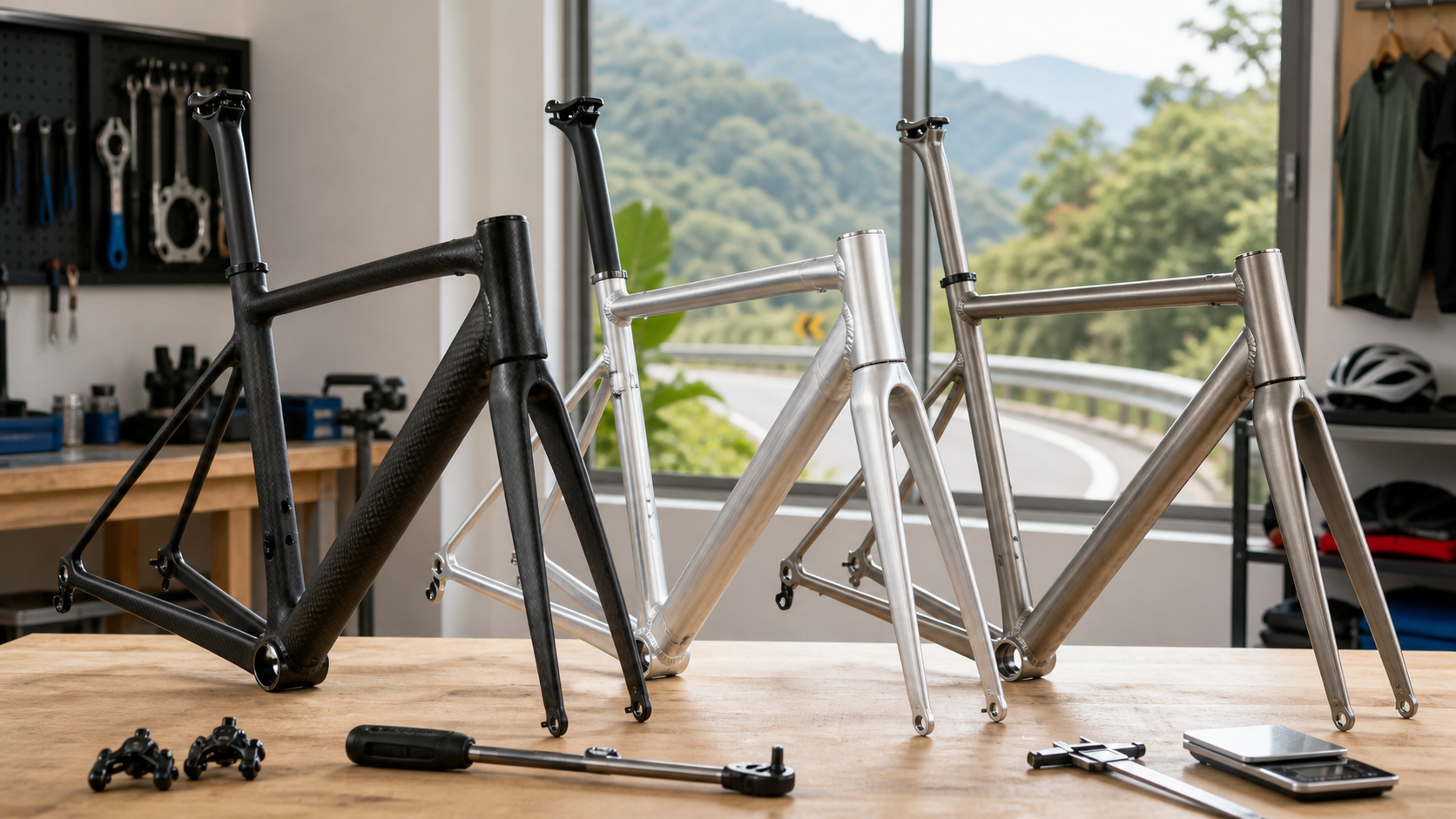
Road Bike Frame Materials Compared: Carbon Fiber vs. Aluminum vs. Titanium Buying Guide
When choosing a road bike, frame material is usually the first big decision. Walk into any bike shop and you’ll find the same model offered in carbon fiber, aluminum alloy, and sometimes even titanium, with the price difference ranging from tens of thousands to hundreds of thousands of NT dollars. This article gives you a systematic look at all three materials so you can make a purchase you won’t regret.
Core Characteristics at a Glance
| Material | Weight (complete frame) | Vibration Damping | Durability | Reference Price Range (NTD) |
|---|---|---|---|---|
| Carbon Fiber | 700g–1,100g | Excellent | Avoid impacts | 25,000–200,000+ |
| Aluminum Alloy | 1,100g–1,600g | Moderate | Excellent | 8,000–40,000 |
| Titanium | 900g–1,300g | Excellent | Outstanding | 60,000–200,000+ |
Carbon Fiber Frames: The Speed-First Choice
Carbon Fiber Reinforced Polymer (CFRP) is currently the mainstream material for competitive road bikes. Its biggest advantage is “designability” — engineers can adjust fiber orientation and layup count at different points on the frame, giving it both longitudinal stiffness (pedaling efficiency) and lateral compliance (ride comfort) at the same time.
Carbon fiber suits riders who:
- Race in road events or time trials
- Chase ultralight weight for climbs like Wuling or Taipingshan
- Have a generous budget and are willing to invest in frame protection film
- Can accept stricter maintenance and transport requirements
Potential risks of carbon fiber: After an impact, internal cracks that are invisible to the naked eye can form. It’s recommended to have regular ultrasonic or tap-tone inspections done annually, and especially after any crash. Taiwan’s humid climate also means moisture infiltration at the joints deserves attention.
Aluminum Alloy Frames: King of Value for Money
6061 and 7005 aluminum alloys are the two most common grades. 7005 offers slightly higher strength and lower weight and is common in higher-end aluminum frames; 6061 is easier to machine and weld, making it the workhorse of the entry- to mid-level market.
Three key advantages of aluminum alloy:
- Repair-friendly: Aluminum welding shops are everywhere in Taiwan, so if a frame is damaged, repair costs are far lower than with carbon fiber.
- Impact and crash resistant: For daily commuting, entry-level climbing, or long-distance touring, aluminum handles rough, everyday use much better.
- Affordable pricing: Under NT$30,000 gets you an entry-level road bike with sensible geometry and a full component group.
Downsides of aluminum alloy: Compared with carbon fiber, aluminum has poorer vibration damping, so wrist and hip fatigue becomes more noticeable on long rides. Pairing it with a carbon fork, a quality saddle, and good bar tape can meaningfully improve ride comfort, however.
Titanium Frames: An Investment for a Lifelong Companion
Titanium (Ti 3Al-2.5V or Ti 6Al-4V) is the most underrated frame material. It combines the light weight of carbon fiber with the durability of aluminum, and its natural corrosion resistance means it needs no surface coating at all — many riders simply ride it in its lustrous raw metal finish.
Reasons to choose titanium:
- You plan to ride the same bike for twenty years or more
- You often ride near the coast or in salty air environments (far more corrosion-resistant than aluminum)
- You value the metallic vibration-absorbing ride quality often called “titanium feel”
- You can accept a higher one-time purchase cost
Titanium welding is an extremely complex process that must be done in an inert gas environment, so there are relatively few manufacturers worldwide capable of building high-quality titanium frames. In Taiwan’s market, custom frames from European and American brands dominate, and lead times often run three to six months.
Practical Buying Advice
Budget under NT$30,000: Choose aluminum alloy paired with a carbon fork for the best value combination. The Merida Scultura 400 and the Giant Contend series are popular choices in Taiwan.
Budget NT$50,000–150,000: An entry-level carbon fiber frame is the biggest upgrade at this price point. Choose a well-known brand (such as the Trek Émonda AL5 or Specialized Allez Sprint) rather than an unbranded low-cost carbon frame, as quality control varies enormously.
Budget over NT$150,000: High-end carbon fiber (T700/T800-grade carbon or better) or a custom titanium frame are both excellent choices, depending on your riding style — go carbon fiber if you’re race-oriented, or titanium if you prioritize long-distance touring and durability.
Conclusion
There’s no absolute “best” frame material — only the one that’s best for you. A beginner on a limited budget can take on Wuling, the Beigao route, or the Lanyang River bike path perfectly well on an aluminum road bike. Performance-focused riders will genuinely feel carbon fiber’s weight advantage on long climbs. And anyone planning to buy just one bike for life will find titanium’s permanent durability well worth the long-term investment. Decide on your riding goals before you buy, and the choice of frame material will fall into place naturally.
Related Reading
- Carbon Fiber vs. Aluminum vs. Titanium Frames: The Complete 2025 Material Buying Guide
- In-Depth Bicycle Frame Material Comparison: Aluminum vs. Carbon Fiber vs. Titanium — Ride Feel, Weight, and Long-Term Investment Analysis
- The Ultimate Road Bike Frame Material Comparison: Aluminum, Carbon, Steel, and Titanium
- Complete Frame Material Comparison: Carbon Fiber, Aluminum, Titanium, and Steel Characteristics and Who They Suit
多到選擇障礙... 換個單車把帶想一個小時 / BTP / 編織&軟木特有材質超吸睛! / 公路車 / CT Yeh
1 年前
換車囉! TIME ADH 2023 全內線碟煞公路車 開箱實錄!/ Dyneema 碳纖維真的太猛了 / 曜越單車 / CT Yeh
3 年前
碟煞公路車 優缺點?換車一年半實際經驗分享 / 公路車 / CT Yeh
2 年前
Lun HYPER 第三代 D45碳幅條輪組 功率對比實測 / 鈦合金行星齒輪,中高階的製造水準 / 公路車 / CT Yeh
1 年前
再一組! 全碳幅條 碟煞/無內胎輪組 開箱! 到底好騎嗎? UNAAS X40 | 公路車 | CT Yeh
4 年前
Unaas X50 全碳纖幅條輪 數據實測對比PK | Lun Hyper 的高階版 | 板輪爬坡也可以很厲害? ! 武嶺2小時大師一起親測! CP值超高 | 公路車 | CT Yeh
4 年前
碟煞公路車 銑面器 !? 原來銑完差這麼多! 降低蹭碟機率! | TIME 公路車 保養小記錄 | CT Yeh
3 年前
公路車 BB培林大升級! / 備戰海鷗繞圈賽 Canyon Aerod & TIME 一起改 / MIT大廠 CEMA對鎖式陶瓷培林BB & 導輪 / 公路車 / CT Yeh
2 年前