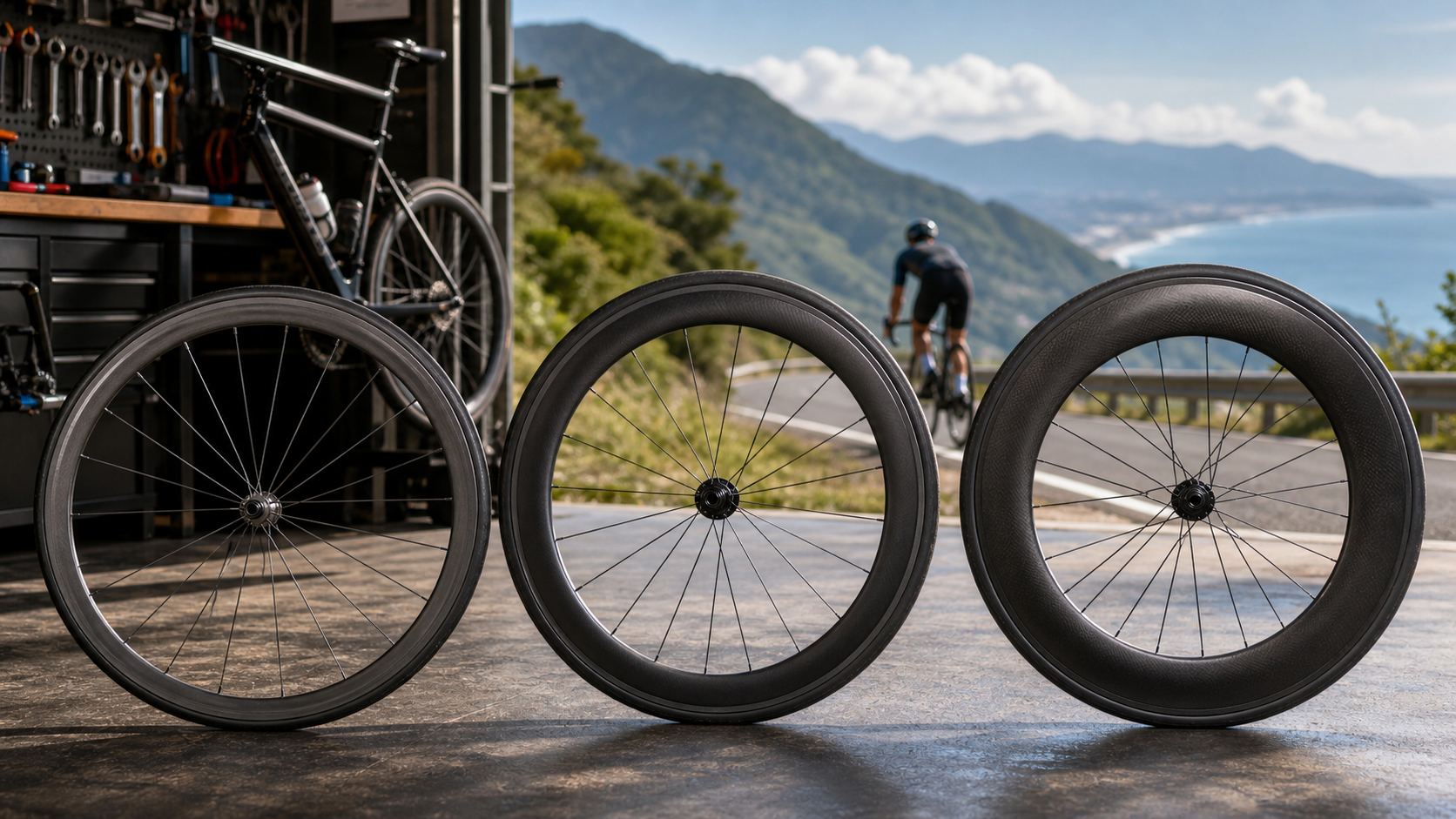
Wheelset Upgrade Guide: Climbing Wheels vs. Time Trial Wheels vs. All-Round Wheels – How to Choose
If you only have one budget to upgrade your road bike, almost every shop owner will tell you: get new wheels. Wheels directly affect rolling resistance, rotational inertia, crosswind stability, and overall weight, and the change in ride feel is far more immediate than upgrading groupsets or frames. But the wheels on the market are incredibly varied—climbing wheels, time trial wheels, and all-round wheels are designed with completely different logic. This article will walk you through each one.
Rim Height and Purpose Comparison Table
| Rim Height | Type | Primary Use | Crosswind Stability |
|---|---|---|---|
| 21–32mm | Climbing Wheels | Mountain roads, long climbs, lightweight | Best |
| 38–50mm | All-Round Wheels | Mixed flats + light climbs | Good |
| 55–65mm | Aero Wheels | Flat-road racing, time trials | Requires skill |
| 80mm+ / Disc | Time Trial/Triathlon | Time trials, triathlon T2 | Poor |
Climbing Wheels: The Perfect Partner for Wuling and Taipingshan
The core logic of climbing wheels is “light.” Every 100g saved in rotational weight delivers far greater climbing benefits than static weight, because rotational inertia requires more energy to maintain and accelerate.
Key parameters for climbing wheels:
- Weight: A combined front-and-rear weight of 1,200–1,400g is the entry threshold; top-tier climbing wheels can go below 1,100g
- Rim height: 21–32mm is the mainstream—the lower the rim, the smaller the aerodynamic drag and the better the crosswind control
- Spoke count: Sparse spoke designs like 16F/21R or fewer further reduce weight
Scenarios suited to Taiwan:
- Long climbs such as Wuling and Hehuan Mountain (continuous elevation gain of 2,000m+)
- Northern mountain roads like Beiyi and Beiheng
- Participating in climbing challenges or hill climb races (KOM)
Brands worth considering (commonly available in the Taiwan market):
- Zipp 202 Firecrest, 303 Firecrest
- Lightweight Meilenstein (top-tier, requires a generous budget)
- Fulcrum Racing Zero Carbon
- Custom-built wheels (using Sapim CX-Ray spokes + lightweight hubs)
Time Trial Wheels: The Extreme Design for Pure Speed
Time trial wheels (including 80mm deep-section rims and disc wheels) are designed for “completing a fixed distance in the shortest time possible,” with no regard for climbing weight—only the lowest aerodynamic drag.
Prerequisites for using time trial wheels:
- Average speed must exceed 35km/h for the aero benefits to become apparent
- Suitable for flat time trials or the bike leg of a triathlon
- Taiwan road conditions: flat sections of the western longitudinal highways, provincial roads from Tainan to Kaohsiung
Crosswinds are the biggest risk: Deep-section rims produce noticeable drift when crosswinds exceed 20km/h. Beginners using deep-section rims on Taiwan’s mountain roads or coastal highways (such as the Suhua Highway) need to be especially cautious. The East Rift Valley roads in Taitung also require extra attention during the northeast monsoon season.
All-Round Wheels: The Smartest Everyday Choice
For most Taiwanese riders, 38–50mm all-round wheels are the most rational choice. They balance aero advantages with crosswind stability, and the weight penalty on climbs isn’t too severe.
The ideal user for all-round wheels:
- Riders whose routes mix mountains and flats (such as island tours or regular training plans)
- Riders unsure of which terrain they’ll primarily ride in the future
- Riders with a limited budget who can only buy one set of wheels
Pay attention to tire compatibility: Modern all-round wheels almost always come in one of three options—tubular, clincher, or tubeless ready. It’s recommended to choose a model that supports tubeless—many Taiwanese riders have already switched to tubeless systems, and in practice, flat rates have dropped significantly.
Three Key Steps for Buying
Step 1: Confirm your primary riding terrain
- Climbs make up 60% or more → Climbing wheels (rims under 25mm)
- Flats make up 60% or more → All-round wheels (38–50mm)
- Dedicated time trial or triathlon → Time trial wheels (60mm+)
Step 2: Confirm hub specifications
- Disc brake frames: confirm rotor specs (CL center lock vs. 6-bolt)
- Rim brake frames: confirm rim material (carbon fiber requires carbon-specific brake pads)
- Confirm rear hub spacing (130mm old standard vs. 135/142mm current standard)
Step 3: Test and calculate tire pressure
- Body weight + gear weight × 0.0068 ≈ recommended minimum front tire pressure (bar)
- Tubeless systems typically run 0.3–0.5bar lower than traditional systems, improving comfort
Conclusion
Wheelset upgrades are the highest-value investment in road bike modifications, but “the most expensive wheels” don’t equal “the wheels best suited to you.” Taiwan’s terrain is highly varied, from plains to 3,000-meter mountains. When choosing wheels, put the routes you ride most often as your top priority. If your budget allows, owning two sets of wheels (one climbing, one all-round) is the most cost-effective setup in the long run.
Related Reading
- The Complete Road Bike Wheelset Upgrade Guide: Aluminum vs. Carbon Rims, Tubular vs. Tubeless
- Bicycle Wheelset Upgrade Benefit Analysis: The Art of Trade-offs Between Deep Rims, Weight, and Drag
- 2026 Road Bike Wheelset Upgrade Guide: Practical Choices for Aluminum, Carbon, and Rim Depth
- The Complete Road Bike Wheelset Upgrade Guide: Aluminum vs. Carbon Wheelset Comparison
Unaas X50 全碳纖幅條輪 數據實測對比PK | Lun Hyper 的高階版 | 板輪爬坡也可以很厲害? ! 武嶺2小時大師一起親測! CP值超高 | 公路車 | CT Yeh
4 年前
再一組! 全碳幅條 碟煞/無內胎輪組 開箱! 到底好騎嗎? UNAAS X40 | 公路車 | CT Yeh
4 年前
鉅齒紋輪組!? ControlTech MEG-T50 EVO 碳纖維幅條輪組/ 功率對比實驗 / 公路車 / CT Yeh
2 年前
Nepest NOVA 碳條輪組:輕量、空力、舒適一次滿足!/ 公路車 / CT Yeh
7 個月前
Vision Metron RS 37碳幅條輪組 (非SL)官網沒有的 低調開箱 / 這重量太銷魂了 / 公路車 / CT Yeh
6 個月前
首發!LUN HYPER 第五代 2025最新版 碳幅條x鈦合金 輪組 D40 開箱 / 居然開始捲高端輪組了 / 公路車 / CT Yeh
11 個月前
公路車 BB培林大升級! / 備戰海鷗繞圈賽 Canyon Aerod & TIME 一起改 / MIT大廠 CEMA對鎖式陶瓷培林BB & 導輪 / 公路車 / CT Yeh
2 年前
來都來了!改好改滿 / CS大導輪 + BB 可以省幾瓦? / 同場加映 TIME XPRO卡踏 / #公路車 #ceramicspeed / CT Yeh
1 年前