Power Meter Buying Guide: Pedal vs. Crank vs. Hub – Accuracy and Cost Comparison
Power meters are the most important data tool in modern cycling training. Compared with heart-rate training, the advantage of power training lies in “real-time feedback”—your physical condition (fatigue, weather, caffeine) does not affect the power numbers; they truly reflect the work you are producing. But with so many types of power meters available, choosing the right one for your needs is a question every rider preparing to upgrade their training tools must face.
Core Comparison of the Three Mounting Types
| Type | Representative Products | Accuracy (Rated) | Taiwan Price (Reference) | Installation Difficulty | Portability |
|---|---|---|---|---|---|
| Pedal | Garmin Rally, Favero Assioma | ±1–2% | NT$12,000–30,000 | Low (swap pedals) | Best |
| Crank | Stages, Rotor Inpower, 4iiii | ±1–2% | NT$8,000–35,000 | Medium | Medium |
| Hub | PowerTap G3 | ±1.5% | NT$18,000–35,000 | High (replace wheelset) | Low |
Pedal-Based Power Meters: The Smart Choice with the Best Value
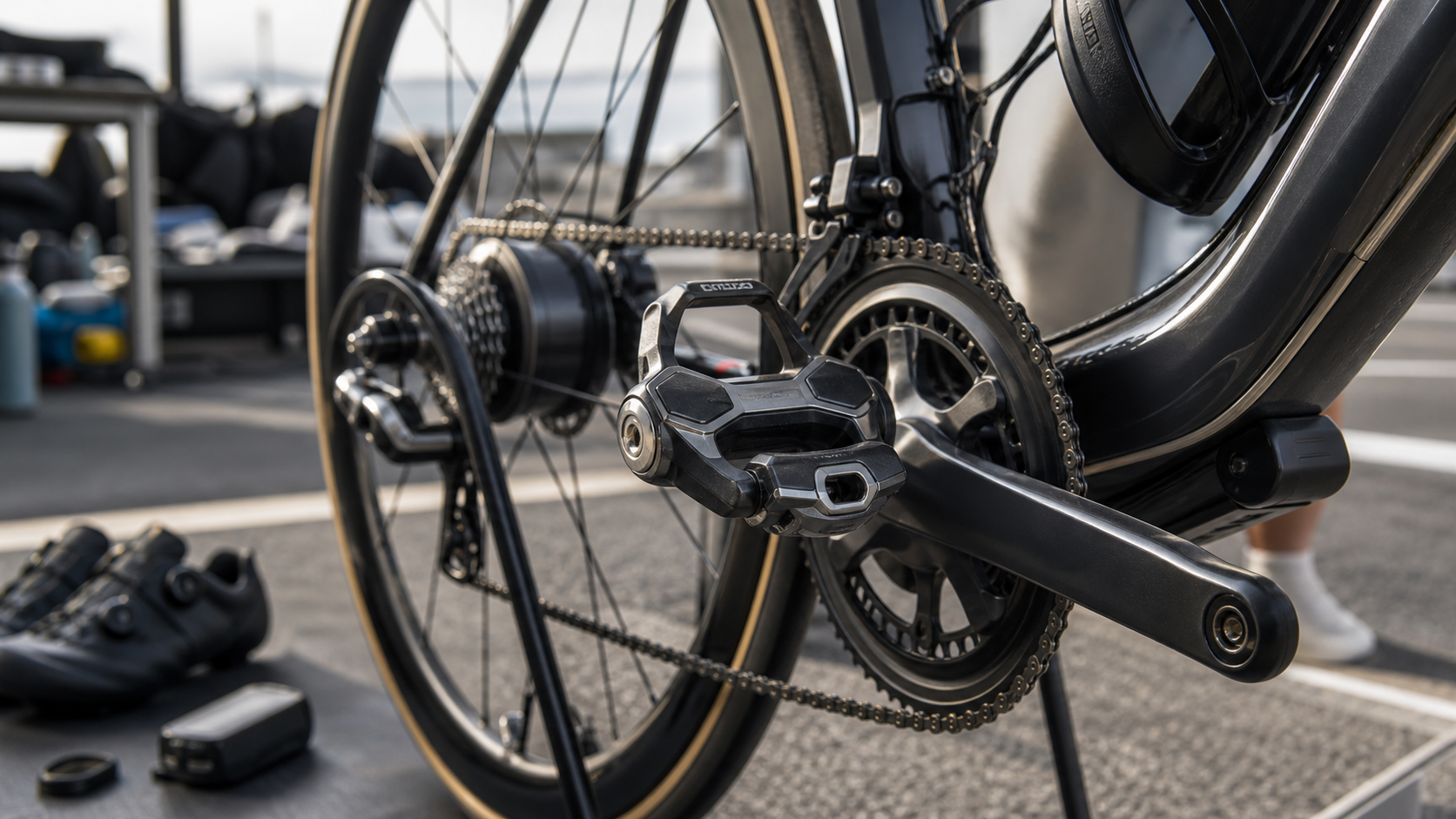
Pedal-based power meters (such as the Garmin Rally 100/200 series and Favero Assioma Duo) have become the most popular type of power meter in recent years, for a simple reason: installation is done by swapping pedals, and sharing across multiple bikes is easiest.
Three major advantages of pedal-based power meters:
- Multi-bike use: If you ride both a road bike and a time-trial bike, or lend your bike to teammates for training, you only need to move the pedals from one bike to another—installation takes no more than 5 minutes.
- Dual-leg power balance measurement: Most pedal-based power meters provide independent left/right leg measurement, allowing you to detect imbalances between legs—extremely valuable for post-injury rehabilitation or position adjustments.
- Zero technical barrier for installation: All you need is a 15mm pedal wrench; anyone can install them.
Pedal-based considerations: Different cleat systems require the corresponding pedal-based power meter (for example, if you use the Look Kéo system, choose the Garmin Rally 100; if you use Shimano SPD-SL, choose the Rally 200). If you plan to switch cleat systems, the power meter must be switched as well.
Entry-level recommendation: Favero Assioma Uno (single pedal, approx. NT$12,000), ±1% accuracy, rechargeable battery design—currently one of the highest-value pedal-based power meters on the market.
Crank-Based Power Meters: Measurement Closest to the Power Source
Crank-based power meters are installed on the crank arm and are currently the most diverse type on the market, ranging from entry-level single-crank left-leg models (Stages Power L) to high-accuracy dual-crank models with independent left/right measurement (Rotor Inpower Duo).
Accuracy advantage of crank-based meters: The crank is closer to the transmission point of the body’s power output than the pedal, theoretically introducing fewer interference factors. For riders using special cleat systems (such as Speedplay) or who frequently change shoes, crank-based meters are the best alternative to pedal-based ones.
Single-crank vs. dual-crank choice:
- Single-crank (e.g., Stages Power L): Measures only the left leg, assuming left/right leg strength is symmetrical; lowest price (approx. NT$8,000). Suitable for entry-level training, but if your legs are imbalanced, the data will contain systematic error.
- Dual-crank: Measures left and right legs separately, higher accuracy, priced from at least NT$15,000. Worth the investment for serious training or riders with left/right imbalances.
Compatibility risk: Crank-based power meters must match the frame’s BB (Bottom Bracket) specification. Common BB standards in the Taiwan market include BSA (threaded), Press Fit BB86/92, BB30, and others. Be sure to confirm your frame’s BB specification before purchasing.
Hub-Based Power Meters: An Aging Technology Being Phased Out
Hub-based power meters represented by the PowerTap G3 were once the market mainstream, but in recent years they have gradually been replaced by pedal- and crank-based models. The main reason is the limitation of being tied to a specific wheelset—you must manually re-lace the power meter hub to a new set of spokes to move it to another wheelset, making both cost and time impractical.
Remaining advantage of hub-based meters: Measurement is unaffected by pedaling motion (power is measured at the final delivery point to the hub), theoretically making it the measurement point closest to “actual driving force,” suitable for calibrating other types of power meters.
Practical advice: Unless you find an exceptionally good deal on the second-hand market, buying a new hub-based power meter is not a mainstream choice.
Key Checklist Before Purchase
Pedal-based:
- Which cleat system are you currently using (Look / SPD-SL / Speedplay)?
- Do you need to use it across multiple bikes?
Crank-based:
- Frame BB specification (BSA / BB86 / BB30 / PF30)?
- Current crank length (170mm / 172.5mm / 175mm)?
- Do you need single-leg or dual-leg measurement?
General checks:
- Does your head unit support ANT+ or Bluetooth? (Confirm transmission protocol compatibility)
- Battery type (replaceable CR2032 vs. rechargeable USB-C)?
Conclusion
For most riders, pedal-based power meters (such as the Favero Assioma Uno or Garmin Rally) are the most convenient and highest-value choice. Crank-based meters suit riders who do not plan to change cleat systems and seek higher accuracy. Hub-based meters are not recommended for new purchases at this stage unless you have special needs. Remember: a power meter is just a tool—after buying one, you still need systematic FTP testing and a training plan to unlock its true value.
Related Reading
- Power Meter Buying Guide: Hub vs. Pedal vs. Crank Accuracy and Convenience
- Power Meter Buying Guide: Pedal, Crank, and Hub Options Compared
- The Complete Power Meter Buying Guide: Crank, Pedal, and Hub Pros and Cons Fully Analyzed
- Power Meter Buying Guide: Pedal, Crank, and Hub Comprehensive Comparison
全台首發!邁金P715踏板功率計!市場價格撼動者再出招 / 功率對比實測 / FAVERO ASSIOMA 可參考! / 公路車 / CT Yeh
1 年前
Fitting訓練兩用功率車 ! Thinkrider ST900 完整實測!/ 坡度升降 / 鄰居測試/ smart bike/公路車/ CT Yeh
2 年前
ThinkRider 智騎 XXPRO 訓練台,高階機種功能 只要 1/3價格!? 實測功率對比、噪音實測 / 公路車 / CT Yeh
1 年前
訓練台體驗) 2019台北自行車展 三大家 訓練台體驗 Tacx Neo Flux 2 Xepdo Apx Wahoo Kickr
7 年前
Stages功率計 和 智騎 X7 Pro 訓練檯同時騎兩個 Rouvy 角色會一起進終點嗎?最後來點數據分析 | 公路車
5 年前
鉅齒紋輪組!? ControlTech MEG-T50 EVO 碳纖維幅條輪組/ 功率對比實驗 / 公路車 / CT Yeh
2 年前
來都來了!改好改滿 / CS大導輪 + BB 可以省幾瓦? / 同場加映 TIME XPRO卡踏 / #公路車 #ceramicspeed / CT Yeh
1 年前
單車 重低音 藍芽喇叭 音質實測 SoundBot SB525 Real Sound Test
8 年前